Trump meets Delcy Rodríguez as relationship with Venezuelan leader deepens
Published in News & Features
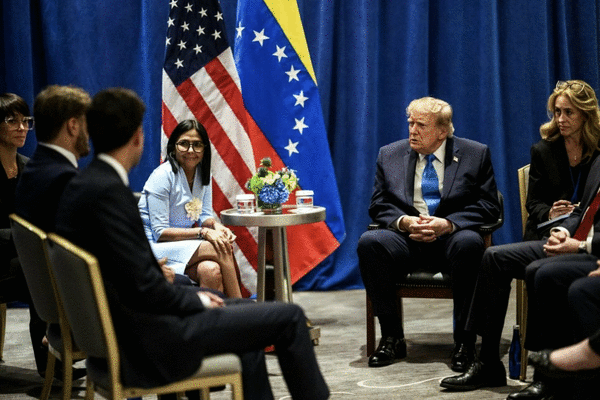
President Donald Trump and Venezuela’s interim president, Delcy Rodríguez, met face to face for the first time Tuesday evening, publicly cementing a rapidly expanding relationship between Washington and Caracas that recent polling suggests is deeply unpopular among Venezuelans.
Trump received Rodríguez at the Lotte New York Palace during a reception for foreign leaders attending the United Nations General Assembly, less than nine months after U.S. forces captured Nicolás Maduro in Caracas and brought him to the United States to face federal drug-trafficking charges.
The meeting was held behind closed doors and without press access, but both governments released photographs showing Trump and Rodríguez together. Rodríguez later described the encounter as “historic” and said they discussed strengthening relations and cooperation in energy, mining and security.
“We held a historic meeting with the president of the United States, Donald Trump, with whom we discussed strengthening the bilateral relationship,” Rodríguez wrote on X.
The encounter came only weeks after Washington and Caracas announced a sweeping oil agreement that has become the centerpiece of their emerging relationship. But the rapprochement is unfolding against considerable skepticism inside Venezuela, according to two recent surveys by the Venezuelan polling firm Meganálisis.
A flash poll conducted before Rodríguez’s trip found that 91% of respondents disapproved of Trump meeting with her. Asked whether Rodríguez would represent them at the U.N. General Assembly, 94% said no.
The same poll found that 80% oppose the Aug. 28 oil agreement between the United States and Venezuela.
Oil at the center of new relationship
The Trump administration has described the agreement as the largest oil deal in history and says it involves more than 65 billion barrels of Venezuela’s proven petroleum reserves. Trump again promoted the agreement during his address to the General Assembly Tuesday.
“We signed the biggest oil deal in history,” Trump said. “That is going to benefit Venezuela and the United States.”
The agreement has generated controversy over the extent of U.S. involvement in Venezuela’s petroleum resources and whether Washington’s growing relationship with Rodríguez will be accompanied by a political transition. Critics have accused the administration of prioritizing access to Venezuelan oil, while the administration has described its policy as aimed at stabilization, reconstruction and eventual democratic transition.
A separate Meganálisis survey conducted in late August found that 69% of respondents said they did not believe Trump wanted what was best for Venezuelans.
Meganálisis reported that its measure of approval of Trump among Venezuelan respondents fell from 92% in January, shortly after Maduro’s capture, to 21% in late August. Over the same period, the share expressing disapproval increased from 6% to 69%.
The firm attributed the shift to frustration over the absence of a political transition, Trump’s relationship with Rodríguez and perceptions that U.S. policy had become increasingly focused on oil. Those explanations are the pollster’s interpretation of its findings rather than independently established reasons for the change.
In another question, respondents were asked whether they believed Trump had removed Maduro “to free Venezuelans” or “to take the country’s oil.” Seventy percent selected oil.
That question offered respondents a limited and politically charged set of choices, however, making the result difficult to interpret as a broader measure of Venezuelans’ views about U.S. motives.
Demand for a presidential election
The August survey also found that 79% of respondents identified a presidential election as the election Venezuela most urgently needed.
Eighty-eight percent described it as “very urgent” for Chavismo to leave power.
The survey also asked about preferences in a hypothetical immediate presidential election. María Corina Machado was selected by 61% of respondents, Rodríguez by 3% and Edmundo González by 1%.
Those figures reflect preferences among respondents at the time of the late-August survey and are not a forecast of an eventual election.
Maduro imprisoned nearby
The Trump-Rodríguez meeting took place only a few miles from the New York jail where Maduro is being held while facing federal drug-trafficking charges.
Trump devoted part of his U.N. address Tuesday to Venezuela and the Jan. 3 military operation that resulted in Maduro’s capture. Rodríguez was in the General Assembly hall during the speech.
“We are working with the leaders of Venezuela to create a better future for Venezuelans,” Trump told the General Assembly.
Trump also invoked the operation while warning that Washington was prepared to use military force when it believes vital U.S. interests in the Western Hemisphere are threatened.
Tuesday’s encounter was the first between a sitting U.S. president and a Venezuelan leader since President Barack Obama briefly met Maduro at the Summit of the Americas in Panama in 2015.
Machado remains outside Venezuela
As Rodríguez gains a more prominent international role, Machado remains outside Venezuela.
Machado has been out of the country since December 2025 and was in Panama as Trump and Rodríguez met in New York. Her team says she has attempted to return to Venezuela several times, including three attempts this week, and alleges that Venezuelan authorities have prevented her return by restricting access to the country’s airspace.
The reports say Machado has also explored returning by sea and through flights to Caribbean islands near Venezuela. One report characterized Washington as apparently supporting restrictions on her return because of concerns that it could disrupt the relationship with Rodríguez.
Rodríguez, meanwhile, is attending the General Assembly as Venezuela’s interim president and thanked Trump for supporting what she called the country’s “reinsertion” into multilateral institutions. No Venezuelan president had participated in the U.N. gathering since 2018, according to the reports.
She is scheduled to address the General Assembly Wednesday, giving her another prominent international platform a day after meeting Trump — even as the recent Meganálisis surveys show large majorities of respondents rejecting both the oil agreement and Trump’s decision to meet with her.
©2026 Miami Herald. Visit at miamiherald.com. Distributed by Tribune Content Agency, LLC.






Comments