US may add carrier and 10,000 troops to Mideast, official says
Published in News & Features
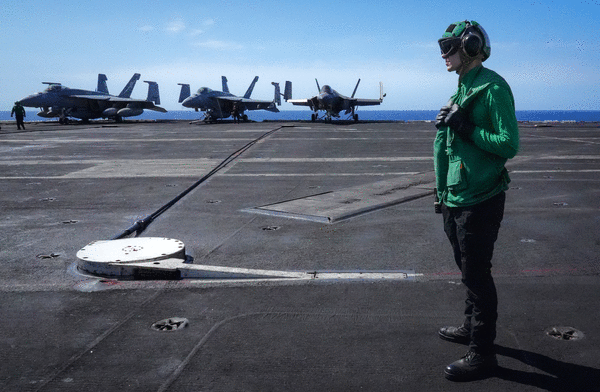
WASHINGTON — The Pentagon may soon deploy an additional aircraft carrier and 10,000 sailors and Marines to the Persian Gulf, according to a U.S. official, a move that gives U.S. commanders more options if President Donald Trump chooses to escalate attacks on Iran.
The USS Theodore Roosevelt carrier left its San Diego home port on Sunday, the official said, adding that no final decision on its destination had been made and that it gives U.S. Central Command more options in the region.
If the Roosevelt does arrive in the Middle East, it will bring the number of carrier strike groups in the region back up to three, the same number as at the outset of the war against Iran. It would also bring to the region the carrier’s 5,000 sailors and Marines and thousands of others spread across its accompanying vessels.
The carrier movements come as Trump said increased military strikes against Iran were “possible” after the November midterm elections.
The USS George H.W. Bush and the USS George Washington will remain in the region. Before the 2026 operations against Iran, the last time the U.S. had three carrier strike groups in the Middle East was in 2003, when they supported the early phase of the invasion of Iraq.
U.S. Central Command, which oversees military operations in the Middle East, said in a statement that “we don’t discuss unit schedules for operational security reasons.”
On Monday, the USS Makin Island amphibious readiness group — with an assault ship, aircraft and 2,200 Marines — also set sail, giving Centcom additional options, the US official said. The USS Boxer amphibious readiness group is currently conducting operations near the Strait of Hormuz.
Deploying three aircraft carriers risks exacerbating the Navy’s current readiness woes, according to Ronald O’Rourke, a longtime analyst of naval forces. The strain on the service was underscored by the controversial extended deployments of the USS Abraham Lincoln, which arrived in Thailand last month after a nine-month tour, and the USS Gerald Ford, which was dispatched to the Mideast after supporting operations against Venezuela and was at sea for 11 months.
“Maintaining even a two-carrier presence in that area over an extended period of time would be a strain for the carrier force,” said O’Rourke, an expert who retired from the Congressional Research Service. But “maintaining a three-carrier presence in that area for an extended period would be a significantly greater strain.”
There’s been a lull in major U.S. or Iranian military strikes amid efforts to rekindle diplomatic negotiations. However, talks to end the war — now in its eighth month – remain deadlocked over issues including Tehran’s control of the Strait of Hormuz.
Iran’s Foreign Minister Abbas Araghchi has suggested in private talks recently that Tehran was willing to restore nuclear inspectors’ access to bombed facilities in exchange for sanctions relief.
©2026 Bloomberg L.P. Visit bloomberg.com. Distributed by Tribune Content Agency, LLC.






Comments