More than 100 aftershocks rattle Panama as earthquake damage mounts
Published in News & Features
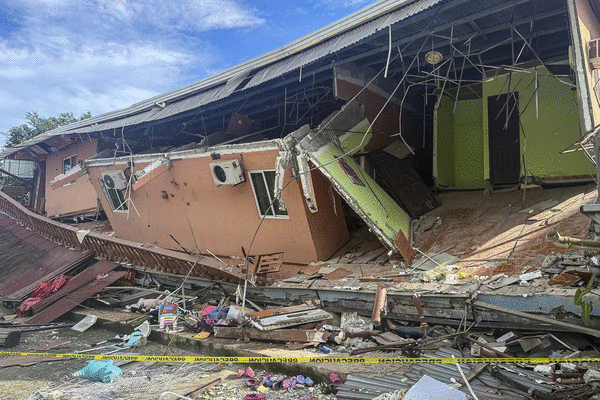
The toll from Friday’s powerful earthquake in Panama continued to mount Saturday, with authorities reporting at least 27 people injured, more than 400 buildings damaged and hundreds of coastal residents evacuated, as emergency crews assessed the destruction and the number of aftershocks surpassed 100.
The magnitude 7.7 earthquake damaged at least 142 homes, 188 schools, 20 healthcare facilities and nine bridges across nine provinces, according to the latest preliminary assessment by Panama’s National Civil Protection System.
No deaths or missing persons had been reported, although authorities warned that the full extent of the destruction remained uncertain, particularly in communities cut off by damaged roads, collapsed bridges and landslides.
“Initial reports reflect damage to homes, educational centers, hospitals, churches, government buildings, bridges and roads in different provinces of the country,” the civil protection office said in a statement.
The earthquake struck at 12:56 p.m. Friday, with its epicenter in southwestern Panama, near the town of Tonosí on the Azuero Peninsula. The U.S. Geological Survey measured its magnitude at 7.7, while Panama’s Institute of Geosciences placed it at 7.5.
The revised damage assessment offered a clearer picture of the earthquake’s impact after authorities spent Friday inspecting buildings, restoring communications and reaching communities near the epicenter. Officials had initially reported only minor injuries and widespread infrastructure damage, without providing a comprehensive count.
Coastal evacuations
In Los Santos province, where Tonosí is located, approximately 300 people were evacuated from a coastal community to higher ground after sea levels rose following the earthquake.
The evacuations followed tsunami concerns that prompted the U.S. State Department on Friday to warn of potential threats along the Pacific coasts of nine Latin American countries, including Panama, Costa Rica, Colombia, Mexico and Ecuador.
The department advised Americans near affected coastlines to move to higher ground and warned that strong currents and unpredictable surges could occur.
Authorities did not report a destructive tsunami in the latest damage assessment.
Five communities in Los Santos remained isolated Saturday because of damaged bridges, roads and landslides, complicating efforts to assess conditions and deliver assistance.
The province reported six people with minor injuries, 14 damaged homes, five partially damaged hotels, four hospitals with partial damage, 22 affected schools, two churches and 18 government buildings.
Across the country, the preliminary assessment identified damage to seven hotels, 13 churches, 26 government buildings and four residential apartment buildings, in addition to the homes, schools and healthcare facilities already counted.
Church tower collapses in Coclé
Some of the most dramatic destruction occurred in Coclé province, where one of the two towers of the Cathedral of St. John the Baptist in Penonomé collapsed during the earthquake.
Bishop Edgardo Cedeño told the Spanish news agency EFE that he and several priests were holding a meeting when the earthquake struck.
Another major collapse occurred at the provincial government headquarters in Coclé, where an entire side of the building gave way, exposing the offices inside. The opposite side sustained extensive cracking.
Coclé reported 17 people with minor injuries, accounting for most of the injuries recorded nationwide.
Authorities also documented 50 damaged homes, two hotels with significant damage, two hospitals with minor damage, two schools, two churches and four government buildings. Eight families were relocated to a shelter.
The damage to government facilities, hospitals and schools raised concerns about how quickly essential services could return to normal in some of the hardest-hit communities.
On Friday, civil protection Deputy Director General Malitzie Rivera warned that water treatment facilities across Panama had suffered infrastructure damage. She said a plant in Chiriquí was operating at only 20% capacity, while power outages and communications disruptions were complicating the emergency response.
The latest assessment continued to identify damage to water treatment plants, although it did not provide a revised estimate of their operating capacity.
Aftershocks
More than 100 aftershocks had been recorded since Friday’s earthquake, according to the latest official information, increasing concerns about the stability of buildings already weakened by the initial shaking.
The continuing tremors represented a sharp increase from the more than 47 aftershocks reported by Rivera during a Friday afternoon news conference.
In Panama City, about 125 miles from the earthquake’s epicentral area, residents rushed from high-rise buildings when the ground began shaking Friday.
The capital’s numerous skyscrapers amplified the sensation of movement, sending frightened residents into streets and open spaces.
The earthquake also triggered massive traffic congestion as thousands of people attempted to return home. Government Minister Dinoska Montalvo said Friday that safety inspections of the Centenario Bridge, including a temporary lane restriction, contributed to the gridlock.
Despite the widespread shaking, the most extensive structural damage was reported in communities closer to the epicenter.
Authorities continued inspecting buildings, bridges, roads and essential infrastructure Saturday while working to restore access to isolated communities and determine whether additional damage had gone unreported.
©2026 Miami Herald. Visit miamiherald.com. Distributed by Tribune Content Agency, LLC.






Comments