Trump's Russia sanctions waiver called mistake by key GOP allies
Published in News & Features
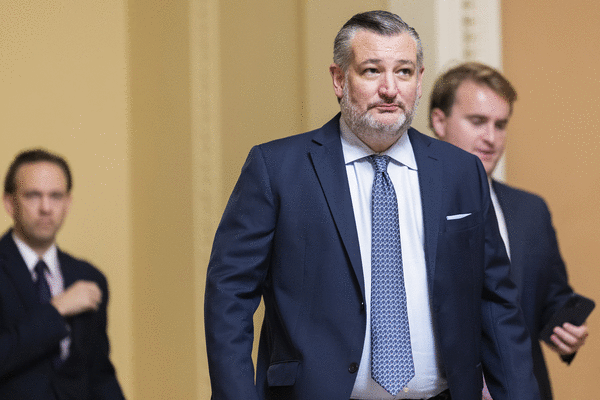
Republican members of Congress blasted President Donald Trump’s decision to waive a tariff law passed last month to restrict Russian energy exports, arguing that the move will help Moscow wage its war on Ukraine.
The Trump administration has cast the waiver as a way to facilitate a deal with Russia on diesel exports — aimed at lowering prices ahead of the midterm elections — but critics said it was irresponsible to bypass the sanctions law passed last month that was championed by the late Sen. Lindsey Graham.
Sen. Ted Cruz, a Texas Republican closely allied to Trump, said the administration should have found other ways to lower fuel costs, such as importing more from Canada or waiving renewable-fuel requirements.
“I wish the president hadn’t done it, I think it was a mistake,” Cruz said Saturday on Fox News, referring to Trump’s executive order late Friday waiving the Graham law. “The current path, unfortunately, just benefits Putin.”
At least eight Republican senators, along with several of their House counterparts, have spoken out against Trump’s diesel deal with Russia or the sanctions waiver.
“What part of enforcing a law passed 86-11 by the Senate does the President and his advisors not understand?” Sen. Thom Tillis, a North Carolina Republican retiring at the end of his term, wrote Saturday in a social media post. He said Trump could lower energy prices by addressing Iran rather than “doing a solid for Vladimir Putin.”
A bipartisan group of 12 senators sent Trump a letter earlier this week urging him to rescind his diesel deal with Russia and enforce the Graham law. The Republican signatories included Tillis, Mitch McConnell, John Cornyn, Susan Collins, Alan Armstrong and Lisa Murkowski.
“Allowing Russian-origin diesel into global markets will offer limited to no relief to Americans,” the senators wrote in the letter, arguing the revenue would help finance Russia’s war in Ukraine and deepen Moscow’s cooperation with China, Iran and North Korea.
While Ukraine has broad support on Capitol Hill, Congress is out of session through the midterm elections, so there’s little prospect of immediate action to block Trump’s diesel deal.
His plan to return Russian diesel to U.S. and global markets is expected to have little immediate effect on prices. A sustained resumption of Russian exports by year-end, however, could help shrink global supply deficits, provided Moscow can meet its commitments despite Ukrainian drone strikes on refineries.
Jeanne Shaheen, the ranking Democrat on the Senate Foreign Relations Committee, joined with six other senators earlier in the week on a letter opposing the decision, saying Congress “explicitly banned Russian energy imports in 2022 to prevent American dollars from financing Putin’s brutal war against Ukraine.”
“President Trump’s decision to allow Russian diesel imports to the U.S. runs directly counter to that law,” Democratic Sens. Shaheen, Richard Blumenthal and Ron Wyden, and Republican Sens. Collins, Murkowski, Tillis and John Curtis said in a statement Sunday.
House lawmakers are also moving against the deal. A group of Democrats and one Republican introduced legislation Friday to block Russian diesel imports, though passage would be difficult in the Republican-controlled Congress and could require overcoming a Trump veto.
Rep. Don Bacon, a retiring Nebraska Republican, co-sponsored the bill. Rep. Brian Fitzpatrick, a Pennsylvania Republican facing reelection in a contested seat, has separately said he would propose legislation barring purchases of Russian oil.
“Many of us won’t fund these things knowing he is propping up a dictator’s invasion and throwing an ally under the bus,” Bacon wrote in a social media post Saturday.
French Hill, a Republican lawmaker from Arkansas, said he has requested a classified briefing on the rationale behind the decision, arguing the U.S. should be increasing economic pressure on Russia.
Democrats have almost unanimously opposed Trump’s overtures to Putin. Senate Democratic leader Chuck Schumer said in a social media post Saturday that “there’s nothing America First” about the new diesel deal and criticized it for giving the Russian economy “life support” while “Americans need relief from skyrocketing prices.”
Ukrainian President Volodymyr Zelenskyy also criticized the waiver, saying it could mark the beginning of broader sanctions relief for Moscow.
“At the time when the Russians launched such a massive strike against our energy sector, in America, regrettably, a decision was made to completely ignore the Lindsey Graham law,” Zelenskyy wrote Saturday on a social media post.
Tensions between Washington and Kyiv have risen since Trump announced the diesel deal last week. Ukrainian defense officials said this week that connection speeds on Starshield, SpaceX’s military-grade satellite service, had been slowed. A U.S. official said Friday that Trump hadn’t ordered any limits on Ukraine’s access to the satellite technology.
“A U.S. sanctions blackout, easing pressure on the aggressor, financial rewards for Putin — all of this only encourages him to keep attacking,” Zelenskyy said.
———
(With assistance from Steven T. Dennis.)
©2026 Bloomberg L.P. Visit bloomberg.com. Distributed by Tribune Content Agency, LLC.



Comments