Airlines pull back from once-hot Tulum as tourists abandon Mexico party paradise
Published in News & Features
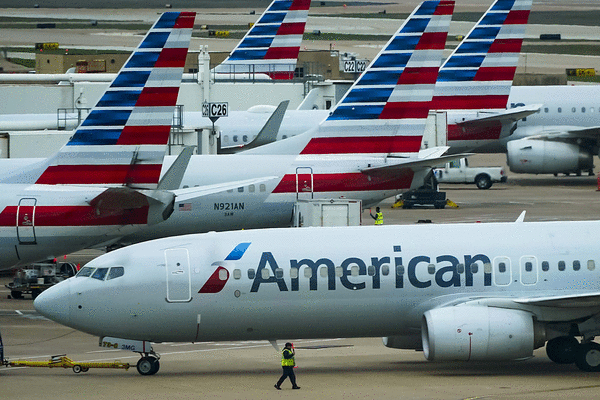
American Airlines Group Inc. became the third major airline in as many weeks to cut flights to the Mexican town of Tulum, as plunging tourism to one of the country’s traditionally most popular Caribbean destinations pushes investors to find ways to restore its ultra-elite vibe.
The U.S. carrier will reduce service at Tulum’s airport as part of a broader reduction in capacity at the terminal, American said on Thursday in a statement to Bloomberg. On Sept. 30 Grupo Aeromexico SAB suspended its Tulum flights and Controladora Vuela Cia de Aviacion SAB, known as Volaris, said it plans to follow suit early next year.
The reduced flying and economic impact will come into focus as the Latin American and Caribbean Air Transport Association aviation summit kicks off Sunday in Mexico City.
U.S. carriers are scaling back sharply, slashing capacity to Tulum by 72% for the quarter, according to Bloomberg Intelligence analyst Francois Duflot. American said it would end service from Miami but would continue to operate its Dallas route.
While high fuel costs, a stronger peso, gangland violence and severe blooms of invasive seaweed have dragged down tourism to Mexican beach destinations broadly, Tulum is suffering more than other destinations. Tulum capacity is down by about half for the season, a stark contrast to neighboring Cancun, where it’s down just 3%.
“Soft demand is definitely at play, as U.S. consumers are probably revising their travel plans as inflation keeps trimming their purchase power,” Duflot said. “The difference between the two airports shows soft travel demand is not the only factor and Tulum has failed to impose itself vs. Cancun.”
The airport, inaugurated in December 2023 under former President Andrés Manuel López Obrador, was built to handle 5.5 million passengers annually as a gateway to Mexico’s southeast. But demand for those towns hasn’t lived up to expectations.
President Claudia Sheinbaum pushed back against concerns over the tourism slump last week, pointing to the return of seasonal flights to Tulum from Canada and the U.S., additional service from the state-owned airline and efforts to improve access to the town’s archaeological attractions.
She attributed Aeromexico’s withdrawal to higher fuel costs and business decisions.
Tulum, even before the airport, was at risk of growing too much, too fast. Poor infrastructure, over construction and abusive prices had hurt its appeal. Infrastructure failed to keep pace with a post-pandemic surge, which saw digital nomads flocking into the Caribbean beach as it had few pandemic restrictions.
Before the surge, the destination catered largely to a smaller, affluent crowd, according to Ignacio Garcia, an Argentine who has lived there for eight years. “You didn’t just see celebrities, you were with celebrities,” he said, recalling visits from Cardi B and Alicia Keys.
The slowdown has also hit hotels. Occupancy in Tulum averaged 63.7% in the first seven months of 2026, down from 72.7% a year earlier, according to Quintana Roo’s Tourism Ministry.
Path forward
Some hoteliers and investors see the slowdown as a chance to move away from mass, party-driven tourism to reclaim the high-end, exclusive destination they say Tulum was always meant to be.
The push for “Tulum 3.0” goes beyond new resorts, looking to cash in on wellness and luxury trends, mirroring the vibe at elite destinations like Aspen in the US and Mykonos in Greece.
For instance, Mexican developer Inmobilia is building a luxury hotel and residential complex under the Faena brand in Tulum, while UMusic Hospitality & Lifestyle, backed by Universal Music Group, is preparing to open a 57-room hotel in December.
The downturn is reshaping the economics for longer-term visitors, too.
Angelika Pokovba, a 30-year-old American who works remotely from Mexico City, has kept a second apartment in Tulum’s La Veleta neighborhood since 2020. Her monthly rent has fallen 40% to 15,000 pesos ($811) as landlords cut prices to retain tenants, helping persuade her to keep renewing the lease.
But shrinking air service could change that equation. Pokovba said that if fewer flights push airfares higher, keeping the apartment may no longer make financial sense.
———
(With assistance from Sri Taylor.)
©2026 Bloomberg L.P. Visit bloomberg.com. Distributed by Tribune Content Agency, LLC.






Comments