As Salvadoran troops flood into Haiti, some feel hope, but others see pitfalls
Published in News & Features
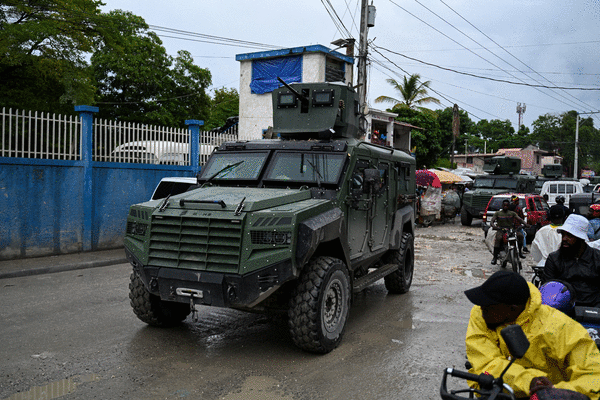
Three days after four Salvadoran soldiers went missing in a gang ambush in Port-au-Prince, Haiti’s government took to social media trying to project the image that it was in charge and dealing with the crisis.
“The government coordinates the State’s response to the kidnapping of Salvadoran soldiers,” read the caption accompanying a photograph of the prime minister, the national police director, the minister of justice and two army officers staring at a laptop.
Behind the scenes, the reality was the government was anything but in control. With efforts to locate the missing men yielding no results, an angry Salvadoran President Nayib Bukele took matters into his own hands, deploying 100 special forces troops to Port-au-Prince on Oct. 22, just as Haiti’s prime minister, Alix Didier Fils-Aimé, was headed to Mexico for a family wedding.
A week later, El Salvador’s military presence in Haiti has grown dramatically, from an original 125-member medical evacuation unit that was part of the international Gang Suppression Force to at least 2,000 troops on the ground, including special forces, marines, infantry soldiers and support personnel.
By the end of the day Thursday, the number of Salvadorans in Haiti is expected to grow to around 2,500. That would put the deployment at just about the same size the entire United Nations-authorized gang-fighting force in Haiti, made up of troops from six different nations, had before the surge, at 2,526.
Many questions
Bukele has billed the rapid buildup as a search-and-rescue operation to find the missing Salvadorans, who were attacked east of Port-au-Prince while returning to camp after a trip to the supermarket. But the deployment, coupled with the prolonged public silence of Haitian officials, is prompting worries about the mission’s scope, its legal authority and its implications for Haiti’s security and the international response to the country’s gang crisis.
The deployment has also raised questions about Haiti’s sovereignty, particularly since Bukele launched the surge in troops without a signed legal agreement with the Haitian government.
With more than a dozen flights landing Salvadoran military personnel and equipment so far, the unusual deployment has thrust Bukele into a direct confrontation with Haiti’s powerful gangs.
Bukele enjoys a reputation in Haiti as a leader who can get things done: His aggressive and successful crackdown on gangs in his Central American nation has given him hero status among many Haitians, who admire what they see as effective leadership even as it has raised ongoing concerns about human-rights violations in El Salvador.
But now Bukele is placing himself at the center of a larger debate over how to handle a gang crisis in a country where experts stress that foreign military interventions will just be temporary — and futile, if there isn’t a systematic response to tackle the underlying finances that fuel the gangs’ operations.
“The question is, what is Bukele trying to accomplish?” said Vanda Felbab-Brown, a senior fellow at the Brookings Institution and security expert on Haiti. “Is he single-handedly trying to degrade the criminal gangs and … is he trying to extend his international image and curry favor with the United States?”
Rubio, the region and Haiti
Shortly after becoming U.S. secretary of state last year, Marco Rubio pushed for countries in the region to help stabilize Haiti through a military intervention led by the Organization of American States.
At the time, a Kenya-led security mission, authorized by the U.N., had deployed to Haiti and was struggling to restore order. The OAS, meantime, was facing steep funding cuts from the Trump administration.
When countries in the region failed to take the lead, Washington decided to sponsor the creation of a more lethal, larger force to fight the gangs that, even though it would operate without American troops, would be under U.S. control. And so the Gang Suppression Force was born, authorized by the U.N. Security Council in September 2025 for a year with a force strength of 5,500.
The U.S. plays an outsized role in determining which countries contribute military personnel to the force and how and when they deploy. In September, the U.N. extended the mandate for the force for another six months.
Since the force began deploying with troops from Chad in April, the mission has struggled to gain momentum. Haitian police officers have complained that the foreign soldiers are reluctant to confront gangs or hold territory taken back from gangs.
Deployments from contributing nations have lagged and costs have risen. The force, unlike the fresh surge of Salvadoran troops, has put in place safeguards for arriving troops, including two weeks of in-country training on human rights.
Most of the Salvadorans have not undergone such training. Also, several sources told the Miami Herald that El Salvador had not signed a required status-of-forces agreement with Haiti when its reinforcements began arriving.
Without such an agreement, “if they become accused of crimes of killing non-combatant civilians ... they can be tried,” Felbab-Brown said.
Five forces, no clear strategy
The legal framework is not the only concern about Bukele’s strategy.
With the arrival of the Salvadoran contingent, five different security structures are now operating in and around gang-controlled Port-au-Prince, amid what experts say is a lack of coordination and a clear Haiti-led strategy for defeating the gangs.
The five groups include the Haitian national police, the fledgling Haitian Armed Forces, the Gang Suppression Force, a drone task force that uses contractors linked to Erik Prince, the former Navy SEAL who founded the private military firm Blackwater, and the newly arrived Salvadorans.
It remains unclear whether Bukele’s soldiers will join the drone strike force or carry out independent operations under a Salvadoran commander.
The Haitian government, meanwhile, has been silent on how long the Salvadoran troops will remain or what rules will govern their deployment.
“There are major issues as to what kind of rules of engagement the El Salvadorian forces will be adopting, how mindful they will be in strictly separating gang members from the civilian population,” Felbab-Brown said.
She pointed to concerns of civilian casualties arising from the explosive drones provided by Prince’s team. “This has already been a big problem,” she said.
Jean Dorneval, a former Haiti defense minister, said while there is public enthusiasm and support among Haitians for Bukele’s troops, the government needs to provide answers.
“The population sees it as a good thing, but we do need to know under what framework they’ve arrived,” he said. “They need to have a legal framework or else they are mercenaries.”
He questions what the deployment means for the future of the U.N.-authorized forces.
Unannounced arrivals
Another concern: Whether the Salvadorans troops will overshadow or sideline the Gang Suppression Force, which was assembled with safeguards overseen by a six-nation Standing Group of Partners. Even senior Salvadoran officials in Haiti, where the troops are staying at a camp near the U.S. Embassy, have been left in the dark about their orders, sources told the Herald.
The Dominican Republic and Colombia have offered assistance. Santo Domingo, which hosted defense and public security leaders from across the Western Hemisphere this week, has offered medical support to the Salvadorans. Colombia has pitched in with the chartered airlifts.
But El Salvador is footing the bill, Bukele said in a message to Haitians Thursday on X.
“It’s with our own modest funds that we’re covering 90% of the expenses. It costs us dearly, but we’ve learned from our own suffering: justice and peace have no price,” he said. “We went through the same suffering that Haiti is going through today.”
Under Bukele, El Salvador has gone from being a global murder capital to one of the safest countries in Latin America, though that has come about through a massive incarceration rate that is among the highest in the world amid continuing accusations of human-rights violations.
For many Haitians, the arrival of his troops means a chance to finally see decisive action on gangs. The strongman’s authoritative tactics, while criticized by human rights groups, are viewed with admiration in a country where gangs have seized control of much of the capital, forced more than a million Haitians to flee their homes, carried out repeated killings and kidnappings and subjected women and girls to horrific rapes.
In Haiti’s Lower Artibonite region, where armed groups have launched repeated attacks on the population, activist Bertide Horace said she welcomes the Salvadoran deployment and Bukele’s involvement.
“The government isn’t helping us find a solution,” she said. “We think he can be a model for us ... because the situation he had in his country isn’t that much different from what we are living in Haiti.”
Horace spoke as residents of Petite Rivière de l’Artibonite were fleeing another offensive by the Gran Grif gang that began on Oct. 19. Several bodies had been recovered from a river, and armed men had seized the town center, she said.
“The situation has become complicated for us,” Horace said. “Every day they are launching simultaneous attacks in multiple locations; all the people are on the run.”
Horace hopes the goal of the Salvadoran reinforcements isn’t solely to find the Salvadoran soldiers ambushed by the Chen Mechan gang.
“The essential objective needs to be how they can eradicate the gang and banditry issue, which has really reached a critical mass for us,” she said.
Guichard Doré, a former adviser to President Jovenel Moïse, whose assassination in 2021 set off the current gang crisis, said Haitians are reaching a breaking point.
“There is an exasperation on the part of the population because practically every day there is a massacre,” Doré said.
Even if there are concerns about the Salvadoran deployment, he added, “a good part of the population understands the need for something to quickly be done so that people can return home.”
The risks
Though Bukele’s methods and transformation of El Salvador has resonated with Haitians, the reality is that the Caribbean country has suffered through multiple foreign interventions in the past with mixed results.
“Bukele might be seen as someone who walks on water in Haiti, but if the mission goes awry quickly, if many civilians are killed … it could be viewed as an invading force, as a foreign government conducting counterinsurgency in another country,” said Felbab-Brown.
On the other hand, if the Salvadoran forces manage to make rapid progress, weaken or even kill some prominent gang leaders, she said, the operation could “strengthen the perception of President Bukele as an extraordinarily competent anti-crime leader” in Latin America.
“If, however, the force doesn’t have those quick accomplishments and becomes associated with abuse, violence, civilian casualties ... it could be seen as a vicious occupying force that the Haitian people don’t want, and of course we have to see how the gangs will react,” the security expert added.
“These are very early days, but it’s a stunningly daring and risky undertaking for El Salvador,” Felbab-Brown added.
On Wednesday, nearly a week after the Salvadoran reinforcement began arriving, Haiti’s government finally publicly addressed the deployment.
A government statement followed a meeting between Fils-Aimé and diplomats accredited to Haiti, whose concerns led the European Union to issue a statement supporting the Gang Suppression Force. Fils-Aimé and Bukele had spoken by phone, the brief statement said, about deployment and operations to locate the missing men.
The leaders also reaffirmed their commitment to strengthening bilateral coordination and operational cooperation within the framework of the Gang Suppression Force. The statement offered no other explanations.
Bukele late Thursday said in his statement on X that the deployment of his soldiers and equipment on Haitian soil is nearly finished.
“This is not an operation against the Haitian people, nor an invasion of the country of Haiti,” the post in Haitian Creole said. “We are not a great power. We have no interest in coming to dominate the Haitian people, nor in laying hands on Haiti’s wealth.”
What he wants, he said, is for his missing aviation technicians to return home — “and we’re giving the gangs a lesson: These gangs that make the Haitian people suffer, that kill people the population loves, that prevent them from living a normal, free life, without fear.”
‘War zone’
In the days since the gang ambush of the Salvadorans, residents in Santo and Croix-des-Bouquets, where the attack took place, have described the area as experiencing “war zone” conditions. Many have fled their homes amid the intensified clashes, accompanied by heavy gunfire and drone explosions.
Doctors Without Borders, the French medical charity, said its hospitals have received dozens of wounded patients from the area. The charity has also been forced to suspend mobile clinic operations and distributions of treated water in some of the areas.
“We are very concerned about this surge in violence in densely populated neighborhoods of the capital,” Davina Hayles, the charity’s head of mission in Haiti, said.
“We fear that this armed conflict will claim even more victims and displace even more people in the coming days, particularly with the arrival of additional international security forces,” Hayles said. “Some of our locally based colleagues have themselves been forced to leave their homes and take refuge... It is imperative that civilians be protected and spared.”
People want hope
The escalation and troop reinforcements have rattled some gang leaders. In recent days, Lanmò San Jou, leader of the 400 Mawozo gang, which participated in the ambush on the Salvadorans, has released several videos on social media and addressed Bukele directly.
But Haitians familiar with the groups, which are part of the Viv Ansanm gang coalition, warn they should not be underestimated. Unlike the gangs Bukele confronted in El Salvador, Haiti’s criminal groups have developed extensive defenses, access to increasingly sophisticated weapons and have shown the ability to quickly replenish their ranks.
Jean Gilles Bernard Camille, a community organizer who lives in a gang stronghold in the capital, said foreign forces have repeatedly underestimated the capacity and power of Haitian gangs and their ability to adapt.
“They know how to fight,” he said.
Their knowledge of the terrain gives gangs an advantage that the Salvadorans troops, with their lack of intelligence in Haiti, don’t have, he added.
Camille pointed to an incident in which a Salvadoran helicopter was nearly blown out of the sky by gangs as it searched for the missing men.
“All of these missions, once they come to Haiti they always fail because they are always minimizing the crisis,” he said. “They minimize the reality in Haiti. When you minimize it, you will fail.”
_____
©2026 Miami Herald. Visit miamiherald.com. Distributed by Tribune Content Agency, LLC.






Comments