Longtime West Virginia Sen. Rockefeller dies at 89
Published in News & Features
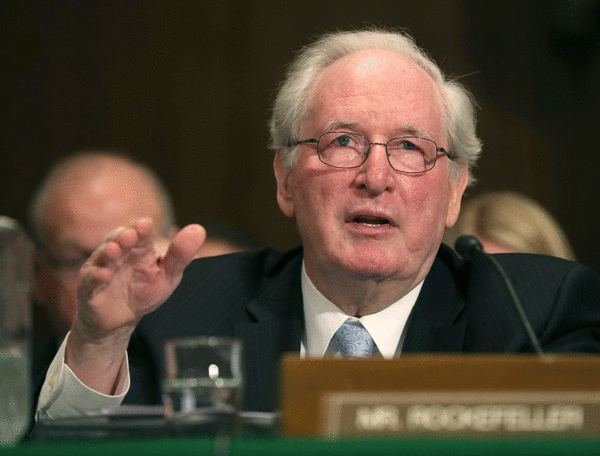
WASHINGTON — Former Sen. John D. "Jay" Rockefeller, a five-term West Virginia Democrat and champion for the rural poor, has died at the age of 89.
Rockefeller, who retired after the 2014 elections, played key roles on the tax-writing Senate Finance Committee, where he helped write landmark children’s health insurance legislation, as well as the Commerce, Science and Transportation and Intelligence panels which he chaired.
A staunchly progressive lawmaker, he represented a deeply conservative state that turned further to the right in his later years. Rockefeller, scion of a famous New York family renowned for its wealth, never wavered in his convictions and retired rather than face a potential backlash from voters upset by the then-Obama administration’s attempts to rein in the coal industry.
Sen. Shelley Moore Capito, R-W.Va., who challenged Rockefeller for his seat before he decided not to seek reelection, released a statement Friday praising her predecessor’s legacy.
“Jay dedicated his life to serving West Virginia and our nation, leaving a lasting legacy. He was always a true gentleman who treated me with respect, kindness, and encouragement,” Capito said. “Over the years, we developed a wonderful friendship that transcended politics, and I will always be grateful for that.”
West Virginia’s Republican Gov. Patrick Morrisey — himself a transplanted Northerner, with roots in Brooklyn and New Jersey — lauded Rockefeller’s record on health care and aid for coal miners and veterans in their adopted state.
“His work helped shape our state and left a lasting mark on the lives of generations of West Virginians,” Morrisey said.
‘Reborn’ in West Virginia
Rockefeller was born in the New York borough of Manhattan on June 18, 1937, the great-grandson of Standard Oil Co. founder John D. Rockefeller, who was once considered the world’s richest man. Rockefeller attended Harvard University, graduating with an A.B. in 1961, but his passion was for the far-east and spent three years studying at the International Christian University in Tokyo.
He returned to the states and was appointed by President John F. Kennedy to the National Advisory Council of the Peace Corps in 1961, spearheaded the Peace Corps initial program in the Philippines. He worked for a brief time in what was then known as U.S. Department of Far Eastern Affairs before deciding to embark on a public service role of a more personal nature. He enrolling as a VISTA volunteer, in the program which would later be known as Americorps, and moved to the small mining community of Emmons, West Virginia in 1964 at age 27.
In West Virginia, Rockefeller found his life’s work. He described the experience as being “reborn,” and spoke often the poverty and hardship he encountered living in the small town. “I could not leave,” he said of West Virginia. “I (had) become so devoted to those people and the unfairness.
He had planned to stay only one year, but decided to stay and became active in local politics. He broke from his family’s long tradition of Republican loyalty and ran successfully for the House of Delegates as a Democrat in 1966. Two years later, he was elected secretary of state.
Rockefeller lost a bid for governor in 1972, but he became the president of West Virginia Wesleyan College and continued to place roots in the state. He married Sharon Percy Rockefeller in 1967 and they started their family. When he ran for governor again in 1976, he won, and served two terms before winning election to the U.S. Senate in 1984, ultimately serving five terms before retiring in 2014.
Rockefeller was determined to increase economic opportunities for West Virginia, for whom he felt was forgotten and abandoned by the rest of the country. He called the people of his state “ the hardest working people I know,” and believed that bringing more business opportunities would help lift the state out of severe rural poverty and the dependence on the coal industry.
Rockefeller traveled to Japan and worked tirelessly to bring a Toyota manufacturing plant to Buffalo, W.Va, one of over twenty Japanese companies he’d brought to West Virginia. He fought for fair trade policies and targeted tax relief to protect West Virginia industries such as steel and chemicals.
Friend and foe
Coal mining had long been the economic backbone of West Virginia, but Rockefeller felt more must be done to protect miners, many of whom worked in unsafe conditions or fell ill with Pneumoconiosis, or Black Lung Disease, after years of inhaling coal dust.
But defying the coal industry came with a political cost. When Rockefeller originally ran for governor in 1972, he had opposed mountaintop mining, also called strip mining, or the practice of removing large amounts of earth and rock in order to access underground seams of coal. When he ran again in 1976, he reversed his position and won.
But even as he ascended to the Senate, Rockefeller remained both friend and foe to the coal industry.
Despite growing up on the Upper East Side of Manhattan, figuratively and literally hundreds of miles away from coal mines, Rockefeller understood its deep roots in West Virginia’s economy and culture. He believed it was the miners — rather than industry — for whom he was defending.
He hung a century-old photo of a coal miner in his Senate office in Hart, and would point to the photo and remark to visitors that “this is why I’m here and who I work for.”
Rockefeller fought to secure pensions for miners, especially as coal companies would file for bankruptcy and immediately restructure to do away with pension plans.
In 1990, Rockefeller was one of only 11 senators to vote against the bipartisan Clean Air Act, which he felt disadvantaged workers in West Virginia. But those close to him said the decision weighed heavily on him, and Rockefeller privately worried that the lack of such regulations would pollute the air and destroy waterways, the brunt of which would be born by the same disadvantaged people whom he vowed to protect.
He believed strongly in the deliberative aspects of the legislative process, consuming great amounts of reading material to familiarize himself with the issues. During a time of increasing partisan rancor, Rockefeller still reached across the aisle to find a willing partner, even when there was not one to be found.
In 2010, as the Environmental Protection Agency’s greenhouse gas regulations were coming to fruition, Rockefeller came up with a compromise to delay implementation for two years.
He viewed himself as a broker between industry interests and the hard working people from coal-states like West Virginia. He had hoped that his years of standing up for coal miners and West Virginia interests would foster enough goodwill among industries primed to oppose any compromise that was less than an all-out rejection of the existing EPA statutes.
But industry walked away from Rockefeller, preferring a hard-line opposition to EPA regulations, and lobbied other senators to vote against Rockefeller’s measure. Furious, Rockefeller took to the floor of the U.S. Senate to denounce the coal industry and its leaders, an unprecedented action for a popular coal-state senator.
“The reality is that many who run the coal industry today would rather attack false enemies and deny real problems then find solutions,” he said on the Senate floor on June 19, 2013 . “Scare tactics are a cynical waste of time, money and, worst of all, coal miners’ hopes. But sadly, these coal operators have closed themselves off from any other opposing voices and few dared to speak out for change — even though it’s been staring them in the face for years.”
His fury against the coal industry was heard loudly, many speculating that he would retire rather than face reelection.
He had won reelection to the Senate handedly during his five campaigns. In 2008, his final election, he was re-elected with nearly 64 percent of the vote. But six months following his fated coal speech, in January 2013, Rockefeller announced he would retire at the end of his fifth term.
Health care battles
Rockefeller’s legacy may best be known for his fight to expand health care for vulnerable populations, including children, the economically disadvantaged and the elderly. Rockefeller served as one of the chief congressional champions for President Bill Clinton’s proposed health care overhaul, later he played a critical role and was a loud progressive voice in writing and passing the Affordable Care Act in the Senate.
Rockefeller believed strongly in a public health insurance option, offering it as an amendment in the Senate Finance Committee during the ACA markup. A public-run insurance plan, he said, would put patients before profits, and help those people, especially West Virginians, with high healthcare costs and poor coverage who were left “out in the cold.”
“These are people,” Rockefeller said, visibly emotional during his closing arguments to the Senate Finance Committee. “Eleven-year-old kids. These are families, and we have to respect them. And you respect them by giving them a choice.”
The amendment failed. Rockefeller pivoted to strengthen Medicaid and Children’s Health Insurance Program provisions, believing that poor and disadvantaged families could seek refuge within those programs. CHIP had been one of Rockefeller’s signature legislative victories, helping to write that program initially in 1997 and later working on a major expansion that became law in 2009.
Despite his initial concerns and later disappointments — at one time saying publicly he could not support ACA as it stood — he later brought his support, citing it as a win for all Americans and actively lobbied his colleagues to support it.
Rockefeller was also known for his role on the Senate Intelligence Committee. A former chairman, he was critical of the nation’s mismanagement of the Iraq war and clashed frequently with Republicans over the treatment of detainees. After he retired from Congress, Rockefeller served as a distinguished fellow at the Council on Foreign Relations.
Respect for Rockefeller ran deep on Capitol Hill. He was beloved by staff and known as a thoughtful, deliberative lawmaker. He had a fondness for classical music and served as a board member of the Bach Consort, an organization in Washington devoted to the study and performance of the music of Bach and his contemporaries. He admired art and Asian culture, and served as a board member of the Asia Society. He was known as a man dedicated to his work and his adopted state of West Virginia.
Rockefeller is survived by his wife, Sharon Percy Rockefeller, four children: John (Emily) Rockefeller V; Valerie (Steven) Wayne; Charles Rockefeller; and Justin (Indre) Rockefeller; and nine grandchildren.
_____
(Disclosure: the author served as a staffer in Rockefeller’s Senate office from 2009-2011.)
©2026 CQ-Roll Call, Inc., All Rights Reserved. Visit cqrollcall.com. Distributed by Tribune Content Agency, LLC.



Comments