Democrats ended the GOP supermajority in the Florida House. What's next?
Published in News & Features
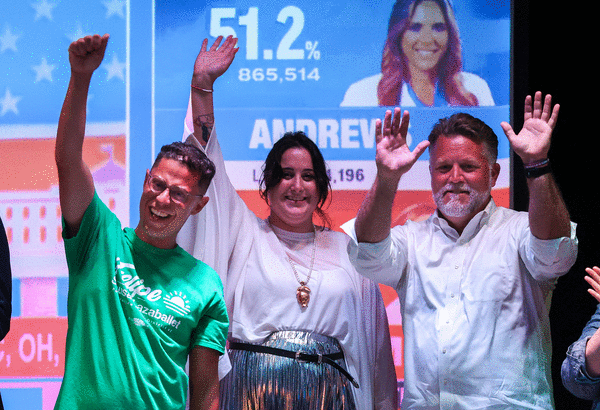
Central Florida Democrats celebrated one of their best nights in years last week after flipping six seats in the state House and one in the Senate.
But as part of the minority in both chambers, their power now largely rests in having broken the GOP supermajority in both the House and Senate, which allowed Republicans to push through legislation without much opposition.
The real test comes in 2028 and beyond. Is Central Florida now a reliably blue wall preventing such Republican power in the future? Or will those suburban seats swing back and forth?
The GOP supermajority in the House, the control of more than two-thirds of seats, had allowed the party to waive rules governing lawmaking, shut down floor debates and pass conservative ballot initiatives and public records exemptions that require a two-thirds vote.
“Republicans still are in the control, and if they are determined and unified and give themselves enough time, they can still pretty much pass whatever they want,” said Aubrey Jewett, a professor of political science at the University of Central Florida.
But he added that Democrats can now delay Republican legislation that before would have been quickly pushed through the chamber. These delays might force the GOP to the negotiating table, particularly in the final stretch of the 60-day legislative session.
“There could be a real pinch to get legislation passed. It might be that Democrats are able to have some influence when time pressure is really there,” he said. “Republicans maybe are looking to get some things through … making some deals or take into account some of the legislative priorities of the Democrats.”
Across Florida, Democrats gained 15 seats in the state House, the party’s best showing in at least 30 years. They hold 49 seats in the chamber to the Republicans’ 70, with one race yet to be called.
Democrats in Seminole, Orange and Osceola swept all seven House seats in those counties. Jared Fox, Darryl Block and Eric Gray unseated Republican state Reps. Doug Bankson, Rachel Plakon and Erika Booth, while Jane Aman, Nik Dean and Anthony Nieves captured seats held by former state Reps. Susan Plasencia, David Smith and Paula Stark. Democratic state Rep. Leonard Spencer also defended his seat.
Republicans would need to pick up 10 seats to retake their supermajority. If Democrats hold on to those seven Central Florida seats, they could help prevent that from happening.
Central Florida Democrats also ended the GOP supermajority in the Florida Senate with Maitland Mayor John Lowndes’ defeat of Republican state Sen. Jason Brodeur, one of the most power members of the Legislature, in a district that covers parts of Orange and Seminole counties.
Democrats now have 13 Senate seats to the Republicans’ 25, with one independent. Lt. Governor-elect Bryan Avila’s seat is vacant, but would not restore the supermajority even if a Republican wins it in a special election.
On paper, all of the flipped seats had been considered Democratic-leaning for years, including 2022 when Dems lost all of them in a red wave in Florida, and 2024, when Dems gave back the one seat they had gained in a special election earlier that year.
Jewett said those seats likely will still be up for grabs in future elections, despite growing Democratic strength in the region that included a win on the Seminole commission and a sweep of the Orange commission.
While Jewett acknowledged Tuesday’s results establish Central Florida as one of the most consistently Democratic areas of the state, he said an important thing to consider is the likelihood of Florida Democrats repeating their historic gains — which were buoyed by a nationwide blue tsunami.
“Maybe this is the beginning of the Democratic resurgence, where they can build on this and make gains and eventually get back to the majority,” Jewett said.
“On the other hand you could argue this was a one-time occurrence based on a midterm election that was a referendum on a widely unpopular Republican president, and two years from now Democrats will be hard-pressed to even keep these gains, let alone expand them,” he added.
Jewett said key factors going forward will be if Florida Democrats can beat GOP voter turnout like they did this year and who both parties nominate as their presidential nominee in 2028.
“Democrats should not necessarily expect that 2028 will be a Democratic year again. It depends on whether or not (President Donald Trump) is still as unpopular as he was when we were voting this cycle,” agreed Gregory Koger, a political science professor at the University of Miami.
Both professors said one advantage the newly elected Democrats will have in defending their seats is incumbency, which brings with it broader name recognition and the opportunity to endear themselves to voters by providing constituent services.
In House District 36, which covers nearly all of north Seminole County, two-term incumbent Rachel Plakon was unseated by Democrat Darryl Block, a Sanford attorney. Block won about 55% in a district that Plakon had won by about 54% in 2024, a nearly 10-point swing.
Block said he initially thought the race would be close.
“We understood that GOP voters outnumbered Democrat voters, but we expected some (non-party voter) crossover, and we thought the rural boundary issue was going to give us some GOP crossover. Not in my wildest dreams did I think that it would be like it was,” Block said.
When asked if he thought he may have to work harder to defend his seat in 2028 if the national environment isn’t as favorable to Democrats as this year, Block said the thing he believes will most impact his reelection chances are if he keeps his promises to voters.
In House District 39, which covers parts of northern Orange and southwest Seminole counties, Doug Bankson, also a two-term incumbent, was unseated by Democrat Jarod Fox, a Winter Garden physician. Fox won by about 55% in a district that Bankson had won by about 53% in 2024.
“You saw that across Central Florida this year. I think people were tired of the endless culture wars that have been taking place the past few years in Tallahassee and the fact that they haven’t really been delivering for the everyday Floridians,” Fox said.
Like Block, Fox said he could be reelected if he delivers on his promises to voters. He added that he thinks Democrats’ impressive gains this year are just the beginning of what they can do in the state.
As a physician, Fox said he supports legislation capping the cost of insulin in the state.
He said Republicans have used their supermajority to shield themselves from votes that anger their constituents, including voting against the insulin bill, but that Democrats can now force those bills to the floor and make Republicans take a stance on it.
“Everybody that I’ve talked to on the campaign trail, regardless of (whether) they’re Republican, Democrat, Libertarian, Independent, every political spectrum, are wanting us to tackle healthcare in the states,” he said. “They’re going to have to go back to their constituents and answer for why they either voted yes or no for those things.”
Block added that he’s willing to work with Republicans.
“The GOP has a lot to figure out now. And I think they need the Democrats to help them figure it out,” he said. “My door is open.”
_____
©2026 Orlando Sentinel. Visit orlandosentinel.com. Distributed by Tribune Content Agency, LLC.





Comments