Here's what to know about ICE detentions at airports during holiday travel
Published in News & Features
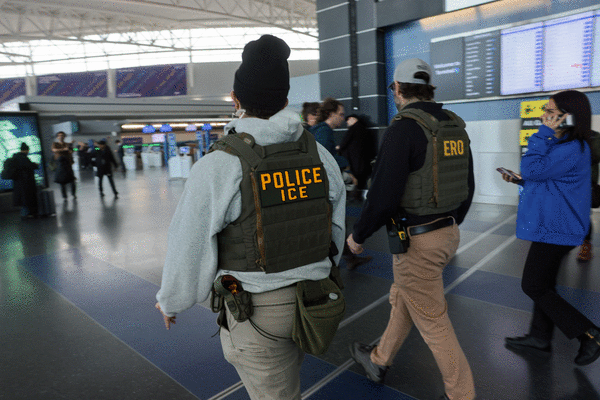
As Thanksgiving travel ramps up in the days following a highly publicized immigration detention of two people at Seattle-Tacoma International airport, federal immigration enforcement in airports has made headlines.
During the Nov. 21 incident, which prompted viral videos and attracted nationwide attention, masked federal agents detained a father-daughter pair on a jet bridge while they were waiting to board an Alaska Airlines plane, delaying the Los Angeles-bound flight.
The Department of Homeland Security alleged in a social media statement that both had overstayed their visas, and accused one of them, Sofia Hernandez Mejia, of assaulting federal law enforcement by throwing hot coffee on Immigration and Customs Enforcement officers. Hernandez Mejia was reportedly a graduate of Western Washington University in Bellingham.
“It’s important to know that these arrests have been happening across airports, and at SeaTac, but maybe not to this level,” said Malou Chávez, executive director of the Northwest Immigrant Rights Project, a regional legal advocacy group.
She told The News Tribune in an interview Tuesday that her organization has seen increasing collaboration between multiple federal agencies to cross-reference people’s information while conducting immigration enforcement at airports.
“What is disturbing is the level of access federal agents have when they are walking into flights about to take off,” she said.
In an emailed statement to The News Tribune, the Department of Homeland Security said it has “reversed” the prior presidential administration’s “policy” that allowed people in the country without legal status to “jet around our country.”
“This administration is working diligently to ensure that aliens in our country illegally can no longer fly unless it is out of our country to self-deport,” the spokesperson said, pointing to an app offering monetary incentives and a free flight for people without legal immigration status to leave the country.
In a newsletter sent on Nov. 23, NWIRP encouraged immigrants to take extra caution when traveling by air. People without immigration status should avoid airport travel entirely, the organization recommended, and immigrants who do travel should make sure their immigration and travel documents are up to date, unexpired and accessible.
The organization also recommended that people with a pending immigration case, temporary visa, prior deportation order, criminal history, or other immigration concerns consult an immigration attorney before traveling.
Chavez reinforced that although having certain types of documentation could work as photo IDs at checkpoints, they’re not always the same as having a lawful immigration status.
“Right now many of our communities, even with pending relief, even with valid Real ID documentation, are being targeted,” she said, referring to a federally recognized type of identification for airport checkpoints. “And the reality is that this administration is trying to create new groups of people that they can go after.”
This is particularly important for people traveling with loved ones who could be impacted or with minors who may be with someone who gets detained, she said. She added that people who are detained will likely end up at the Northwest ICE processing center in Tacoma, adding that people can contact her organization free of charge from there.
In an emailed statement to The News Tribune, ICE said it would uphold its congressional mandate and legal authority to enforce federal immigration laws.
While it said it doesn’t target certain public places like schools, hospitals and churches, the agency said, it asserted that “we will effect arrests at the places and times of our choosing to minimize dangers to the suspect, our officers, and the public, including our nation’s airports.”
ICE added that its officers conduct investigations based on “reasonable suspicion” and probable cause and that the Supreme Court has already “vindicated us on these practices.”
“To be clear — ICE does NOT need to receive permission from local authorities to enforce federal immigration laws,” the agency stated, and also stressed that obstructing an arrest or assaulting an officer is a crime.
For bystanders who witness immigration enforcement, Chávez said, the best thing is to understand the legal limitations of becoming involved, and also to know how and when to use their First Amendment rights to document what is happening.
“Unfortunately, we have seen the federal administration decide to charge someone with assault or with interference in enforcement action, and that may not have been the case, but we would only know if there is footage, right?”
She noted that how some bystanders decide to engage, or not, could look different depending on their situation.
“Some people might walk away, afraid that they may be involved in an attack or assault by enforcement agents,” she said. “Others may stick around and record, knowing that this could be helpful to the person’s case.”
In an email, a spokesperson for the Port of Seattle, which manages SeaTac airport, pointed The News Tribune to a page on its site noting that while the airport is a “welcoming gateway for people and commerce” and its officers do not enforce immigration laws, it has no jurisdiction over federal law enforcement.
The port recommended that people with “uncertain” immigration status “assess” their situation before traveling and carry proof of legal status, including passports for U.S. citizens, green cards for lawful permanent residents, and foreign passports, arrival and departure records, and other documents for visa holders. It also recommended that people share their itineraries with family members and friends and to memorize emergency contact information and phone numbers for immigration attorneys.
“If detained, you will lose access to your electronic devices,” the airport said.
The port also included links to several letters about its work with other government, aviation and community stakeholders to “call for the end of domestic ICE enforcement at SEA airport.”
In its most recent letter, dated Nov. 24 and addressed to federal lawmakers, the port pointed to the Nov. 21 incident and asked for legislation limiting the ability of ICE “to conduct civil immigration operations at or near airports without a judicial warrant related to a felony criminal conviction.”
“We are deeply troubled that on Saturday we observed in devastating detail how disruptive and dangerous current ICE practices at airports can be,” the port said. “We know that without congressional intervention, these events are likely to be repeated at our nation’s airports.”
_____
© 2026 The News Tribune (Tacoma, Wash.). Visit www.TheNewsTribune.com. Distributed by Tribune Content Agency, LLC.






Comments