'Heated Rivalry' review: Gay hockey adaptation on HBO one of 2025's best shows
Published in Entertainment News
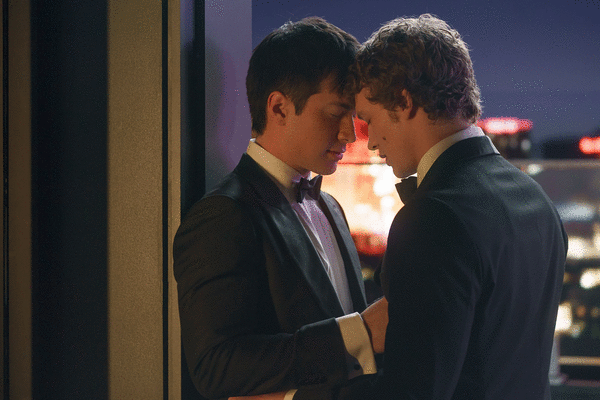
“Heated Rivalry” the novel is the kind of smutty romance read that’s thoroughly enjoyable but slightly ephemeral, a tale of angst and love and outlandish situations that doesn’t linger long in your mind once you get to the happily ever after-ish ending.
“Heated Rivalry” the TV series, however, is anything but: An effervescent combination of faithful adaptation, standout acting and gorgeous cinematography, it’s one of the best shows of the year — and one you won’t be forgetting anytime soon.
Originally meant for just the Canadian streaming service Crave (and only picked up by HBO Max a week before the Nov. 28 premiere), “Heated Rivalry” adapts the novel of the same name by Rachel Reid. (It’s the second in the six-part “Game Changers” series; Season 2, based on the sequel “The Long Game,” has already been greenlit.)
Created and written by Jacob Tierney, best known for “Letterkenny” and “Shoresy,” the six-episode adaptation is not your typical love story; honestly, it’s hard to call it a romance most of the time. It follows two young hockey phenoms — Canadian Shane Hollander (Hudson Williams) and Russian Ilya Rozanov (Connor Storrie) — over the course of nearly a decade as they navigate being rivals on the ice and then, well, something more heated off it.
The pair are the textbook definition of polar opposites: Shane — fastidious, a bit of a loner with expressive brown eyes; Ilya — chaotic, a total charmer with a head full of golden curls. But from the moment they meet — “You’re supposed to smoke over there,” Shane tells Ilya on a cold December day before they’re even drafted to the fictional Major Hockey League — the chemistry between the two is electric, almost palpable.
It doesn’t take long (eight minutes into the first episode) before the sexual tension starts to rise, and only a few minutes more before they have sex for the first time. (Sex scenes in “Heated Rivalry” are legion and explicit — one lasts five straight minutes — with arms, legs and creative camera angles providing the only modesty.)
From there, their story is told in moments and text chains, with months and years passing by in between: Ilya drafted to the Boston Raiders, Shane to the Montreal Metros (and furious to be picked second); a shared meal of tuna melts and ginger ale; a heartbreaking conversation held across an ocean. And while their situationship starts as purely physical — if nothing else, these two never question whether they’re attracted to one another — it’s obvious how this will all end up.
The journey there, though, is wondrous. You just can’t help but fall in love with Shane and Ilya as they contend with their feelings, deal with the secret nature of their relationship (even in this fictional universe, professional sports isn't the most inclusive space) and discover themselves along the way. Hearing Shane say out loud that he’s gay is a joy. Watching Ilya turn to Shane for comfort after talking about his terrible family is breathtaking. The show is a font of queer authenticity, taking pains to realistically portray their struggles and successes.
(And on that note: Can I just say how refreshing it is to watch a queer romance that doesn’t end in miserable grief? Sure, there’s angst and yearning aplenty, moments of heartbreak alongside the physicality especially as the season progresses. But there’s no all-consuming tragedy, no “Brokeback Mountain” or “Fellow Travelers”-level of devastation.)
While adaptations can be tricky, creator Tierney pulls off a bit of a hat trick here. 1. His version mostly sticks to the original, from the most memorable lines — “I’m coming to the cottage,” “Stupid Canadian wolf bird” — to the general sequences of events. 2. He treats important events with proper care without having the show take itself too seriously. (Ilya is a hilariously sarcastic delight.) 3. There’s enough creative license to differentiate itself from the source material, with the highlight being Episode 3, which focuses on another couple from the “Game Changers” series. On the level of the masterful third episode of “The Last of Us” Season 1 with its impact and payoff, it’s a genius, moving inclusion, anchored by François Arnaud’s devastating performance as fellow gay hockey player Scott Hunter.
Speaking of performances, Storrie and Williams, each with only a few credits to their name, are revelatory here. Storrie’s Ilya is a pool of nuance, deeply vulnerable one moment and obnoxiously charming the next. (And you would never know Storrie was born in Texas instead of Russia — his accent is that good.) Williams’ Shane feels like he was lifted perfectly from the book, down to his neurotic need to fold his clothes before sex. Together, they’re a tour de force, completely mesmerizing in their dazzling chemistry.
Also dazzling? The one-two punch (wrong sport, I know) of gorgeous cinematography and inspired score/soundtrack. Jackson Parell’s visuals are utterly showstopping, from the intimate framing of Shane and Ilya to the clever focus on sunlight and shadow.
And Peter Peter’s original compositions and the show’s needle drop songs deserve special kudos for elevating already captivating scenes. (I still have goose bumps from the brilliant pairing of a meaningful line of dialogue in Episode 3 with Wolf Parade’s “I’ll Believe in Anything” in Episode 5.)
My only complaint for “Heated Rivalry”? That it’s already over, and now I have to wait for Season 2. But consider me in it for the long game, because it turns out, even in a year of fantastic shows, “Heated Rivalry” has no rival.
———
'HEATED RIVALRY'
Rating: TV-MA
How to watch: HBO Max
———
© 2025 The Seattle Times. Visit www.seattletimes.com. Distributed by Tribune Content Agency, LLC.







Comments