Michael J. Fox receives Bob Hope Humanitarian Award at Emmy Awards
Published in Entertainment News
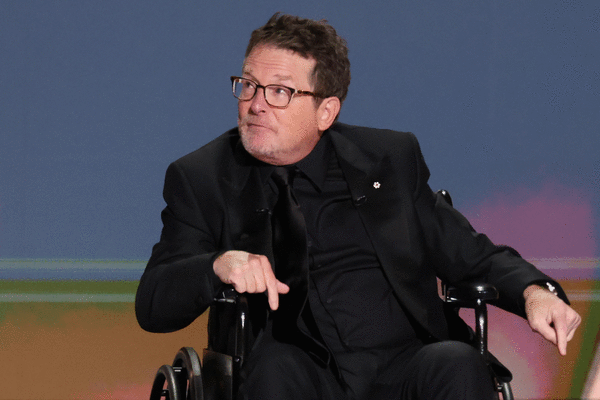
LOS ANGELES — At the 78th Primetime Emmy Awards on Monday, Michael J. Fox was honored with the Bob Hope Humanitarian Award for his contributions to Parkinson’s disease research and advocacy.
He was introduced by his former co-star on the legal drama “The Good Wife,” Julianna Margulies. “You’re such a great acting partner, and had a great time on that show,” Fox said as he spoke from stage in a wheelchair, adding he was happy to no longer speak in legalese.
The five-time Emmy-winning actor was diagnosed with the disease in 1991 at 29, but continued to work and act, starring in films like “For Love or Money” and “The American President” and the hit ABC television series “Spin City.” In 1998, he made his diagnosis public and stepped back from his lead role in “Spin City” in 2000, the year he launched the Michael J. Fox Foundation for Parkinson’s Research, which is considered the largest nonprofit funder of Parkinson’s research.
The Bob Hope Humanitarian Award was established in 2002 to honor an individual in the television industry whose humanitarian efforts exemplify those of its namesake and his altruism. The award is given by the Television Academy and the Bob & Dolores Hope Foundation each year.
Over the years, Fox has done a number of voice-acting roles and the occasional guest role, including a stint on the third season of Apple TV’s “Shrinking.” In the series, he plays Gerry, a patient with Parkinson’s who befriends Dr. Paul Rhoades, the therapist played by Harrison Ford, who is also navigating a Parkinson’s diagnosis. In a conversation with co-creator Bill Lawrence, who also co-created “Spin City,” the actor said he couldn’t resist an opportunity to work on the series.
”... I just thought, it’s fantastic. The depth of character, the quality of relationships, the language — it’s just a beautiful show,” Fox said. “And I thought, just do that for its own sake. I don’t have an agenda.”
Here is an excerpt from his acceptance speech:
“First, a few words about Bob Hope. My parents were were born during the Great Depression, during World War II. For them, Bob was more than an entertainer, he was a selfless champion of soldiers, military families like mine for decades. Christmases, Thanksgivings, other holidays where he could have been celebrating with his family, he was showing up for the troops in Berlin, Saigon, the Middle East, with a turkey leg and a golf club, and maybe if you’re lucky, Lola Falana.
He embodied everything I came to believe in years later. I learned from his example. When [things] seriously get tough, you show up, you help, and if you get a little joy while you’re doing it. That’s even better.
I couldn’t have known how these lessons would resonate in my own life ‘til my late 30s, my late 20s, when my wife handed me a role that I was looking for. Initially, I kept my Parkinson’s diagnosis a secret. I worried that it would affect my work and my relationships with audiences. ... I understood that accepting Parkinson’s didn’t mean I had to surrender to it. I just spent [time] doing what I could for everyone living with this disease, so I set out to advocate for patients’ needs and raise money, and help us towards a cure.
I found brilliant people to lead the effort for me and vowed to fund the best science in the world. I’m proud of the progress we’ve made to benefit Parkinson’s patients and families. We move closer to eradicating this disease forever, I’m deeply grateful to our staff, donors, researchers, and most of the patient community, who make our work at Michael J. Fox Foundation possible.”
©2026 Los Angeles Times. Visit at latimes.com. Distributed by Tribune Content Agency, LLC.






Comments