David Mitchell loves TV, comedy and mystery. By starring in 'Ludwig,' he's 'completed the set'
Published in Entertainment News
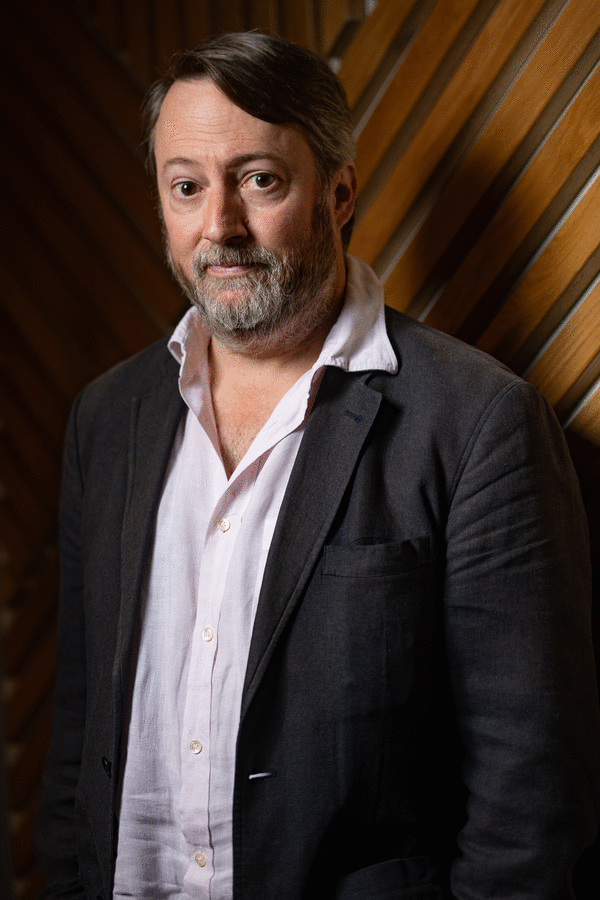
LOS ANGELES — "When is 'Ludwig' coming back?" is a question I've been not infrequently asked since its first season finished on BritBox last spring. (The answer is: Tuesday.) A rich, perfectly balanced mixture of comedy, mystery and human yearning, it stars David Mitchell as John Taylor, an introverted professional crossword puzzle creator called back into the world by his sister-in-law (Anna Maxwell Martin) to impersonate his missing twin brother James, a police detective, in order to discover the reason for his disappearance — and proving, in his socially inept way, born to the job. This season, his cover blown, he continues the hunt while working for the police as a consultant on individual cases.
"He's liberated from his own shyness when he's trying to solve the puzzle," Mitchell said recently over Zoom from London. "A sort of confidence comes over him, and he's willing to take center stage and boss people around. And then as soon as the puzzle's resolved, that confidence seeps away, and he just wants to go home and have a choc ice."
Mitchell, 52, is not especially well known in America, outside the not inconsiderable number of us who live on British humor, but he's spent his whole adult life making comedy. With longtime, sometime partner Robert Webb, he starred in "Peep Show" (a point-of-view situation comedy) and "That Mitchell and Webb Look" (a sketch show). In "Upstart Crow," he played an irascible, credit-stealing William Shakespeare, whose curmudgeonly battles with modernity echo Mitchell's own, or at least that of the erudite, often alarmed persona he adopts on panel shows — above all the reliably hilarious "Would I Lie To You?," where he's served as a team captain since its debut in 2007.
Here, in a conversation edited for length and clarity, he speaks about his love for television and his character on "Ludwig."
Q: How important was television to you growing up?
A: Enormously important. If I was watching television, I was winning. And there was very little choice of television, growing up in the late '70s and '80s in Britain, there were three, then four channels, and so I spent a lot of time watching things that weren't very good. Watching a bad program, I was very happy to do, and watching a good program was amazing. I got into comedy through television. It'd be more artistically respectable to say I got into comedy through watching great stand-up. I didn't. I got into it watching sketch shows and sitcoms on the BBC and Channel 4, and I gradually formed the aspiration to get involved myself. I grew up watching "Blackadder" and "Fawlty Towers" and "Monty Python." I wanted to do something like that. Screens now provide so many other terrifying opportunities to destroy your brain, it's odd to look back at the time when people said, "If you watch too much television, it's bad for your imagination. You should read books, not watch television." And my view now is that you should read books and watch television, and neither is bad for the imagination.
Q: Television is where you always wanted to work?
A: Yes, I think so. I don't think I knew that that was a realistic aspiration … until I was on it, I suppose. But I loved it as a child, as I've said, and not wanting to be on that magical box I was so obsessed with would have seemed perverse. Whenever you said as a child that you wanted to be on TV, grown-ups would smile indulgently and hope you grew out of the idea. I wanted to be on TV at a time when I also wanted to be able to ride dragons and be a king. That aspiration remained with me. The other two, I've left by the wayside.
Q: Were you aware of American TV?
A: I suppose the first sitcom that had a big impact on me here was "Cheers," which seemed to be in the vanguard of a series of brilliant American sitcoms that are both very funny and … sort of terrifying in the number of episodes they were able to produce. But yes, I absolutely loved American comedy, and American comic films as well. That's something I quite often rewatch, films from the '80s I remember quite enjoying, and you go — I sound like such an old person — "They don't make them like that anymore," or they don't make enough of them for there to be the 5% best of them that are works of genius. You don't get when ''When Harry Met Sally…" by making one romantic comedy, you get it by making 200, and one of them is that. That side of Hollywood I miss. I don't know why all films now seem to be either based on superhero comics or incredibly worthy dirges, hoping to win awards without the collateral damage of entertaining anyone en route.
Q: When people talk about "prestige television," it's almost always drama. Comedy does everything that drama does, and more, but for some reason, doesn't get that kind of respect.
A: I heartily agree. People love comedy. I would say self-evidently, it's the most powerful, popular art form. If people are laughing, they're also agreeing, listening, emoting, caring; it's my favorite thing. But if what you want to do is make a beeline towards critical acclaim, don't go via comedy. Take a very serious subject. Crow to the rooftops about how you're addressing it. It's a perverse route to acclaim to go into comedy. But there is no acclaim I want more than the sound of people laughing.
Q: Did you watch detective shows when you were growing up?
A: Yes, I remember watching the BBC Miss Marple adaptations in the '80s, and then the Poirots, and "Inspector Morse." I loved all that. One of the reasons I was drawn to "Ludwig," and in fact, had been sort of mentioning around the place that I'd love to make that kind of show, is that it was the only kind of television I really loved watching that I hadn't had a go at making. I love sitcoms, sketch shows. Panel shows and murder mysteries are my favorite television programs, and I now feel I've completed the set by having made an example of each of them.
Q: It was written with you in mind?
A: With me in mind, which I've found is a very good way of getting cast.
Q: What is it about a detective show that you find particularly satisfying?
A: It's the setting up of a mystery that you know will be resolved. It's making sense of something chaotic. The focus of the story is something being resolved and tidied up. And that's quite a reassuring process to observe. It's a potent mixture to be comforting and intriguing. And I don't think there's another form of television or of literature that quite gets that as much as a well-crafted whodunit. Mark Brotherhood, who writes "Ludwig," has worked hard to try and keep all those elements there — the warmth, the escapism, as well as the mystery, and just enough horror and evil to keep people's attention, but not to make it frightening, not to make it something that will make you reflect on more terrible things in the world outside.
Q: Are there elements of your own personality you find integrated into the character?
A: It's one of the many paradoxes of being a professional performer. I think a lot of professional performers, myself included, think of themselves as quite shy people. And, obviously, by any objective measure, they're not because they've deliberately chosen to place themselves in front of a lot of people's faces, to make themselves a center of attention, and that is not a shy act. But that doesn't make the feelings of shyness insincere. I feel I share John's shyness, except I have sought to be on television, and he doesn't even seek to go into an office every day. So, there must be a fundamental difference, but I understand that about him.
But whether you think of him as shy or not, what he's going through is something almost anyone would find a dreadful ordeal. And to be given a set of circumstances where you're justified in exaggerating the incompetence with which he deals with, it struck me as something that's going to be funny but is also going to be believable and going to be gripping. I know there must be huge differences between me and John Taylor, but we would both hate to have to impersonate a police officer for two weeks because we'd feel tremendously exposed and in jeopardy of criminal prosecution. There is a tiny minority of people who would enjoy that experience, and they are mentally ill.
Q: What sort of pleasure do you get from performing things you've written, as compared to speaking other people's words, or panel shows, where you're just going off the top of your head?
A: Being able to combine the three is something I feel very lucky about. It suits me very well. If I was only performing other people's words, I'd find that frustrating, I think. What I find interesting is when I'm performing something I've written myself, I'm not at all worried about my performance; I'm only worried about what I'm performing. It's nice to have a change of worries. When you're performing other people's words, you're worried about doing that as well as possible. And because I've written a fair bit, I think I feel a respect, perhaps a greater responsibility to the writer than some actors do.
Making something like "Ludwig" is a great privilege, but it takes a long time, months. And you just sort of disappear out of your life, and everyone says, "Where have you been?" And then you say, "Oh, I've been making 'Ludwig.'" And you tell them that five times in a row, in five emails, and you know they're thinking, "You're still making it?" So I love doing a panel show because you make a half-hour program in an evening and get the immediate buzz of thinking of something off the cuff, and if the audience laughs, well, there's no better feeling in the world.
©2026 Los Angeles Times. Visit latimes.com. Distributed by Tribune Content Agency, LLC.








Comments