Defense panels still not clear on Golden Dome's attributes
Published in Political News
WASHINGTON – Seven months after President Donald Trump announced plans for a Golden Dome missile shield for America, lawmakers who oversee the Pentagon say they have yet to learn meaningful information about the system’s attributes, cost or schedule.
Trump said in May that the system’s so-called architecture had been “officially selected.” It would be fielded within three years, he said, for a “total cost” of $175 billion. It would include satellite-launched interceptors. And it would protect America “close to 100%” from enemy ballistic, hypersonic and cruise missiles.
Such a system would be orders of magnitude more extensive and expensive than any previously executed, potentially a multitrillion-dollar proposition, experts have said. Few if any of them believe the capability Trump described can be accomplished on the schedule and at the cost he recounted. More likely, they say, is an initial iteration during this presidential term followed by improvements over many years — but ultimately far less defensive coverage than 100%, if only for budgetary reasons.
The first nearly $25 billion to bankroll technologies that can be used for Golden Dome was appropriated via the reconciliation law in July.
However, as the first year of Trump’s second term ends, lawmakers from both parties say they have yet to receive the detailed spending plan they ordered the Pentagon to provide on that $25 billion. The law appropriates the funds only in broadly worded categories such as $7.2 billion for “space-based sensors.”
A House Armed Services Committee aide said lawmakers “have zero on the cost” of the proposed system, which the aide said is still more a set of options than a concrete acquisition plan.
In interviews in December, lawmakers and aides have made clear they want clearer answers — and soon — about what this enormously complex and expensive endeavor entails. They have all been careful not to disclose classified information.
Sen. Angus King, I-Maine, the ranking member of the Senate Armed Services Committee panel that oversees missile defense programs, said he has yet to be told even the most basic elements of the proposal.
“I want to know what it is they’re going to be deploying in the way of technology, how much it’s going to cost, what parts of the country are going to be protected, how those decisions are going to be made — I mean, that’s just for starters,” King said.
No details
The Pentagon, citing national security, is not disclosing even broad outlines of the system — the kind of information that has been revealed for past antimissile programs at least since the Reagan administration, including during development of the 44-interceptor network deployed today in Alaska and California.
The Pentagon press office, when asked in May and again in late December about basic elements of the system — such as the number of interceptors and how they might be deployed, whether at sea, in space or on land — offered only a broadly worded response.
A Pentagon official said this month that the “implementation plan” is still under review.
“As a matter of policy, we do not provide details relating to specifics of architectural discussion or pre-decisional matters,” the official said by email. “Recognizing adversaries’ intent to exploit Golden Dome’s breakthroughs, we are rigorously protecting America’s strategic advantages inherent in this program.”
The Pentagon has enforced the ban on disclosures to the press even as the Defense Department has put out contract solicitations that are sometimes exceedingly detailed about Golden Dome capabilities.
One of the solicitations, made public in December, described figures associated with the propulsion speed of space-based interceptors, their intercept time and the altitude at which they would be required to strike a threat missile as it takes off.
Asking ‘what exactly it entails’
The press and public are not the only ones unsure of what Golden Dome is. So are most members of Congress, even those such as King who oversee antimissile programs.
Over the past six months, reports written by GOP-majority defense panels in the House and Senate complained again and again that they do not know enough about Golden Dome.
The House Appropriations Committee, referring to the antimissile shield, said members do not know “what exactly it entails.”
Without knowing, Congress cannot judge whether the system is “feasible and affordable,” the report said.
The questions have apparently not gone away.
Most recently, the bicameral compromise version of the fiscal 2026 NDAA that Trump enacted on Dec. 18 required the president to answer a dozen questions for Congress in an annual report, the first of which is due with the fiscal 2027 budget request.
The list includes questions about each Golden Dome “capability, program and project” along with cost and schedule projections.
Unanswered questions
With most of the program’s plan, such as it is, ordered to be classified, lawmakers are limited in how much they can say about what they know — and what they don’t know.
Leading Republicans on the defense panels said in interviews in December they now have more information than they did earlier in the year. Some said that is sufficient for now.
But several senior Democrats who oversee the project, as well as King (who caucuses with the Democrats), said they do not have enough information to gauge the system’s cost or effectiveness.
Several lawmakers and senior aides said they have not been told even the most fundamental elements.
For example, a knowledgeable Senate aide said by email that Congress still has not been provided with “the full details of the architecture, mapping different systems to threats and the relevant interdependencies.”
Nor have the defense oversight committees received “a realistic timeline,” “an analysis of the technological maturity of the components” or “any information whatsoever on costs,” the aide wrote.
Rep. Mike D. Rogers, R-Ala., chairman of the House Armed Services Committee, said he received a late-autumn briefing with more “granularity” about the Golden Dome plan. But Rogers suggested it is still not 100% complete or clear.
“We’re starting to get a better idea of what it’s going to look like,” Rogers said.
Sen. Deb Fischer, R-Neb., the chair of the Armed Services Strategic Forces Subcommittee, which oversees missile defense programs, said she is “comfortable with the information I have received.”
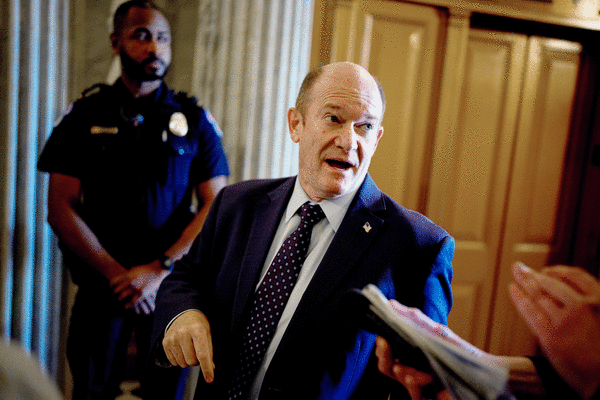
Sen. Chris Coons of Delaware, the top Democrat on the Defense Appropriations Subcommittee, like many other Democrats, agrees with the goal of improving protection against missile threats. But Coons said Golden Dome is still essentially a vague promise.
“The Pentagon, six months into this, owes us a clearer path forward and plan,” Coons said.
‘Total accountability’
The manager of the Golden Dome program, Space Force Gen. Michael Guetlein, said in a speech in December that the program’s secrecy is needed for security. He said he hopes to be able to say more publicly about the program’s goals in 2026. He also said he has met with several hundred industry executives.
Guetlein has briefed House authorizers and appropriators on the program in recent weeks, including a meeting on Dec. 17 with the House Defense Appropriations Subcommittee.
Rep. Betty McCollum of Minnesota, the top Democrat on that panel, attended the briefing.
McCollum said later, without discussing classified information, that Golden Dome “is not a concept anymore; it’s plans.” She said it would probably be deployed in phases. And she said Guetlein was asked in the briefing a lot about the system’s costs.
“If this is something we’re going to do, it has to become part of the base budget,” she said. “Congress is going to be keeping close tabs on the cost of this, and we made it really clear we want total accountability.”
Trillion-dollar questions
The dollar amounts at issue could prove substantial.
A network of interceptors and radars, including in space, could cost as much as $3.6 trillion over 20 years, according to Todd Harrison, a defense budget expert with the American Enterprise Institute.
But the cost and schedule could swing considerably one way or the other depending on changes in how many missiles the system is designed to intercept and, in particular, how much of it is supposed to be accomplished from space.
Those are exactly the kind of issues, both technical and fiscal, that lawmakers are increasingly focused on, especially as the fiscal 2026 Pentagon spending package takes shape in the new year.
“Before we appropriate for the full [fiscal] year for the Defense Department, we should have clarity about priorities — between nuclear subs, surface ships, aircraft platforms and investments in space,” said Coons of the Defense Appropriations Subcommittee. “And Golden Dome is the single biggest unanswered question: How much do they need, by when and for what purpose? They need to answer that question.”
©2025 CQ-Roll Call, Inc., All Rights Reserved. Visit cqrollcall.com. Distributed by Tribune Content Agency, LLC.















































Comments