Pressure grows for Supreme Court to end 'emergency' wins for Trump
Published in Political News
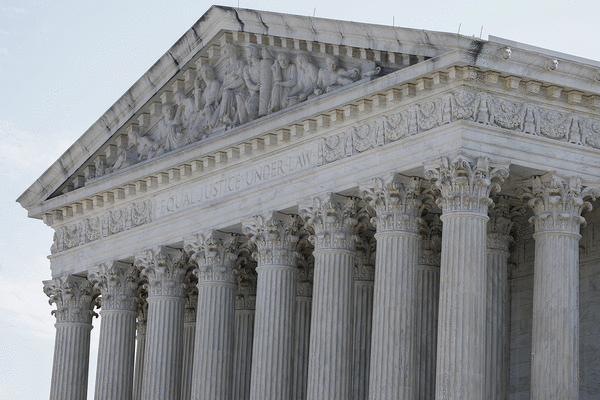
WASHINGTON — The U.S. Supreme Court twice last year cleared the Trump administration to end protections for hundreds of thousands of Venezuelan migrants fleeing violence and instability. In the months that followed, current and former judges repeatedly called out the justices for failing to explain their reasoning.
The issue is before the high court again, and this time, there are signs the justices heard the criticism. They declined to immediately intervene in the government’s favor this week in two other cases, meaning Haitians and Syrians with legal status in the U.S. remain shielded from deportation for now.
But the court granted the administration’s request to leapfrog over appellate courts and fast-track arguments next month on the merits of the fight, potentially ruling by July with a broad decision backing the president’s power to end what’s known as temporary protected status, or TPS.
Lawsuits challenging the administration’s efforts to roll back TPS protections have become a flashpoint in the debate over the Supreme Court’s handling of emergency requests, known to critics as the “shadow docket.” Since President Donald Trump returned to office, the conservative-majority court has resolved 27 such requests filed by the administration, backing him in full or part in 23 of them — in many cases with little or no explanation.
“We hope this is the beginning of the end of what has become this court’s routine acceptance of the government’s purported ‘emergency’ requests,” J. Michael Luttig, a former Republican-appointed federal appeals judge, said in an email.
Luttig helped organize an unusual friend-of-court brief signed by more than 175 former state and federal judges urging the justices to let the full legal process play out in the Syria case before intervening.
The justices didn’t give a reason why they decided against giving the government an early “emergency” win in the Haiti and Syria cases like they did last year in a related dispute involving Venezuelans. But they have faced mounting public pressure to slow down and show their work – even if they ultimately rule for the administration.
Emergency orders aren’t designed to conclusively resolve a legal question, only to determine what happens while litigation goes forward. The Supreme Court considers which side is “likely” to prevail, while weighing how much each would be harmed by a temporary ruling against it.
The court sometimes says which of those considerations were decisive. On other occasions it’s silent, and many district and appeals judges say that lack of specificity leaves them authority to reach different outcomes in similar cases – or even later in the same litigation.
There are at least a dozen lawsuits challenging the administration’s moves to end protected status for Haiti, Syria and 10 other countries. In nine cases, judges ruled against the government after the Supreme Court gave officials a green light to end it for Venezuela, first in May and later in October.
A federal appeals court panel in February refused to immediately disturb a New York judge’s ruling keeping TPS for Syrians. The Supreme Court’s past orders in the Venezuela case didn’t tie their hands because they “contained no explanation,” the judges said at the time. “Those orders involved a TPS designation of a different country, with different factual circumstances, and different grounds for resolution by the district court,” the panel wrote.
A different appeals court said it retained leeway in the Haiti case because of the "lack of express guidance" from the Supreme Court in the Venezuela rulings.
The latest block came on March 13, when a Massachusetts judge temporarily preserved Somalia’s designation. That same day, the Justice Department appealed another judge’s ruling keeping the protected status for South Sudan.
Meanwhile, the Trump administration has pressed ahead with scaling back the scope of the program. The Department of Homeland Security recently announced that the protected status would end for citizens of Yemen in early May. No lawsuit has been filed to challenge the move so far.
U.S. Solicitor General John Sauer, the government’s top Supreme Court lawyer, argued in a brief in the Haiti case that there is a pattern of judges’ “ongoing refusal to heed this court’s instruction that its interim orders” should inform their rulings.
The Supreme Court hasn’t announced a date for arguments in the Haiti and Syria cases. If the government succeeds, thousands of people with authorization to live and work in the U.S. could be forced to return to some of the most dangerous parts of the world.
“The stakes are literally life and death,” said Geoffrey Pipoly, a lead attorney for the Haitians who sued. He cited reports of brutal killings, humanitarian crises and the risks especially facing people coming from the U.S., who are seen as kidnapping targets for ransom demands.
Lupe Aguirre, deputy director of U.S. litigation at the International Refugee Assistance Project, which represents the Syrians, said in a statement that they’re glad for the temporary reprieve for their clients. However, she said, “it is disappointing that the Supreme Court took the extraordinary measure of taking on our case before the lower courts have weighed in.
White House spokesperson Abigail Jackson said in a statement that, “The Supreme Court has made it clear that the Trump administration’s efforts to remove Temporary Protective Status are lawful. Despite this, lower courts have continued to go rogue and ignore the highest court’s rulings."
Congress created the temporary protected status in 1990. Almost 1.3 million people in the U.S. from 17 countries were covered by early 2025, with Venezuelans and Haitians representing the largest share, according to the Congressional Research Service.
Recipients are shielded from deportation and can get approval to work. They can pursue citizenship, green cards, asylum or other legal pathways, although immigrant advocates say that took years even before the Trump administration ground processes to a halt. Individuals found guilty of “serious” crimes aren’t eligible for the status and they can lose it for new convictions.
Challengers accuse the Trump administration of failing to follow the required administrative steps to end TPS, relying on unsupported reasoning and violating migrants’ constitutional due process rights.
Outgoing Homeland Security Secretary Kristi Noem found that while “certain conditions in Haiti remain concerning” and there was “sporadic and episodic violence” in Syria, there were no longer “extraordinary and temporary conditions” that prevented citizens from safely returning.
"Temporary means temporary and the final word will not be from activist judges legislating from the bench, " Homeland Security spokesperson Lauren Bis said in a statement.
In the Haiti case before the justices, U.S. District Judge Ana Reyes in Washington concluded that it “seems substantially likely” that Noem “preordained her termination decision and did so because of hostility to nonwhite immigrants.”
Decisions in the TPS cases are mostly – though not always – split along ideological lines, with judges appointed by Republican presidents siding with the Trump administration and Democrat appointees ruling against it.
Disagreements over the Supreme Court’s emergency directives have come up in other lawsuits against Trump’s second term policies. Judges pushed back on applying orders the way the Justice Department wanted in fights over firings and funding cuts, deportations and evidence about the Department of Government Efficiency.
When the majority does explain its reasoning, lower courts need to fall into line, according to Justice Neil Gorsuch. “Lower court judges may sometimes disagree with this court’s decisions, but they are never free to defy them,” he wrote last August.
The justices have debated the issue out of court as well.
Sitting next to Justice Brett Kavanaugh at a recent joint appearance in Washington, Justice Ketanji Brown Jackson said the court was creating a “warped kind of proceeding" by being quick to act based on a preliminary assessment of the issues.
“You are signaling the answer to a process that is still underway,” she said.
Kavanaugh noted instances in which the court intervened at the behest of then-President Joe Biden’s administration, including a 2023 decision that kept a widely used abortion drug available amid a legal fight.
“One thing that frustrates me is the short memories of those people making the critiques,” he said.
_____
With assistance from Christopher Cannon and Steve Stroth.
_____
©2026 Bloomberg L.P. Visit bloomberg.com. Distributed by Tribune Content Agency, LLC.








































Comments