Supreme Court to hear arguments over meaning of 'Election Day'
Published in Political News
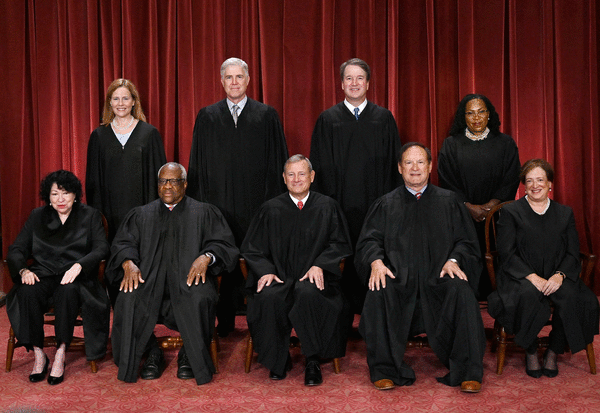
WASHINGTON — The Supreme Court is set to hear arguments Monday over what the phrase “Election Day” means and whether states can accept ballots in federal elections that arrive after that date.
Republicans challenged a Mississippi state law, passed amid the COVID-19 pandemic, that allows officials to count ballots that arrive up to five days after the federal Election Day if they are postmarked by Election Day.
The state has asked the justices to overturn a U.S. Court of Appeals for the 5th Circuit ruling that invalidated the state law, deciding it conflicts with a federal law that sets Election Day as the first Tuesday after the first Monday in November.
More than a dozen states and the District of Columbia have similar laws, and a ruling against Mississippi could send those states scrambling to change rules and communicate to voters to get their ballots in earlier.
Adav Noti, executive director of the Campaign Legal Center, said a ruling that wipes out Mississippi’s law could “cause a lot of confusion in those states about voting by mail and voting absentee immediately upon the decision coming down,” Noti said.
Noti said states are currently preparing for the midterm elections, and a ruling changing election laws now would upset those efforts.
“It is not good to change the rules around elections or voting while elections are happening. That should be done in between elections,” Noti said.
The justices are expected to issue a decision by the end of their term in June, which could avoid nasty post-election fights this year and in 2028.
Justin Levitt, a law professor at Loyola Marymount University who focuses on election law, said that although overturning the laws in Mississippi and elsewhere could be disruptive, it avoids the court deciding the issue in the middle of a contested election.
“I’m a fan of this one, of having an answer one way or another before we get to a post-election context,” Levitt said.
The case started when the Republican National Committee and state political parties challenged Mississippi’s law in 2024. Initially a federal trial court upheld the state law, and the RNC appealed to the 5th Circuit.
A unanimous three-judge panel ruled that the state law is invalid. The full 5th Circuit declined to hear the case and Mississippi appealed to the justices.
The RNC and the Trump administration have argued in Supreme Court filings that federal law defined “Election Day” specifically, and that means states must close the ballot box and begin tabulating results. Federal law doesn’t give states the authority to define it for themselves, the committee’s court brief said.
“If the election-day statutes say nothing about what must be done on election day, they say nothing at all,” the brief said.
The Trump administration, which will participate in oral arguments, told the justices in a brief that federal law mandates that voters’ ballots should be completed and received by the end of Election Day.
“That combined action — receipt of a private choice by a public officer — had to be perfected ‘on’ election day, not after,” the brief said.
The administration argued that “closing the ballot box on election day is a powerful safeguard against late-breaking foul play.”
President Donald Trump has long criticized the counting of late-arriving ballots, and the policies in those states served as the hooks for some of his most prolific evidence-free claims of fraud in the 2020 election. That included exhortations to “STOP THE COUNT” on social media after election night.
Trump also issued an executive order in March 2025 targeting states that allow late-arriving ballots, but it has been blocked by the courts.
Republicans in Congress took up the banner on the issue this year, introducing a bill that would require states to not accept late-arriving ballots in federal elections. That bill has not advanced yet this Congress.
Democrats have pushed back against that legislation as well as the Supreme Court case. Rep. Joseph D. Morelle, D-N.Y., ranking member on the House Administration Committee, which oversees election rules, said in a statement about the case Thursday that Trump would do “anything to undermine free and fair elections.”
“We cannot let the president’s unhinged conspiracy theories stop the verdict of the American people,” Morelle said.
Mississippi told the justices in court filings that for more than 100 years, Congress has allowed states to accept late ballots in special circumstances, particularly for soldiers serving in wars.
The state argued that the definition of Election Day is meant to cover the action of the voter casting their ballots, not when the state receives it.
The state contends that the RNC and Trump approach would mean “that ballot casting — not ballot receipt — defines an ‘election,’” the brief said. “That is not a sound view of Congress’s work. Congress did not impose the destabilizing revolution in election administration that the ruling below would require.”
Congress already allows states to take time to finalize and certify the results, the state said, meaning the election isn’t held up by allowing the counting of late-arriving ballots.
The Democratic National Committee, in a brief in the case, urged the justices to overturn the 5th Circuit ruling and argued that federal law differentiates between when voters make their choice of candidates and when election officials can receive that choice.
“Throughout this Nation’s history — from the Founding, through the Civil War, to the present — the term ‘election’ has been universally understood to refer to the voters’ act of choosing an officeholder, not to any later administrative acts to determine what choice they made,” the brief said.
Several election laws, the DNC brief said, acknowledge states’ ability to receive ballots after Election Day, particularly for servicemembers serving overseas. The DNC brief also pointed out that early presidential elections were divided between the act of electors choosing the president and those votes actually being received and counted by the new Congress.
Noti said that dozens of laws, ranging from campaign finance to ethics, reference Election Day within their statutes, making the side effects of such a decision “hard to anticipate.” One early effect could be on the legal justification for early voting.
“If Election Day means that one day, is it permissible for states to have early voting?” Noti said. “Would early voting be called into question everywhere it exists for hundreds of millions of voters?”
Noti pointed out that it also raises a problem for voters when election administration issues happen and polling places may remain open late into the night.
“Right now the rule everywhere is if you’re in line at the time polls close on Election Day you can cast your ballot,” Noti said. “There is just absolutely no evidence that Congress thought about voters in line at midnight when it passed these statutes and reaffirmed them for generations.”
The case is Watson v. Republican National Committee.
©2026 CQ-Roll Call, Inc., All Rights Reserved. Visit cqrollcall.com. Distributed by Tribune Content Agency, LLC.
















































Comments