US sees 'possibility of diplomacy' with Iran as war costs rise
Published in Political News
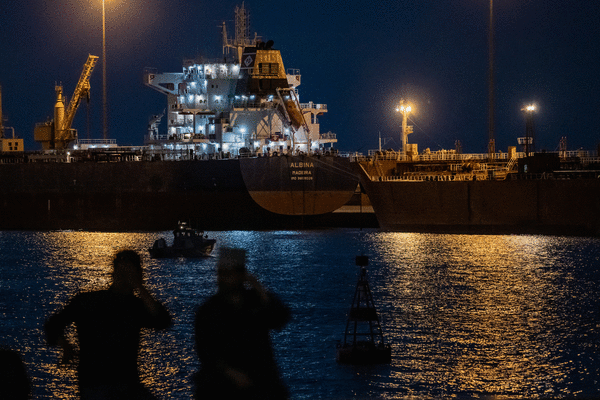
WASHINGTON — President Donald Trump signaled that Iran had offered a “present” as a show of good faith in negotiations he has claimed are ongoing to end a 25-day conflict that’s upended global markets, even while he deploys more troops to the Middle East.
Trump wouldn’t detail the gift, “worth a tremendous amount of money,” but confirmed it was related to energy flows through the Strait of Hormuz. A Thai ship passed through the vital waterway earlier Tuesday, Iran’s Tasnim news agency reported.
“We’re in negotiations right now,” Trump told reporters at the White House, saying that special envoys Steve Witkoff and Jared Kushner as well as Secretary of State Marco Rubio and Vice President JD Vance were all involved. Still, Trump’s optimism contrasted with the Pentagon’s movement of more ground troops to the region.
Iran and Israel showed no signs of letup in the conflict. Iran continued its grip on the Strait of Hormuz, while Israel kept up strikes on the Islamic Republic, with its Defense Minister Israel Katz saying the campaign would continue “at full intensity.” The Trump administration has also ordered the Army’s 82nd Airborne Division to deploy about 2,000 soldiers to the Middle East, a person familiar with the matter said on Tuesday, a sign that the U.S. for all its talk of negotiations was retaining the right to escalate further.
“As President Trump and his negotiators explore this newfound possibility of diplomacy, Operation Epic Fury continues unabated to achieve the military objectives laid out by the commander in chief and the Pentagon,” White House Press Secretary Karoline Leavitt said.
Oil fell on reports of a diplomatic push to end the war, eclipsing news that more troops were on the way to the region, with West Texas Intermediate dropping below $89 a barrel.
Trump claimed again, as on Monday, that Iran was in agreement on some parameters of a potential deal — starting from the U.S. insistence that the Islamic Republic is prevented from obtaining nuclear weapons. That has long been a U.S. red line, and was a condition agreed when Iran and the U.S. along with other great powers forged a nuclear accord under President Barack Obama, a pact Trump withdrew from in 2018.
“They’re talking to us, and they’re talking sense. It all starts with they cannot have a nuclear weapon,” the U.S. president said Tuesday. “Nobody knows who to talk to, but we’re actually talking to the right people, and they want to make a deal so badly, you have no idea how badly they want to make it.”
There remained broad uncertainty on Tuesday about who, exactly, is involved in the negotiations, the structure of talks and the outlines of any potential agreement. Axios, citing two sources with knowledge of the discussions, said that the U.S. and a group of regional mediators were discussing the possibility of holding high-level talks with Iran as soon as Thursday, but were awaiting a response from Tehran.
The New York Times reported that the U.S. offered Iran a 15-point proposal for concluding the war. The plan was delivered by Pakistan. Who in Iran’s leadership received the overture and their reaction remained unclear, the Times said, citing two unnamed officials in the article.
Several Gulf states also signaled willingness to join the U.S.-Israel campaign if Iran strikes their critical infrastructure.
In an indication of the market volatility, Treasuries unwound a portion of the day’s losses in late session Tuesday, following a report by Israel’s Channel 12 that suggested the U.S. was seeking a one-month ceasefire for negotiations with Iran.
At home, Trump faces uneven support for the war effort, even within his own party. U.S. gasoline prices have risen each day since the conflict began, marking the longest such streak since May 2022, according to American Automobile Association data.
While Trump said on Monday that he’s refraining from U.S. strikes on energy sites, giving the Islamic Republic five days to reach a deal, the fact that U.S. Marines are on their way to the region raises the prospect of ground operations. U.S. Central Command and the Office of the Secretary of Defense referred questions on potential troop movements to the White House. The Wall Street Journal reported the move earlier.
“All announcements regarding troop deployments will come from the Department of War,” White House spokesperson Anna Kelly said in a statement. “As we have said, President Trump always has all military options at his disposal.”
At the same time, global leaders are jockeying for sway.
Trump has spoken with Pakistan’s army chief, Asim Munir, about the conflict, people familiar with the matter said. Prime Minister Shehbaz Sharif said in a social media post on Tuesday that Pakistan would be “honored” to mediate the talks — a post that Trump later shared on his own account without saying whether he would accept the offer.
Indian Prime Minister Narendra Modi said he advocated for peace in a phone call with Trump that touched on the strait, a key route for India’s energy imports. Meanwhile, Prime Minister Benjamin Netanyahu asked close confidant Ron Dermer to monitor any U.S.-Iranian negotiations to make sure their country’s interests are upheld, an Israeli official said.
Elsewhere in the Middle East, American allies including Saudi Arabia and the United Arab Emirates have hardened their stances against Tehran because of consistent attacks on their territories.
Saudi Arabia told the U.S. it’s ready to strike Iran if its own power and water plants were targeted by the Islamic Republic, according to people with knowledge of the matter. Foreign Minister Faisal bin Farhan Al Saud said last week the kingdom’s restraint isn’t “unlimited.”
Saudi Arabia’s Crown Prince Mohammed bin Salman has been urging Trump to continue the war to help remake the region, the New York Times reported on Tuesday, citing people briefed by U.S. officials on the conversations. The White House declined to comment on the president’s private discussions.
Conflicting comments from Iranian officials and through state media have only added to confusion around the status of negotiations.
Tehran received U.S. requests through mediators for talks to end the war, the state-run IRNA cited foreign ministry spokesman Esmail Baghaei as saying. “Necessary warnings were given about the severe consequences of any aggression against Iran’s critical infrastructure,” Baghaei said.
Iranian Foreign Minister Abbas Araghchi has in recent days held calls with counterparts in Turkey, Oman, Pakistan, Egypt, Russia, Azerbaijan, Turkmenistan and South Korea.
The deputy speaker of Iran’s parliament, however, ruled out negotiations with Trump. Fars quoted Ali Nikzad as saying Iran would not negotiate “with someone who is a liar and in whom there is no sign of honor, humanity, or conscience.”
Iran appointed a hardline veteran of the Islamic Revolutionary Guard Corps, Mohammad-Bagher Zolghadr, as the country’s top national-security leader, replacing Ali Larijani, who was killed in an Israeli airstrike last week. Zolghadr is a military man with little diplomatic experience.
The early indications suggest potentially arduous negotiations, with no guarantee the sides will be able to clinch a deal that ends the war. Iran has previously insisted on reparations and pledges from the U.S. and Israel that they don’t attack in the future — demands Trump and Netanyahu are unlikely to accept.
The conflict has claimed more than 4,350 lives. About three-quarters of those have been in Iran, while over 1,000 people have been killed in Lebanon, where Israel is fighting Tehran-backed militant group Hezbollah.
Traffic through the Strait of Hormuz, a conduit for about a fifth of the world’s oil and liquefied natural gas, remains all but stopped. Only a few tankers have passed through since the conflict began, often after engagement with Iran.
Iran has started charging commercial vessels transit fees for passing through the strait, another sign of Tehran’s effective control over the world’s most important maritime energy channel.
_____
With assistance from John Bowker, Mia Gindis, Eltaf Najafizada, Meghashyam Mali, John Harney, Vivianne Rodrigues and Charles Gorrivan.
_____
©2026 Bloomberg L.P. Visit bloomberg.com. Distributed by Tribune Content Agency, LLC.












































Comments