Editorial: On the witness stand, Marco Rubio faced a Miami friendship he can't outrun
Published in Political News
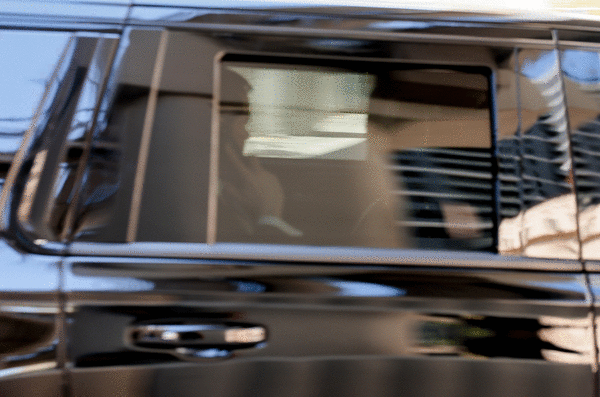
On Tuesday morning, U.S. Secretary of State Marco Rubio returned to his hometown — not to talk about the Iran war, Venezuela or his pressure campaign on Cuba. Rubio was summoned to a downtown federal courtroom to testify in the criminal trial of a former Miami congressman and his once “very close” friend, in Rubio’s own words.
U.S. Rep. David Rivera and another defendant are on trial, accused of acting as unregistered foreign agents for the Venezuelan government almost a decade ago during Nicolás Maduro’s regime. Rubio is not accused of any wrongdoing. But Rivera’s scandals have hung around Rubio’s neck for years, making their friendship a potential liability for the former U.S. senator who certainly still has presidential aspirations.
The testimony in a criminal trial by a sitting U.S. Cabinet member felt surreal. This is one of the top people in the federal government whose role includes handling a foreign war and crafting U.S. foreign policy at a time of U.S.-generated world turmoil. But in the courtroom on Tuesday, Rubio was back to his Miami start as an ambitious young politician.
Rubio sat in the witness stand stone-faced for most of his testimony. There was, however, the occasional chuckle — “I’ve got two jobs,” he joked, referring to his dual role as secretary of state and as President Trump’s national security advisor.
It was clear from watching the court proceedings how the paths of Rubio and Rivera diverged after a similar start. The two men, both Cuban American, rose in Miami and Florida Republican politics together, becoming friends in the 1990s. They co-owned a home in Tallahassee while serving in the Florida House in the 2000s. They knew each other’s families and attended weddings together. When Rubio was elected to the U.S. Senate in 2010, Rivera was elected to the U.S. House, though he only served one two-year term while Rubio was reelected twice.
But on Tuesday, as they sat at opposite sides of the courtroom, Rubio’s star power was evident. U.S. District Judge Melissa Damian said twice that Rubio looked “great” in older photos that Rivera’s team wanted to enter into the record showing the two men socializing. Rivera’s defense lawyer even asked Rubio to sign a copy of his 2012 book, “An American Son,” which the defense presented as evidence of the close relationship between Rubio and Rivera. (Rubio mentioned Rivera in the book’s acknowedgements.)
At the core of Rubio’s testimony were two 2017 meetings the then-U.S. senator had with Rivera in Washington, D.C., involving brokering a deal for a democratic transition in Venezuela. In the first one, Rivera told Rubio that “insiders” from Maduro’s regime wanted Rubio to deliver a letter from Maduro to Trump signaling Maduro’s willingness to hold free and fair elections, Rubio said. The second meeting included other people, including Rivera’s co-defendant, Esther Nuhfer, and Venezuelan businessman Raúl Gorrín, who was purportedly helping broker a deal for Maduro’s exit. Rubio said the gathering was a “total waste of my time.”
In the end, Rubio never received the promised letter and U.S.-Venezuela relations continued to deteriorate. Earlier this year, the U.S. captured Maduro, who’s been replaced by his vice president, Delcy Rodriguez, as interim president.
Rubio told the prosecution he would not have accepted the meetings had he known that Rivera had a $50 million contract with the U.S. subsidiary of Venezuela’s national oil company.
Rubio’s testimony was crucial to the case because prosecutors allege these meetings were part of Rivera’s efforts to curry favor on behalf of Maduro. Rivera has pleaded not guilty to the charges and his defense contends his relationship with Rubio, a staunch opponent of socialism and the Venezuelan regime, shows he did not work for the Venezuelan strongman.
That same relationship has followed Rubio ever since Rivera started facing legal problems. In 2022, a federal judge ordered Rivera to pay a $456,000 fine for making campaign contributions under someone else’s name — the judgment was reversed on appeal two years later. Before that, he avoided charges involving a casino consulting deal that sparked Internal Revenue Service attention.
If the old saying, “don’t forget where you came from,” is true, Rubio is learning that the hard way.
___
©2026 Miami Herald. Visit at miamiherald.com. Distributed by Tribune Content Agency, LLC.





Comments