Maryland House panel quietly adds redistricting language to elections bill
Published in Political News
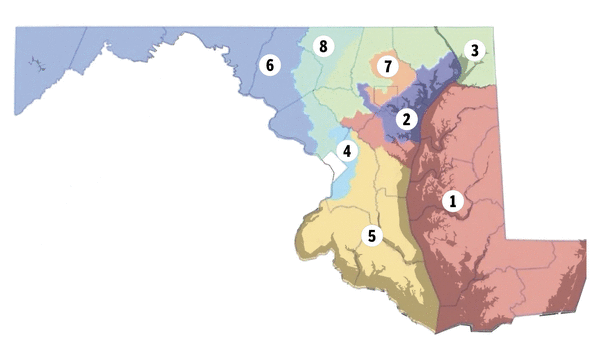
The Maryland House Government, Labor and Elections Committee quietly, and unanimously, approved an amendment adding redistricting language to a Senate elections bill — a move Republicans warned could provoke pushback on the House floor and also drew concern from voting rights advocates.
The amendment, introduced by Frederick County Del. Kris Fair, a Democrat, would authorize the General Assembly to grant the Supreme Court of Maryland the power to review the state’s congressional district maps first. It would update Senate Bill 5, which would require special elections in most cases to fill vacancies in the General Assembly. Under current state law, vacancies are filled by the governor from a list provided by the departing lawmaker’s party.
The committee approved Fair’s amendment 14-0 without discussion to advance the bill during a meeting that lasted about two minutes. Four members were not in attendance: Republican Dels. Brian Chisholm and Mark Fisher, and Democratic Dels. Sheree Sample-Hughes and Jared Solomon, according to the Maryland General Assembly.
House Minority Leader Jason Buckel, an Allegany County Republican, told reporters Wednesday that the brief committee meeting left members unclear about what they were voting on.
“[SB5] is a bill that I think many of us could support … They did not take that to their subcommittee, so they didn’t explain it to anyone,” Buckel said, adding that Republicans were particularly excluded because only two of the five GOP members of the committee were not in attendance for the vote. “Members came in, didn’t really understand, and weren’t really advised as to what the amendment was, and thought they were voting basically just on the bill that they had supported previously.”
Fair pushed back, saying lawmakers received the amendment in advance and that the committee followed standard procedures.
‘There’s no standards’
Buckel said he plans to seek a special order on the House floor to strip the amendment, though he acknowledged time constraints late in the legislative session could make that difficult. He added that the amendment could also weaken standards governing how congressional districts are drawn or could be drawn in extreme ways.
“You could stretch a district from Baltimore City to Cumberland. You could stretch one from Montgomery County to Ocean City. There’s no standards. It’s all politics. That’s a terrible idea,” he said.
Fair disputed those claims, saying the amendment is intended to resolve a legal ambiguity identified in a prior court ruling stemming from the 2022 redistricting cycle.
Lawmakers passed a revised map ahead of the 2022 elections, after a 2021 version was struck down for partisan gerrymandering. The 2022 map gave Democrats a 7-1 advantage and was not reviewed by a court. However, a subsequent decision by the Supreme Court of Maryland in a case involving state legislative maps reached a different conclusion about how constitutional standards apply.
Fair said the amendment clarifies that those standards apply to state legislative maps, not congressional districts, and would allow challenges to congressional maps to go directly to the state’s highest court. “[The amendment] provides a final answer on the questions, so we don’t have to worry about very long, protracted appeals,” Fair told The Baltimore Sun on Wednesday.
He added that the change is not intended to revive stalled efforts this year to redraw Maryland’s congressional districts midcycle. “The Senate’s made its position on redistricting very clear,” he said, describing the amendment instead as addressing a longer-term issue.
“There is actually a problem that we might not be thinking about for this year, but in years to follow,” Fair said. “We currently have a bill that, logistically, is dealing with Article III questions in our constitution, so why not address that issue and provide clarity to the courts all in one fell swoop?”
Broader bill at risk, advocates say
Still, voting rights advocates, like Common Cause Maryland, were concerned. The group previously pushed for changes to how legislative vacancies are filled.
Joanne Antoine, executive director of Common Cause Maryland, told The Sun the amendment could derail the broader bill, which has been a priority for voting rights advocates for almost 20 years.
“The House has finally decided to take action on the compromise bill, and now it’s at risk of dying because they’ve made it about redistricting,” Antoine said in a Wednesday interview. “I don’t even want to say on life support. I think this is it.”
As amended, the bill would go before voters as a referendum on their November 2026 ballots and include multiple changes: requiring special elections in certain cases, clarifying districting standards for state legislative maps, and allowing lawmakers to authorize the state’s highest court to review congressional maps.
While Fair explicitly told The Sun that the amendment is not tied to this year’s redistricting push, it mirrors broader efforts by House Democrats and Gov. Wes Moore to pursue a “plan B” strategy after the Senate blocked a proposed congressional map earlier this session. The alternative plan has yet to materialize.
Senate President Bill Ferguson, who has publicly opposed mid-cycle redistricting efforts all session, citing legal and political risks, did not respond to The Sun’s requests for comment.
________
©2026 The Baltimore Sun. Visit at baltimoresun.com. Distributed by Tribune Content Agency, LLC.




















































Comments