As Congress leans on 'pro formas,' bills become law without Trump signature
Published in Political News
WASHINGTON — With members largely in their districts to campaign in the final stretch before midterms, the House and Senate have transitioned to “pro forma” mode. But the rhythm of chambers gaveling in briefly every few days can mask the political undercurrents in the constant push and pull of power between Congress and the executive branch.
That dynamic was on display in July, when a blockbuster housing overhaul and a lesser-known measure expanding disaster relief payments to farmers quietly became law without the pomp and circumstance sometimes seen in presidential bill signings.
The two laws were enacted through what’s known as the “10-day rule.” The Constitution says that bills become law after 10 days, excluding Sundays, without a presidential signature — as long as Congress has not adjourned. Pro formas, brief meetings of the House or Senate during which business is not usually conducted, allow the chambers to stay in session.
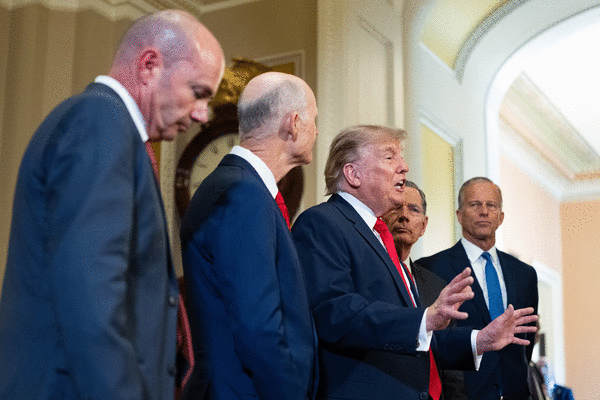
The pair of bills enacted this summer appear to have little in common except this: Each was sponsored by members of the president’s party. Congressional experts say President Donald Trump’s penchant for using his political leverage, particularly against fellow GOP lawmakers, is among the driving forces for withholding a presidential signature.
“It’s not so much maybe about the actual policy of it, but about denying House and Senate Republicans the optics of a big bill signing,” said SoRelle Wyckoff Gaynor, assistant professor of public policy and politics at the University of Virginia.
That, she added, “is a powerful tool that really only Trump can wield.”
In the case of the housing law, Trump declared he would not sign the bill because he was frustrated that the Senate had not passed an election security bill that would require voters to prove their citizenship.
The president canceled a signing ceremony hours before it was scheduled to take place, catching Hill Republicans by surprise and effectively denying lawmakers a victory lap on the bipartisan package.
“When that bluff is called, [Trump] can either choose to make a high-profile signing ceremony on something he threatened to not allow,” said Casey Burgat, the director of the legislative affairs program at George Washington University’s Graduate School of Political Management. “Or he just kind of keeps it under the radar, knowing that it will become law.”
The new normal?
Congress’ use of pro formas to constrain the president’s ability to use a so-called pocket veto or make recess appointments has also contributed to the use of the archaic 10-day rule, experts say.
A pocket veto, the mirror opposite of the 10-day rule, occurs when a president allows legislation to sit for 10 days when Congress is adjourned, effectively killing it without having to issue a veto.
“They [House and Senate] are being so strategic, and they have since the mid-2000s, to stay in pro forma session pretty much every day that they’re not in full session,” Gaynor said. “Part of it is, of course, to avoid pocket vetos or recess nominees.”
Holding pro forma sessions also prevent the president from making recess appointments, which allow him to temporarily fill federal vacancies that require Senate confirmation. But the president can only do so while the Senate is in recess, and such appointments can only last until the end of the next legislative session.
Pro forma sessions gained popularity with congressional leaders in 2007, during the George W. Bush administration, when then Senate Majority Leader Harry Reid, D-Nev., used it to block the president from recess appointments.
The strategy expanded when the GOP took control of the House in 2011 and Republican leaders forced both chambers to hold pro forma sessions in an unsuccessful effort to block President Barack Obama from making recess appointments to the National Labor Relations Board and the Consumer Financial Protection Bureau.
But in 2014, the Supreme Court ruled that several Obama administration appointments to the NLRB were unconstitutional, saying the Senate was not technically in recess.
Trump revives old practice
The practice of bills becoming law without the president’s signature appears to have begun under the presidency of James Buchanan, according to a survey by Harvard University published in 1890.
It reached an apex under Democratic President Grover Cleveland — coincidentally the other president to serve two nonconsecutive terms — occurring 283 times during his first term when he was contending with a GOP-controlled Senate.
Even so, the tactic appears to be exceedingly rare in the modern Congress. A search on Congress.gov indicates that nine measures have become law in the same manner in just over the past half-century, including the two bills under Trump.
Before this year, the last measure enacted under the 10-day rule was during the Obama administration, according to congressional records. In his last few months in office, Obama distanced himself from a measure to renew sanctions against Iran over concerns of undermining a landmark nuclear agreement with the country at the time. It became law without Obama’s signature.
For the 2026 farmer disaster aid law, Trump offered no such context.
“Typically we can reconstruct some semblance of an explanation,” said Sarah Binder, a political science professor at George Washington University and senior fellow at Brookings.
Former President Ronald Reagan, she noted, allowed a bill requiring a 60-day notice period before factory plant owners could shutter operations and commence layoffs to become law without his signature in 1988 in order to shore up Democrats’ support for key parts of his trade agenda.
Not long after, President George H. W. Bush stalled on a measure that made it a federal crime to desecrate the U.S. flag. He publicly cast doubt on its constitutionality, declaring his preference for a constitutional amendment instead.
But for Trump, it seems to be more of a power play. His efforts to intimidate fellow Republicans are part of the equation, experts say.
“The president at this stage of his second term obviously has some legislative demands that he doesn’t have the votes for,” said Burgat. “With so few levers of leverage, he’s threatening to veto things or not attach his signature unless his demands are met.”
When asked if the president plans to use the 10-day rule again this fall, the White House did not respond to multiple requests for comment.
But scholars say additional bills could be codified this year without the president’s signature, especially during a lame-duck session following the midterms.
“It’s something that I think is just going to become more common as Congress is essentially always in pro forma session,” Gaynor said.
©2026 CQ-Roll Call, Inc., All Rights Reserved. Visit cqrollcall.com. Distributed by Tribune Content Agency, LLC.










































Comments