Tafoya and Flanagan clash over what it means to be 'pro-choice'
Published in Political News
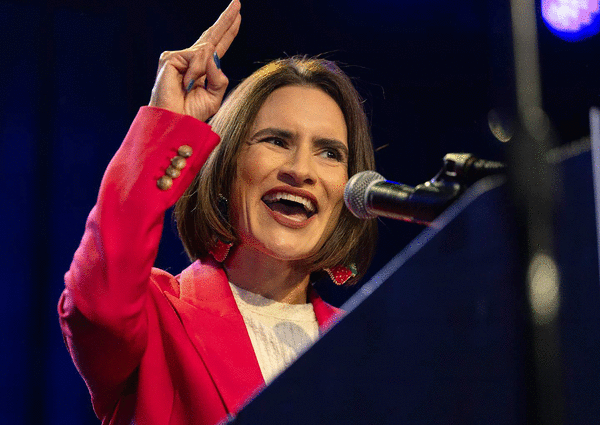
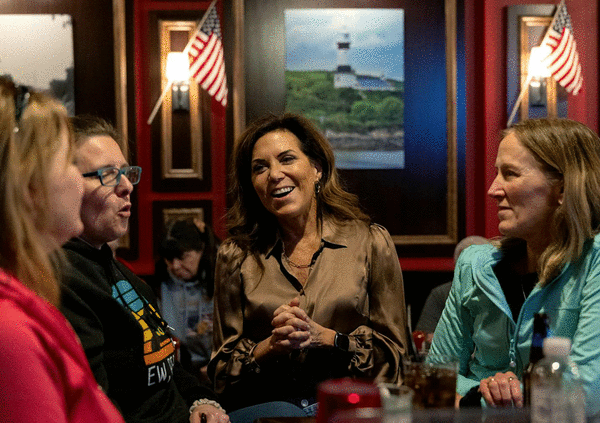


Michele Tafoya launched a new campaign ad last weekend calling herself a “pro-choice Republican,” a bid to reinforce her image as an independent voice for Minnesota in the U.S. Senate.
She’s not alone in talking about abortion on the campaign trail.
Lt. Gov. Peggy Flanagan is trying to reach voters who punished Republicans after Roe v. Wade was overturned, arguing Democrats are still the best option for those who want to protect access to the procedure.
The emergence of the fight over abortion access, four years after the U.S. Supreme Court eliminated the Constitutional right to an abortion and turned the decision over to the states, offers a stark reminder that reproductive rights remain a critical issue for many Minnesota voters.
For Tafoya, it demonstrates a belief that her stance — unusual for a Republican — will be a net positive in the general election, even if she might pay a price with some in her party’s base.
“I have taken a lot of heat from my party over this,” Tafoya told reporters on Tuesday.
“I believe the woman has a right to choose, up to 12 weeks certainly, and that is where I stand,” Tafoya said, while arguing that Flanagan’s support for Minnesota’s permissive abortion laws has gone too far. “I wonder if there’s any single issue that Peggy Flanagan has taken that is not in lockstep with the extreme left of her party.”
It also has forced Flanagan to spend time trying to dispel any notion that Tafoya is a moderate to keep swing voters in the fold.
“There’s only one pro-choice candidate in the Senate race, and it sure as hell isn’t Michele Tafoya,” Flanagan said at a news conference last weekend. “And we won’t let any 30-second ad erase years of what she has told us.”
Tafoya has long described herself as pro-choice, and before running for office she lamented how Republicans lose many voters, especially women, with candidates who promise to ban access to abortion or strictly limit it.
“Republicans, if they want to win anything in the future, better get their messaging right on abortion,” she said on her podcast in 2024.
At the same time, Tafoya believes Roe was decided on flimsy legal grounds and that the court was right to overturn it. “This is not a constitutional right,” she said during a June 2022 podcast.
Still, when she announced her campaign for Senate, she explained that she supports access to abortion through 12 weeks of pregnancy.
That is a more permissive position than many elected Republicans in the state, but it’s also more restrictive than the standard set by Roe, which prevented states from banning abortion through roughly the second trimester, or up to 28 weeks. Approximately 84% of abortions in Minnesota in 2024 were carried out within the first 12 weeks of pregnancy.
While wooing Republican voters in her primary campaign this summer, Tafoya said she would still be an ally to conservatives on the issue by voting to confirm “strict constructionist” judges and opposing government money for abortion.
She described her views as aligning with Trump.
“The issue of life is a states' issue, it is not a federal issue,” Tafoya told a crowd in Mahtomedi in April. The overturning of Roe allowed states to decide whether to restrict abortion.
“Whatever my personal opinion is, (it’s) not coming into play because as a senator you’re not going to face those decisions.”
Asked during an MPR News debate Friday how she would define “reasonable access” to abortion, Tafoya said three months, but argued Minnesotans have access for nine months now — a fact she wouldn’t change.
“The law is settled here in Minnesota and I have absolutely no intention of changing that from the United States Senate,” she said.
Democrats have disputed the notion that the issue is no longer a federal matter. At a Flanagan news conference, U.S. Rep Kelly Morrison, an OB-GYN, said the “fight is far from over in Washington” and urged voters to support Flanagan to block Trump from appointing more anti-abortion judges.
Flanagan called Tafoya’s stance “political expediency.” Someone willing to vote for anti-abortion judges, Flanagan said, is “not pro-choice.”
“You cannot call yourself completely aligned with Donald Trump on abortion and then somehow call yourself ‘pro-choice,’” she said in the MPR News debate Friday. “It’s ridiculous.”
Flanagan’s own record on abortion has drawn attacks from Tafoya and Republicans.
Minnesota Democrats in 2023 codified court rulings and passed bills clearing away most legal hurdles to abortion in the state, moves that set no gestational limits on the procedure.
DFLers and abortion providers in Minnesota argue that abortions performed later in pregnancy are extremely rare and are typically the result of serious medical problems. Yet because of the legislature’s actions and court precedent, Minnesota is one of the most permissive states in the country on abortion, which Flanagan celebrated in 2023.
“I’m proud to live and raise a family in Minnesota knowing that Minnesotans have the freedom to make decisions about their own lives and about their own bodies,” the lieutenant governor said when Walz signed a bill cementing the right to an abortion in state law.
Flanagan doesn’t endorse spreading Minnesota’s abortion laws to the rest of the country. Spokeswoman Maddie Heinz said Flanagan wants to pass a federal law reinstating Roe.
Flanagan has also called for an “overhaul” to the U.S. Supreme Court, including adding more justices as a check on Trump’s power. The Supreme Court has had nine members for more than 150 years, but with the court’s current conservative bent, some Democrats have endorsed the idea of adding justices to make the court more favorable.
“I believe that we should add additional seats to the Supreme Court,” Flanagan said in Friday’s MPR debate. “I believe that we absolutely should look at staggered terms ... We need to make sure that we are pushing for more stringent ethics rules around the Supreme Court.”
In the Friday debate, Tafoya criticized that stance, saying Flanagan wanted to pack the court “until there are enough judges there to do their bidding.”
Tafoya has also criticized Minnesota’s abortion laws as too permissive, calling the status quo here “barbaric.”
That’s in part based on Walz signing an update to a state law for infants born alive after an abortion attempt. Previously the law stated that “all measures consistent with good medical practice ... shall be taken by the responsible medical personnel to preserve the life and health of the infant who is born alive.”
The updated law says medical personnel are required “to care for the infant who is born alive.” It also removed a reporting requirement for infants who are born alive after an abortion attempt.
Supporters of the change say it doesn’t get in the way of parents or doctors trying to save the life of the child, but it does give them the option to not engage in medical intervention in rare instances where an infant is born alive with fatal fetal anomalies.
“I don’t care really how rare it is,” Tafoya said at the April event in Mahtomedi. “Tim Walz can say it doesn’t happen, but if there’s a botched abortion at eight or nine months and the baby survives and there’s no obligation to care for that infant, that’s extreme.”
Heinz said Flanagan “supports current abortion laws in Minnesota and does not believe in passing any new laws to restrict abortion.”
_____
(Briana Bierschbach of the Minnesota Star Tribune contributed to this story.)
_____
©2026 The Minnesota Star Tribune. Visit startribune.com. Distributed by Tribune Content Agency, LLC





































Comments