Missouri's Emanuel Cleaver wins 12th term in Congress after attempted gerrymander failed
Published in Political News
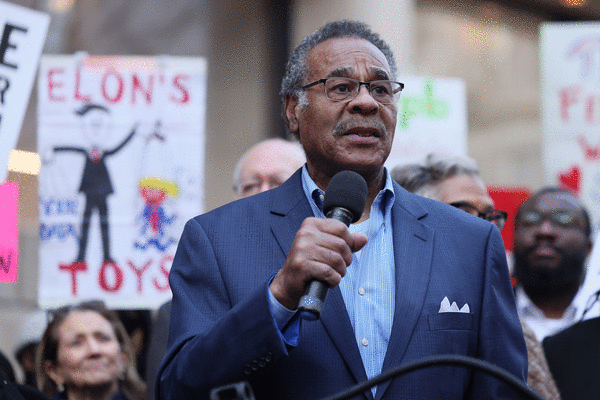
KANSAS CITY, Mo. — U.S. Rep. Emanuel Cleaver cruised to victory Tuesday, winning a 12th term in his Kansas City-based district, thanks in large part to the reinstatement of the congressional map under which he had twice won reelection handily.
Cleaver defeated state Sen. Rick Brattin, a fiercely conservative Harrisonville Republican who was banking on a congressional district more favorable to Republicans. The Associated Press called the race for Cleaver at 8:46 p.m. with 72% of the vote counted. Cleaver led in the polls with 74% of the vote.
Missouri lawmakers passed a new congressional map last year under pressure from President Donald Trump, aiming to oust Cleaver. States typically redraw their districts every 10 years, but Trump sparked a wave of redistricting midway through the decade in both Republican- and Democratic-led states.
Under the 2022 map, now back in effect, Cleaver’s district included Kansas City and some suburbs in Jackson and Clay counties. The 2025 map, now suspended, would have cut out Kansas City’s urban core and extended deep into rural mid-Missouri, around Columbia and the Ozarks.
Missouri’s 5th Congressional District will remain the same as in 2022 and 2024, despite an attempt to redraw the district in 2025. Neil Nakahodo, The Kansas City Star
The 2025 map would have made seven of Missouri’s eight congressional districts favorable to Republicans in a state where Democratic presidential candidate Kamala Harris received 40% of the vote in 2024.
The congressional map was struck down for this election cycle after a lengthy court battle. In December, the referendum campaign People Not Politicians submitted enough signatures to qualify the measure for the ballot. The referendum would have suspended the law pending a statewide vote.
But Republican Secretary of State Denny Hoskins waited until the statutory deadline of Aug. 4 — the date of the primary — to reject the map, determining that it was unconstitutional.
The Missouri Supreme Court ruled against Hoskins, placing the referendum on the Nov. 3 ballot and suspending the law retroactively until voters approve or reject it. The decision was appealed to the U.S. Supreme Court, which affirmed the Missouri Supreme Court’s decision three times.
The saga left Missouri in a unique position of having candidates win their primary election in different districts from those in which they competed in the general election. The outcome also preserved the status quo in Kansas City, with Cleaver again heading to Washington buffered by two Republican districts.
_____
©2026 The Kansas City Star. Visit at kansascity.com. Distributed by Tribune Content Agency, LLC.





























Comments