Johnson banks on GOP unity as permitting bill vote nears
Published in Political News
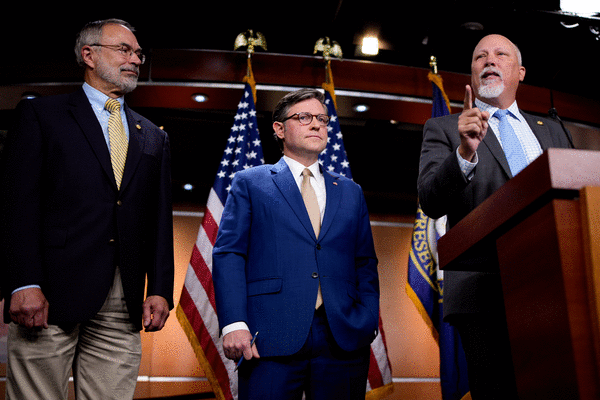
WASHINGTON — The House will take up a Senate-passed bill to overhaul the federal permitting system under a rule when it returns next week, a House aide said on Tuesday. The bill, which passed the Senate on Nov. 19 in a 62-33 vote, has the endorsement of President Donald Trump and a wide range of industry groups that are generally GOP allies. Adoption of the rule, typically a party-line affair, would almost certainly lead to final passage and Trump's signature.
But it may come down to GOP attendance, with many departing members not showing up to vote in the days following the midterms. Speaker Mike Johnson, R-La., in a Nov. 20 letter to colleagues, implored them to come back to work next month to finish out the lame-duck session, citing the permitting bill vote among other things. But it remains to be seen whether defeated lawmakers will take him up on that.
And several Republicans, led by House Freedom Caucus members, have used their leverage in rule votes to extract last-minute changes to legislation from leadership.
Last December, the House considered a bill to overhaul the National Environmental Policy Act from Rep. Jared Golden, D-Maine, and House Natural Resources Chairman Bruce Westerman, R-Ark. Ahead of the vote on that rule, Republicans including Freedom Caucus Chairman Andy Harris, R-Md., sought last-minute changes to portions of the bill they were concerned would allow offshore wind projects in the Atlantic Ocean to move forward. Westerman agreed, which in turn caused the American Clean Power Association to withdraw support for the bill.
Harris hasn’t commented yet on the Senate-passed permitting measure. Nor has Freedom Caucus Rep. Chip Roy, R-Texas, who has called for permitting generally to be a lame-duck priority but was another one of the holdouts on Westerman’s bill last year. Still, the Freedom Caucus is generally on board with permitting legislation and specifically cited it as a priority for the session's waning days.
Republicans are generally expected to support the bill, which enjoys backing from industry groups like the American Petroleum Institute, National Mining Association and Edison Electric Institute, which represents investor-owned utilities. The bill’s supporters go beyond the energy sector, including groups like the American Road and Transportation Builders Association and National Association of Home Builders.
And two Democrats — Golden and Rep. Marie Gluesenkamp Perez of Washington, both members of the Blue Dog Coalition — have taken the rare step of crossing the aisle to support Republican rules this year in order to move legislation they support. Both have issued statements that speak favorably of the permitting bill.
Senate Environment and Public Works Chairman Shelley Moore Capito, one of the bill's lead authors, was enthusiastic about the bill's chances in the other chamber.
"I think there’s a real will there," the West Virginia Republican said Tuesday after presiding over a pro forma session. "We’ve got to get enough Republicans there to vote, and I think that’s what the speaker is hoping to do. I think he wants to do it under a rule, it sounds like, but I’m very excited about it because I think it’s very, very doable."
Divided Democrats
With the path through the House yet to be fully illuminated, a vote under suspension of the rules, which requires two-thirds of members present and voting to pass, remains an option. But that's a trickier path given the split among Democrats.
The Senate-passed bill emerged from that chamber in a weaker position than advocates anticipated earlier this month, when 73 senators backed advancing it on an initial procedural vote.
After opponents got through with the measure — including an amendments blockade by Oregon Democratic Sens. Jeff Merkley and Ron Wyden that left backers unable to incorporate changes necessary to shore up support — there were just 62 "yes" votes, although there were four absent GOP supporters.
Just 15 out of 47 Democratic caucus members voted for it, including only one member of the Environment and Public Works panel — Rhode Island’s Sheldon Whitehouse, who wrote the bill with his GOP and Democratic counterparts on EPW and Energy and Natural Resources.
If there is full attendance on both sides, the threshold for passage on suspension would be about 290 votes. Permitting bill supporters would need about one-third of House Democrats to vote in favor — 71 with current vacancies — similar to their level of Senate Democratic support, assuming all Republicans were on board.
That doesn’t seem out of the question given that the leadership of the 112-member-strong New Democrat Coalition has expressed support led by the current chair, Brad Schneider of Illinois; the incoming chair, fellow Illinoisan Nikki Budzinski; and Scott Peters, D-Calif., chair of the coalition’s Environment, Climate and Clean Energy Working Group. So has the centrist Blue Dog Coalition.
Clean energy groups like the Solar Energy Industries Association and American Clean Power Association back the bill, as do key labor unions including the AFL-CIO, Laborers’ International Union of North America and International Brotherhood of Electrical Workers. The AFL-CIO sent a legislative alert on the bill, which indicates it may include the measure on its annual legislative scorecard.
But Rep. Jared Huffman, D-Calif., ranking member of the House Natural Resources Committee, is a firm “no” on the current bill. He offered a series of changes on Monday needed to win his support — which have negligible chance of acceptance by the bill’s authors or by Trump, who last week said the bill would put money “back in the pockets of hardworking Americans” and lead to “tremendous amounts of new building.”
Huffman wants to roll back proposed limits on Endangered Species Act reviews as well as the bill's 150-day limit on judicial challenges and “project certainty” protections intended to bar future administrations from revoking approved permits. Huffman said the certainty protection would legislate “a third term for Trump” by preventing future administrations from revoking permits for projects that could have detrimental environmental impacts, such as fossil fuel or mining projects.
Meanwhile, the official position of the nearly 100-member Congressional Progressive Caucus is opposed. And the House Sustainable Energy and Environment Coalition said it couldn’t support the Senate bill without changes, arguing the measure “includes environmental rollbacks that are concerning to us.”
Two influential Democrats on energy and climate issues came out against the measure in its current form this week — Reps. Sean Casten of Illinois and Mike Levin of California, who are among the SEEC’s vice chairs. Casten and Levin have worked together on legislation intended to overhaul the transmission permitting system and address energy affordability.
In a statement Casten said the bill would make it “impossible” for a future administration “to undo the damage being done by the Trump Administration’s willful disregard of current environmental law and judicial precedent,” adding he would vote "no" on the Senate-passed bill “with confidence in our ability to craft a better version in the 120th Congress.”
Casten, who co-founded a clean energy startup before coming to Congress, is currently challenging House Financial Services ranking member Maxine Waters, D-Calif., for the gavel next year, in a bid resting in part on his environmental bona fides, including sustainable investment and climate-risk regulation.
Levin, an environmental lawyer by trade, praised the bill’s provisions making it easier to build interstate transmission lines, a key bottleneck barring the development of more wind and solar power generation.
“These grid reforms are real, and there’s no guarantee a better bill comes along that can actually become law soon,” Levin said in his statement. But he said it wasn’t worth the potential environmental costs, adding that “taking the current deal would mean giving up protections we may never win back in exchange for gains that aren’t guaranteed either.”
Major environmental advocacy groups like the Sierra Club and Natural Resources Defense Council have long been opposed to the measure, as have Native American tribes and representative organizations like the National Congress of American Indians.
Fate of manager’s package
Another factor affecting the debate in the House is how to handle a bipartisan package of Senate changes agreed to on both sides of the aisle, but blocked on the floor by Merkley, a staunch opponent of the bill.
That amendment included language making it more difficult to circumvent National Historic Preservation Act rules; giving landowners and state regulators more time to resolve disputes before eminent domain is invoked for transmission projects; and closing loopholes in the bill’s language aimed at making data center developers pay for their own electric-grid upgrades.
If that amendment had been included, the Senate vote count may have been higher. But attaching it in the House would send it back to the Senate for another round of votes, which may not be practical given the dwindling legislative session. An alternative would be to tuck the amendment into another must-pass bill, like government funding legislation or the National Defense Authorization Act.
The New Democrat Coalition’s statement, while overall supportive, said the group “will look for opportunities to negotiate changes that reflect environmental and Tribal concerns.”
Senate Indian Affairs Chairman Lisa Murkowski, R-Alaska, and ranking member Brian Schatz, D-Hawaii, worked on changes in the amendment to address concerns tribes and Native American organizations raised about the NHPA section.
“I'm not going to abandon it just because the bill has been passed now. So working it on the House side, looking for other opportunities to advance it yet this Congress,” Murkowski said Nov. 20. “So we're not done.”
Capito told reporters Tuesday that the permitting bill's fate has been invading her dreams.
"My husband Charlie wakes me up, I’m like in sleep going ‘huh, huh, huh.’ He goes, ‘What’s wrong? What’s wrong?’ I said, ‘I’m just dreaming about permitting reform,'" Capito recalled. "That’s kind of a sad state of affairs. It was our 50th anniversary.”
—Lauren Green, Jackie Wang and Jacob Fulton contributed to this report.
----------
©2026 CQ-Roll Call, Inc. Visit at rollcall.com. Distributed by Tribune Content Agency, LLC.






































Comments