San Jose tech giant PayPal agrees to $30 million settlement with feds over DEI fund
Published in Business News
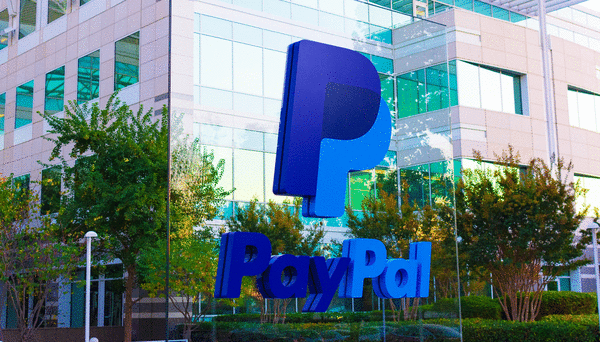
In 2020 San Jose financial technology giant PayPal proudly announced it would spend a half a billion dollars to support Black and minority businesses and communities because, in the words of then-CEO Dan Schulman, “Black lives matter.”
On Tuesday, the company agreed to a $30 million settlement with the federal government to resolve claims that the $500 million Economic Opportunity Fund was discriminatory.
The U.S. Department of Justice said Tuesday that the fund “gave a preference to businesses based on race, color, and national origin,” but was not implemented to address “any specific instances” of discrimination.
“This Department of Justice is delivering on President Trump’s vow to root out illegal DEI from every corner of corporate America,” said acting U.S. Attorney General Todd Blanche. “American corporations are on notice: you will face our aggressive enforcement if you use race or national origin to discriminate against qualified Americans.”
The government’s contention that DEI is by nature discriminatory relies on the concept of “reverse discrimination,” in which dominant groups are seen as victims of racism, said University of California-Santa Cruz lecturer Nolan Higdon, who studies the technology industry and U.S. culture and politics. Higdon rejects the concept.
“To be able to be racist you have to have the power over other people,” Higdon said. “People of color don’t have power over other people in the United States.”
The Justice Department noted the Equal Credit Opportunity Act prohibits creditors from discriminating against applicants “on the basis of race, color, religion, national origin, sex, marital status, age” and other protected characteristics.
PayPal in agreeing to the settlement admitted no liability in connection with the fund, the settlement agreement said. The federal government in the agreement said it had not found PayPal’s fund violated any laws, including the Equal Credit Opportunity Act.
When PayPal announced the fund in 2020, it said it would put $500 million into supporting businesses owned by Black people and under-represented minorities, including through direct investments in Black- and minority-led startups and minority-focused investment funds.
“For far too long, Black people in America have faced deep-seated injustice and systemic economic inequality,” Schulman said in the announcement. “Black lives matter and we need to drive transformative change. We must take decisive action to close the racial wealth gap that sustains this profound inequity.”
Schulman stepped down as PayPal CEO in 2023 and Enrique Lores is now its chief executive.
Under the agreement announced Tuesday, PayPal will create a new program called the Small Business Initiative that will waive $30 million in fees on about $1 billion in financial transactions by U.S. small businesses engaged in farming, manufacturing, technology, or other industries if the business is certified as veteran-owned. The agreement specifically mentions that artificial intelligence enterprises are included among eligible technology companies.
“For more than two decades, PayPal has helped small businesses start, scale, and thrive by expanding access to digital financial tools,” PayPal said in a statement. “We’re excited to launch the Small Business Initiative to infuse American small businesses with even more economic opportunity.”
The company said the Economic Opportunity Fund “was a one-time initiative, under a previous leadership team, with investment selection made at least five years ago,” but added that it maintains its 19 investments made by the fund in minority-led venture capital firms.
The settlement comes as the administration of President Donald Trump in his second term has targeted businesses and universities over DEI initiatives it claims are discriminatory and research it has labeled DEI.
Last month, New York-based IBM agreed to pay $17 million in a settlement with the Justice Department to resolve claims by the department that it took race and sex into account during hiring and promotions. IBM, in settling, denied the allegations.
Bay Area technology giants that have provided public support to President Donald Trump by donating money to his 2025 inauguration and new White House ballroom have publicly pulled back from DEI.
Just after Trump took office, Google scrapped its diversity hiring goals. Annual reports by Mountain View digital advertising titan Google’s parent firm Alphabet since the start of Trump’s second term cut references to DEI, after saying from 2021 to 2024 that the company was “committed to making diversity, equity, and inclusion part of everything we do and to growing a workforce that is representative of the users we serve.” The words “racial equity” disappeared from Google’s “Belonging” web page around the time Trump took office in 2025.
Last week, a judge approved a $50 million settlement in a 2022 lawsuit accusing Google of paying Black workers lower wages, denying them advancement opportunities and subjecting them to a hostile work environment. In settling the lawsuit, Google denied improperly treating Black workers.
Facebook parent Meta of Menlo Park in early 2025 did away with its major DEI programs, including those involved with hiring, training and the selection of suppliers, Axios reported.
PayPal, in its annual reports filed since Trump took office in 2025, has continued to report its workforce gender and ethnic diversity percentages, but dropped language about “fostering diversity, inclusion, equity, and belonging.”
UC Santa Cruz’s Higdon noted that many Silicon Valley companies are vulnerable to federal government policies and actions on regulation, taxation and contracting. PayPal on its website says nearly 200 federal agencies, including the IRS and U.S. Postal Service, accept its service for payments. As a digital-payments application, PayPal is regulated by the federal Consumer Financial Protection Bureau.
Silicon Valley companies began embracing DEI last decade because their own analysis found their workforces lacked racial and gender diversity, while reports began emerging that showed “very unpleasant experiences” for women and minority employees, and academic research found that “diversity actually leads to better business outcomes,” said Ann Skeet, senior director of leadership ethics at Santa Clara University’s Markkula Center for Applied Ethics.
Higdon sees Silicon Valley firms’ past public support for DEI as largely “woke-washing” that caters to the public sentiment of the moment, and doesn’t resonate with working class Americans who have seen wages stagnating since the 1970s, and opportunities for people of color not matching the talk from corporate offices.
“When Trump says he’s getting rid of that stuff, that really appeals to working class people,” Higdon said.
The Justice Department’s statement that the PayPal settlement delivered on “President Trump’s vow to root out illegal DEI” highlights the department’s role under Trump as an arm of the White House rather than as an independent agency, as it has traditionally been seen, Skeet said.
However, race- and gender-based inequalities remain in many areas of society and the economy, Skeet said. While some companies are actually stopping diversity work, many are continuing to pursue it but are changing the way they talk about it, Skeet said. Under a Democratic administration, DEI will likely be back on the table openly, she said.
“This really does feel like political theater to some degree,” Skeet said.
©2026 MediaNews Group, Inc. Visit at mercurynews.com. Distributed by Tribune Content Agency, LLC.








Comments