Youth fishing is catching on again in Minnesota
Published in Outdoors
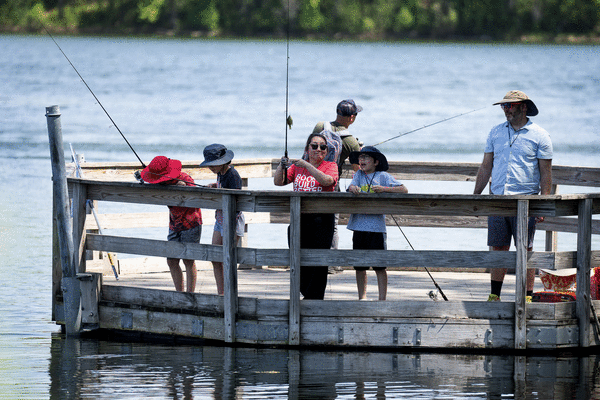
MINNEAPOLIS — More Minnesota young people are fishing the state’s lakes and rivers.
Considering the post-pandemic drop in license sales to young anglers — and overall — the uptick is positive news and an encouraging sign as the 2026 season opens.
About 111,000 licenses were bought by people ages 16 to 20 in 2025, an increase of more than 15% from 2023, according to Department of Natural Resources sales data.
The pieces are in place on the active state fishing scene that could make the uptick sustainable. There are fishing hatcheries of a different sort that are thriving, from school bass leagues to community outreach events and how-to programs in park systems.
Keep it up, said Garry Leaf, a board member for MN-FISH, a state advocacy organization.
Continuing to create those opportunities is critical to maintaining youth fishing’s gains, Leaf and other fishing supporters said. License sales in that age range were in decline after the pandemic.
“Let’s double down [on opportunities],” he added, “because those kids are going to have an effect on other kids."
National data about youth exposure to the outdoors shows that kids who fish are more likely to continue into adulthood. Eighty-five percent of current anglers fished before the age of 12, according to a report by the Outdoor Foundation and the Recreational Fishing and Boating Foundation in 2025. Participation fell sharply once people turned 18, “making families with young children one key to growing future participation,” researchers said.
Competitive boost
Many young Minnesotans — including some in middle school — now have options to test their skills through school competition. Like trapshooting and mountain biking, bass fishing is a nontraditional sport with momentum.
Bass fishing leagues are more popular than ever. Minnesota Junior BASS Nation, for one, will have about 900 anglers combined this year in its high school opens and junior tournaments for kids entering third through eighth grade.
High schoolers can choose from three leagues of varying sizes: Student Angler Tournament Trail (SATT); Minnesota Junior BASS Nation; or the Student Angler Federation (SAF). All funnel toward their own state championships. Some go on to nationals.
SATT holds seven events per year, run virtually using the Fishing Chaos app. SAF holds a single, live weigh-in tournament. BASS Nation has 10 conferences, each with four to six schools. Depending on the year, each conference might have 25 to 40 teams, each consisting of two anglers and a boat captain.
“Youth tournament bass fishing is only growing,” said Andy Boyum, president of the Minnesota Youth Fishing Organization (MNYFO). He also will run tournaments, new this year, for middle schoolers. The MNYFO is the umbrella group for the Junior Angler Tournament Trail, which will have 60 teams.
Derick Doberstein has seen the spike up close. Rogers High School, where he teaches, had four BASS Nation teams in a field of 36 teams at the state championship in 2015.
“Now we run 10 conferences that are all averaging probably three to 35 boats,” said Doberstein, who now is BASS Nation tournament director. Six of the 10 conferences are in the metro area.
Tournaments present logistical challenges. There are permits to acquire from the DNR. Organizers are wary of their impact on the fishery or the drivetime and amount of parking for competitors. Most of the fishing is on the weekdays, to tamp down the pressure and overlap with the public, too. The events are capped at 40 boats.
“We try to strike a balance where we try to keep it local and friendly, but ... we want to also be slightly competitive,” he added.
Blasting off from the dock, landing a big fish — they add a rush that “just going out on the weekend maybe doesn’t have,” Doberstein said.
“The reality is [kids] need that little extra something on it.”
‘Busier than ever’
Nonprofits and local organizations that do outreach to newcomers act as feeder systems of sorts, making them significant players in fishing’s future.
Kids younger than 12, and their families, are Ray Ruiz’s target audience. His nonprofit, Baztec Fishing & Outdoors, teaches the basics of tying knots and casting. It also keeps the barrier low: Everything is free. His partners include conservation groups, local government and service organizations.
“We are busier than ever,” the former DNR fishing skills educator said.
Baztec is adding upward of five youth-oriented events a year and will host 40 to 50 events this spring and summer, Ruiz said. Last year, the organization took more than 2,100 families out fishing and also supported Urban Ice Anglers’ 10K Ice Anglers Project — to introduce 10,000 kids to the sport.
Ruiz said some parents are taking responsibility to find fun programs outdoors to limit indoor screen time.
“We see multigenerational families … kids, parents, grandparents,” Ruiz said, adding that communities of color are especially represented.
Some of those adults already have shared fishing experiences with the children and other family members and are looking to deepen kids’ appreciation of the sport, too, Ruiz said.
“This is what the [license sale figures] don’t show,” he added.
Plus, the DNR has given Baztec a handy tool and talking point. The agency now publishes its fishing regulation books in four other languages besides English: Hmong, Karen, Somali and Spanish.
State of fishing
The DNR attracts rookie anglers to its “I Can Fish!” program for ages 5 to 17. There are 24 programs overall at various state parks, beginning in early June and running through mid-August.
In addition, most state parks allow fishing without a license. Some also loan free rods and tackle. The agency also operates Fishing in the Neighborhood, a foundational program anchored in the metro. Its specialists manage and stock 70 small lakes and ponds. Many have piers.
“Those programs definitely have seen a rise and seen folks take advantage,” said Paul Vang, DNR education and skills team supervisor in the agency’s fish and wildlife division.
Many Minnesota kids have a natural interest in getting active outdoors, Doberstein said. BASS Nation, like the others, has created the alchemy of fun, accessibility and structure to activate that inherent desire.
“I think there’s always going to be a [fishing] future here in Minnesota as long as we can protect our waters and protect our lands and make sure that kids have access to it,” he added. “Competitive angling is just a way to add that little bit of spice. Maybe that’s what it takes.”
©2026 The Minnesota Star Tribune. Visit startribune.com. Distributed by Tribune Content Agency, LLC





Comments