Detroit Auto Show's 'prove-it' year: More hybrids, gas, experiences
Published in Business News

DETROIT — The Detroit Auto Show is not quite the wild spectacle it once was — gone are the flashy vehicle reveals that involved shattering a glass window or herding cattle, no longer is there the crush of 5,000 global journalists or public attendance figures that sometimes approached 1 million people.
But organizers believe the Huntington Place event that starts this week and runs through Jan. 25 — for the second year back in its traditional winter time slot — is ready to get some swagger back in the age of social media and splintered attention spans.
The show aims to be a little more experiential now, a little more festival-like, as it seeks to encapsulate a wider slice of the city's auto story and gin up more shareable content.
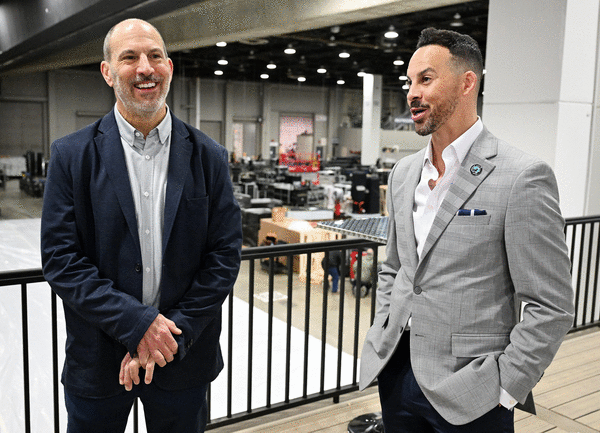
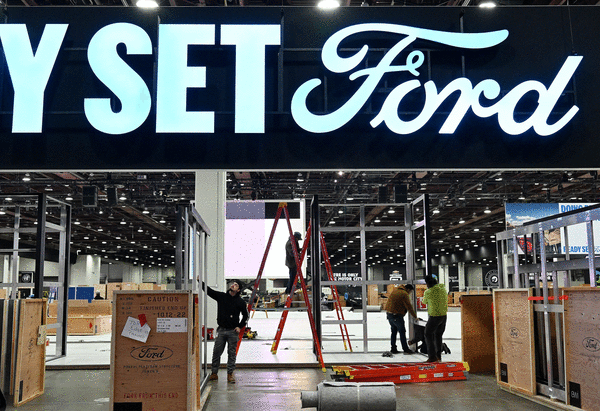
"It's a whole ecosystem that's tied directly into the things that are built here in Detroit," said Sam Klemet, the executive director of the show as well as the Detroit Auto Dealers Association, in a recent interview inside Huntington as workers built stages and displays around him.
The ecosystem includes expansive indoor tracks for test rides, a new area dedicated to overlanding, a Jumbotron showing live interviews, and a couple of "chalets" with rooftop decks offering bird's-eye views of the show floor. It has a gallery of ultra-luxury cars, a zone for young people to explore automotive careers, chances to see Detroit Grand Prix race car drivers, musical performances, and several high-profile political speakers.
Organizers hired a special "experience architect" this year to help curate the show's vibe, and there is a big focus on content creation — for sharing during the show and throughout the year.
"The show needs to live beyond the 10 days, the two weeks that we're here in Huntington Place," said Todd Szott, chair of this year's show and co-owner of several Oakland County dealerships. He noted that organizers were inspired by trips over the past year to other prominent shows, such as those in Los Angeles and Munich.
Szott said the event can now "provide value not only in bringing industry and consumers in to see what's new in the automotive space, but also continue to do that for people who maybe couldn't make it to the show or didn't see particular things."
There will be plenty of new cars to see and sit inside — 27 brands are participating, five more than last year's event. Automakers with corporate displays for 2026 are General Motors Co., Ford Motor Co., Stellantis NV, Toyota Motor Corp., Kia Corp. as well as a new addition, Subaru Corp.
And attendees will be able to view dealer-supported vehicle displays from brands including Aston Martin, Audi, Ferrari, Honda, Hyundai, INEOS, Jaguar, Land Rover, Mercedes, Mini, Polestar and Volkswagen. Add in several exotic, ultra-luxury makes displayed in "The Gallery" section of the show, which were curated both from dealers and private collections, and the show's total brand count tops 40.
With automakers pulling back from high-profile, pricey auto show appearances in recent years, Klemet said Subaru's decision to offer a corporate-sponsored display for the first time since 2022 shows the company believes in the Detroit event's vision.
"But I think we need to prove ourselves a little bit," he said. "And I think this is very much a prove-it show, and so we're up for that."
For the Detroit Three, the Detroit Auto Show — formerly the North American International Auto Show — remains a big deal. Ford labels it "Super Bowl week for autos," and the automaker recently argued against CEO Jim Farley attending a congressional hearing in Washington, D.C., this week because of the scheduling conflict.
Ford is the only automaker this year expected to do a vehicle reveal as it makes news about its Bronco SUV and discusses other aspects of its off-road lineup. It will also have a series of other models on display, from special 2026 Mustangs to refreshed SUVs and pickups, along with its Bronco off-roading area.
GM and Stellantis will also have executives in attendance and big displays of their new models. More than in the past few years, attendees can expect the automakers to be promoting hybrids and gas-powered vehicles amid the industry's broad pullback on EVs.
At last year's show, GM emphasized its EV portfolio, although it still showed off its money-making gas-powered models. This year, the company plans a showcase of nearly 50 vehicles from Chevrolet, Buick, GMC and Cadillac to highlight its “breadth of product offerings,” spokesperson Genna Young said.
It will also feature a Cadillac F1 car to promote the brand's entrance into the sport, plus a technology display showing how EV drivers can use their vehicles to power their homes during electricity outages.
Stellantis is in the midst of launching several new vehicles that will be available for viewing on the floor — including the new hybrid Jeep Cherokee and electric Recon SUV models, gas-powered Dodge Charger muscle cars, the beefy new $100,000 Ram 1500 SRT TRX pickup, which is making its public debut, and an off-roading concept version of the Chrysler Pacifica minivan.
The automaker will have its Camp Jeep area, which includes an off-roading test track, and a few special edition vehicles celebrating the nation's 250th anniversary.
Toyota said it will have 26 vehicles displayed and will headline its exhibit with the updated 2026 RAV4 small SUV. Several members of the Corolla car family will be shown, including the souped-up GR Corolla, as will the GR86 sports coupe.
"The auto show is working really hard to at least maintain variety on the floor, but automaker support isn't there for a lot of brands, and I think that makes a difference in the experience," said Stephanie Brinley, an auto analyst with S&P Global Mobility who has attended more than 30 Detroit shows over the years.
Still, she said the show's organizers are taking creative steps with consumer engagement, and there will be no shortage of things to do for attendees. And auto shows like Detroit remain incredibly helpful for car shoppers, she said.
"It's still the place you can see the most brands and most number of vehicles without the hassle of going to a dealership," Brinley said.
Last year, organizers said 275,000 people attended the auto show. The event had an estimated economic impact of $370 million. Klemet said there's room for attendance growth this year, especially given that 30% of attendees last year were first-timers, and as organizers have sought to build relationships with new audiences, like car clubs. Szott said he also foresees growth as the show gets "back into that January rhythm."
Previously, there was "a cadence in this town where we got through the holiday, let's turn to the auto show," he said. "You kind of expected it. I think after last year, a lot more people were ready and expected a show here in January, and we signed a deal to do it for a few years."
The Detroit Auto Show has long reflected broader trends in the industry. In 2022, for instance, then-President Joe Biden visited to promote American electric vehicle manufacturing and charging infrastructure, sitting in several vehicles and driving the electric Cadillac Lyriq. Prior years had seen a focus on other types of mobility, such as electric scooters and vehicles equipped for autonomous vehicle testing.
This past year has been marked by an industrywide EV reset spurred by a looser regulatory environment under the Trump administration. President Donald Trump himself is scheduled to be in town Tuesday, just as the auto show kicks off, to give an address focused on the economy and bringing manufacturing back to the United States. He's also scheduled to tour a Ford factory.
At the show, these dramatic policy shifts will no doubt mean more focus on hybrids and beefy gas-powered pickups and SUVs on the floor. Also, last year, one of the indoor tracks was purely devoted to EV rides, but this year, manufacturers will be driving both hybrids and gas-powered vehicles on it.
"I think this year is going to be a lot about hybrids, kind of that interim step — taking maybe half a step back (from EVs), getting people more comfortable with electrified vehicles through hybrids," Szott said.
Conversations on the show sidelines, meanwhile, are sure to center on those various policy changes, the supply chain overhaul the industry saw over the past year amid higher tariffs, and a pending renegotiation of the United States-Mexico-Canada trade agreement. Among the politicos scheduled to speak at the show: Gov. Gretchen Whitmer, former Transportation Secretary Pete Buttigieg and Ohio Sen. Bernie Moreno, a former car dealer who often weighs in on the industry's issues.
"You're going to have that open discussion about where the industry is going," Szott said.
Ram CEO Tim Kuniskis said in a recent interview that for many automakers, dramatic auto show car reveals that used to be so common at the Detroit event don't make much sense anymore. It's more effective for a brand to do its own event or reveal nowadays, where it can generate a buzzy video, as Ram did with its recent TRX truck launch.
"I can cut it up, I can put it on social, I can put it longform on YouTube, and then it lives on," he said.
Yet having a presence at auto shows remains important, Kuniskis said.
"We want to be at the right auto shows," he said. "We want to have our product there. We want customers to be able to look, see, touch, feel, get in them. There's nothing — yet — in the virtual space that can recreate that feeling of getting in, feeling it, smelling the leather. You can't recreate that."
_____
Staff Writers Breana Noble and Summer Ballentine contributed.
_____
©2026 The Detroit News. Visit detroitnews.com. Distributed by Tribune Content Agency, LLC.








Comments