Huawei's sweeping US criminal trial kicks off in Brooklyn
Published in Business News
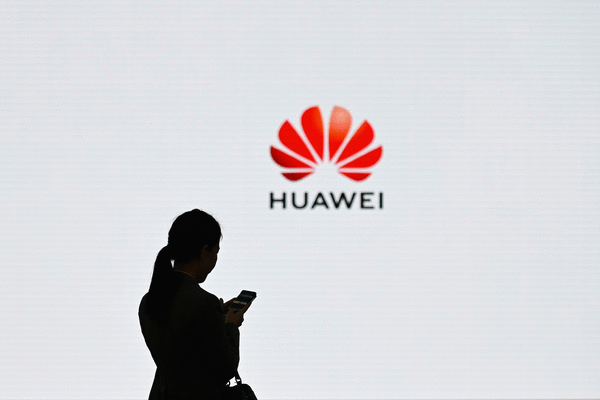
Huawei Technologies Co. is finally on trial in New York in a criminal case brought during the first Trump administration that’s among the most ambitious prosecutions the U.S. government has ever pursued against a Chinese company.
The showdown kicked off Wednesday with opening statements and is set to play out for months in federal court in Brooklyn.
It comes eight years after the Justice Department first filed charges against the world’s largest maker of telecommunications equipment. For most of that time, the company has been largely excluded from the American market under trade measures imposed by the Trump and Biden administrations in the name of national security.
In the criminal case, Huawei is accused of defrauding international banks, including HSBC Holdings Plc and Citigroup Inc., related to alleged violations of U.S. trade sanctions on Iran and North Korea. It’s also charged under a federal statute that is often used to target organized crime conspiracies with scheming to steal intellectual property from six American technology companies, as well as money laundering and obstructing justice.
Taylor Stout, a Justice Department lawyer, told jurors “crime was an important business strategy” for the company.
“Theft, lies, corruption, for 20 years, that’s how Huawei — a massive Chinese telecom company — victimized American companies and abused the American financial system all in an effort to dominate the telecommunications industry around the world,” Stout said.
Huawei is a crown jewel in China’s tech industry and seen as central to Beijing’s artificial intelligence ambitions as the world’s second-largest economy seeks to wean itself off American-designed hardware.
Huawei’s lawyer, Brian Heberlig, argued the government’s case is based on “cherry-picked” allegations that company attorneys will refute during the trial. He said the U.S. case targets “a few isolated instances over 20 years.” He insisted that banks knew Huawei was doing business with Iran and had even competed for its business.
“There’s no blueprint for crime, just an investment strategy,” Heberlig said.
Washington summit
The trial is getting under way as a Sept. 24 summit looms in Washington between U.S. President Donald Trump and China’s president, Xi Jinping. The two met in Beijing earlier this year and a trade truce between the countries is scheduled to expire in November. The Chinese embassy in Washington didn’t respond to requests for comment.
Prosecutors said in a filing last week that to “streamline” the trial they will not proceed with two of four counts relating to alleged violations of trade sanctions. Still, lawyers said in court Tuesday during jury selection that the trial — with a total of 12 counts in play — may run into December.
A conviction for Huawei would be another public relations hit, but it’s unclear how much the case will affect the bottom line for the company, which reported net income of 23.81 billion yuan ($3.54 billion) in the first half of this year.
RICO penalties
The U.S. has not specified the scope of penalties it might seek. The Racketeer Influenced and Corrupt Organizations Act, or RICO, carries maximum fines for companies of $500,000 per violation, but also allows prosecutors to seek twice the amount of any ill-gotten proceeds from a racketeering scheme.
“Huawei is an extraordinarily well-financed company now,” said Jonathan Liebenau, a professor at the London School of Economics who has closely studied the company. “It’d have to be a very large fine to make an impact.”
Trump has for years taken aim at Huawei in a broad rhetorical attack on Chinese companies.
The criminal case was publicly unveiled in early 2019 under the Trump administration’s so-called China Initiative, a Justice Department program to combat Chinese espionage and influence in the U.S. Prosecutors have since won numerous convictions against Chinese nationals, but have struggled in trials against large Chinese companies on American soil.
From the beginning, the Huawei case heightened tensions between Washington and Beijing while the world’s two largest economies were mired in a trade war. Months later, Trump officials labeled the Shenzhen-based company a national security threat, alleging that it sold telecommunications equipment that could be used by China’s Communist Party for spying.
US blacklist
Huawei denied those claims but remains on a U.S. blacklist that bars American firms from selling their products to the company without special government approval.
The initial criminal indictment set off a diplomatic crisis when Huawei Chief Financial Officer Meng Wanzhou, whose father founded the company, was arrested at the behest of the U.S. on financial fraud charges while she was traveling through Canada.
Almost three years after she was placed under house arrest in Vancouver, Meng reached an agreement with the Biden administration that allowed her to return to China in 2021.
In June, U.S. District Judge Ann Donnelly ruled that prosecutors can tell jurors that Meng said in her deferred prosecution agreement that the company illegally conducted business in Iran and lied to HSBC about its sanctions compliance. HSBC and Citigroup have not been accused of wrongdoing in the case and declined to comment.
The U.S. has turbo-powered the case by relying on RICO. Sometimes called “conspiracy on steroids” by legal experts, the law allows the government to introduce a greater body of evidence and have wider latitude in seeking to forfeit assets if the jury returns a guilty verdict.
The RICO charge that was added to the case in 2020 alleged that Huawei engaged in a pattern of misappropriating intellectual property from U.S. tech companies to gain a competitive advantage and grow its business.
Trial delayed
The case was delayed getting to trial for years by the Covid pandemic, which made it difficult for lawyers and witnesses to travel.
There has also been intrigue along the way: In 2022, two Chinese intelligence officers were accused of trying to bribe a U.S. law enforcement official with $61,000 in Bitcoin to steal evidence and get inside information about the Huawei case in Brooklyn.
The U.S. said at the time it believed both men were residing in China and were acting on behalf of the Chinese government — a claim that Chinese officials have denied.
The case is USA v. Huawei Technologies Co., 18-cr-00457, U.S. District Court, Eastern District of New York (Brooklyn).
(With assistance from Dong Lyu.)
©2026 Bloomberg L.P. Visit bloomberg.com. Distributed by Tribune Content Agency, LLC.







Comments