China's ascendant auto industry: How top Detroit 3 execs are responding
Published in Business News
DETROIT — From robot-heavy factories to using artificial intelligence to design cars, automakers are speeding to catch up with China's lightning-fast development of low-price vehicles as the manufacturing giant's vehicle production grows rapidly and globally.
Experts at the Automotive News Congress in Detroit last week warned of China's creeping dominance in Europe, Africa, South America and now Canada and Mexico — cutting into business once enjoyed by U.S. automakers and threatening to push Ford Motor Co., General Motors Co. and Stellantis NV from the global stage.
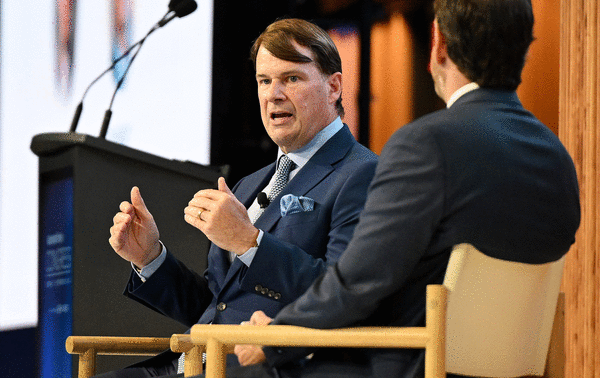
"I would say we're America's car company, but we do most of our business outside of the U.S.," said Ford CEO Jim Farley to a crowd of top industry decision-makers on Sept. 29. "And the competitive threat from China really requires a complete reinvention."
If Chinese automakers are allowed into the United States, Mobility Global analysts have predicted those companies could claim 11% of the market by 2038 — squeezing already slim profit margins for legacy makers. While bipartisan members of Congress push to ban the sale and production of Chinese cars in the United States, the leaders of the Detroit Three automakers recognize that won't shield them from competition.
Elected officials and industry leaders have raised concerns about China gaining near-monopoly status in the global auto industry. Because of the overlap in manufacturing and technology breakthroughs between vehicles and defense equipment such as drones, that could pave the way for Chinese military dominance as well.
"Our future defense of our country and our industrial base of our country depends on how we feather this just right so we do not isolate competition, but we also create a fair playing field," Farley said.
But unlike China's decades-long EV strategy, including government subsidies, U.S. automakers have largely been left to face Chinese competition on their own.
Automotive venture capitalist Steve Greenfield said U.S. companies have less incentive to invest in EVs, which are performing poorly in the United States but are still expected to lead global auto sales in the future.
"How do I cater to shareholders who want me to deliver quarterly results when my competition is playing an entirely different game and has the luxury of looking at very long timelines and applying tremendous pressure towards achieving those goals?" said Greenfield of Automotive Ventures.
"An automaker that's public that's catering to that quarterly pressure is not going to be able to think long term and say, OK, what would I do if I was given this gift where I can harvest cash flows in the short term to make big strategic bets that might be able to leapfrog the Chinese?" he later added. "My fear is that we aren't positioning the domestic automakers to be able to make those bets."
Ford's approach
Farley has proposed mimicking China's joint-venture model and allowing Chinese automakers to partner with U.S. companies to build and sell in the United States, providing a window into China's speed, technology and manufacturing techniques.
Under Farley, Ford has adopted technology licensing with Contemporary Amperex Technology Co. Limited, or CATL, at its Marshall, Michigan, battery plant and entered into a joint venture with Geely Automobile Holdings at a factory in Europe.
"What we're trying to do is pick just the right things where we can compete on our own," Farley said at the Automotive News Congress. "We're not delegating our future to someone else, but we're also learning from them."
Farley, who took the helm at Ford in 2020, said he approved the automaker's "skunkworks" EV engineering team after comparing the 75-pound electrical wiring infrastructure in the Mustang Mach-E to the 30-pound wiring harness in the Tesla Model Y.
The small group of engineers was tasked with comparing Chinese BYD Co. batteries to CATL cells made at Ford's Marshall battery plant. Farley said using BYD batteries was expected to be at least 20% cheaper.
"Our team looked at that 20% and said, why don't we benchmark their gearboxes and rotors and motors?" Farley said. "We found that they were actually, in the end, 20% less efficient because the batteries were so cheap. They didn't need to make a breakthrough in efficiency of the electromagnetic powertrain.
"We totally innovated the way we did all those three components, and now we use 20% less battery than BYD does," Farley added. "And so our cost is about the same, even though the (BYD) battery is 20% cheaper, because we use that much less battery than them."
"That's one of many hundreds of examples, actually, of what the (Universal) EV team did to compete with China," he said. The first offering from the team is the $30,000 Fathom midsize electric truck that's scheduled to go on sale next year.
To make the vehicle, Ford is investing $2 billion into the Louisville Assembly Plant to create the new Ford Universal EV Production System, a manufacturing process that more resembles a tree than a single assembly line by bringing together three sub-assemblies and reducing parts by 20%.
Farley said the plant will lean on robots to cut costs, which some auto analysts say is necessary to compete with the low price tags on Chinese vehicles.
"In a lot of Chinese OEM factories that are heavily robotic, (it's) nothing like we're going to see in Louisville," Farley said.
GM's EV strategy
GM President Mark Reuss repeated the Detroit automaker's commitment to EVs despite sluggish U.S. sales. Executives have said the company will continue investing in cheaper battery tech in hopes of offering lower-cost models once the vehicles become popular in the United States.
"We're maybe a little slower on EVs, for instance," Reuss said about the U.S. market. "That's OK, but the whole world is moving that way, and so we invested in the platforms that are EV platforms. They're not (internal combustion engine) platforms, and so our reinvestments in EV will be different than just model changes. They'll be core investments into the architecture to get profitability and scale with EVs for the long run."
He cited vertical integration as one way GM is working to provide more tech without raising prices, a huge advantage among Chinese automakers.
"Whether it's castings for defense or bringing those investments and new technologies into our cars to manufacture them, whatever those are, we've got to be better than anybody else, and we've got to have proprietary technology and engineering to do it," Reuss said.
One example: GM is using AI to speed vehicle development.
Reuss said GM's partnerships with dealers and its reputation with customers give it a competitive advantage over new Chinese companies.
"You can't go in and buy a Chevrolet set of franchises in South America," Reuss said. "You can't buy customer loyalty that’s earned over 100 years. You can't buy the relationship we have with dealers ourselves. You can't buy the service and the loyalty that brings over a long period of time in our product cycle. So those are things that we really invest in."
GM is also one of the shrinking number of non-Chinese automakers selling vehicles in China's competitive market, giving the Detroit automaker a window into the country's manufacturers.
“We need to be able to look at what they’re producing (and) understand it thoroughly," Reuss said. "We aren't going to be able to compete with subsidies, but we can compete on technology, engineering and delivering value to what the customers really want."
Stellantis leans into partnerships
Stellantis is already struggling to implement a sweeping turnaround after losing $26.3 billion (22.3 billion euro) last year. Faced with greater competition from China on top of that, new CEO Antonio Filosa said the transatlantic automaker teamed up with Chinese companies Leapmotor and Dongfeng.
"The way we are catching up in Europe is we do a lot ourselves, but we are launching a very, very competitive new platform, STLA One, with (the) Chinese," Filosa said. "We know our STLA One platform is really competitive, the best competitor in the market. It will come first in Europe, then we will also implement for some cars here in the U.S."
The STLA One platform is a flexible, modular design focused on simplifying vehicle development across more than 30 models globally by 2035. The next-generation Jeep Cherokee will be the first U.S. vehicle assembled on the new platform.
Whatever path U.S. automakers take, Greenfield said big changes are a must: "The automakers have to be bold, and some of them may not survive this globally. I know that's horrible. I think it's true."
©2026 www.detroitnews.com. Visit at detroitnews.com. Distributed by Tribune Content Agency, LLC.










Comments