The US bets on her, but can Venezuela's new boss deliver? Her life might depend on it
Published in News & Features
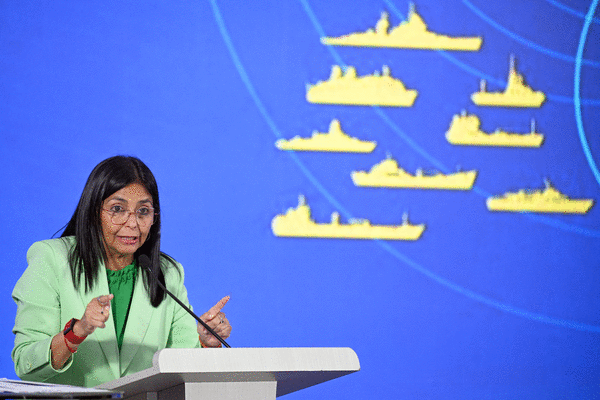
When the Trump administration signaled its willingness to work with Delcy Rodríguez as the face of a Venezuelan transition, the calculation appeared coldly pragmatic.
Rodríguez, a seasoned survivor of the regime’s internal purges, seemed to offer Washington what it urgently needed after the capture of Nicolás Maduro: continuity without chaos. The assumption was that the Venezuelan vice president could pivot her country toward the United States while keeping the regime’s most dangerous factions in check.
But according to multiple sources with direct knowledge of the post-raid landscape, that assumption rests on dangerously fragile ground. Far from consolidating power, Rodríguez finds herself encircled by hard-liners, radicalized security forces and a splintering military apparatus. In that environment, she may be less a transitional leader than a figure racing against time to avoid being overthrown by the very system she helped build.
Rodríguez was sworn in Monday as Venezuela’s interim president in the presence of her brother, Jorge Rodríguez, the Chavista leader of the National Assembly, as the legislature inaugurated a new session.
A presidency with no boots on the ground
In the immediate aftermath, Rodríguez emerged as the nominal head of a transitional arrangement. But sources stress that she is not president in any meaningful sense. The real authority behind the transition, they argue, is Washington itself.
Her path to survival, those sources say, is brutally simple — and potentially politically suicidal: She must either remove or otherwise neutralize Defense Minister Vladimir Padrino López and Interior Minister Diosdado Cabello, the two men who control the country’s military and security forces.
While Rodríguez and her brother have climbed to the top of Venezuela’s political hierarchy, they are not the ones holding the guns.
U.S. pressure could soon force her hand. According to sources, Washington may demand that Rodríguez facilitate the arrest or surrender of Padrino and Cabello to accompany Maduro, who appeared before a New York judge Monday to hear drug trafficking charges. Both men have been indicted in the U.S., along with Maduro, for allegedly running the so-called Cartel de los Soles and turning Venezuela into a narco-trafficking state.
The U.S. is currently offering a $25 million reward for Cabello’s capture and $15 million for Padrino López.
The pressure is backed by force. President Donald Trump and Secretary of State Marco Rubio have publicly signaled that the U.S. is prepared to launch additional strikes similar to the predawn raid that captured Maduro and his wife, Cilia Flores.
“The general assumption is that Rodríguez could be next,” one Venezuela-based source told the Miami Herald. “But being told to hand over Padrino and Cabello — that’s a very tall order.”
Complying would amount to one of the greatest internal betrayals in the history of the Chavista revolution founded by former leader Hugo Chávez: delivering two of its founding enforcers to U.S. justice or facilitating their removal. Refusing, another observer said, would put Rodríguez directly in the crosshairs of American intelligence and diplomacy.
“She’s trapped,” the source said. “If she complies, she betrays Chavismo. If she doesn’t, she’s finished.”
A shadow war inside Chavismo
Among the two men Rodríguez is expected to sideline, sources consistently describe Cabello as the more dangerous — and far harder to neutralize.
Unlike Maduro, who lived surrounded by layers of security and ritualized power, Cabello has adapted to survival mode. Sources compare his tactics to those used by guerrilla leaders: sleeping during the day, moving constantly at night, personally managing his routes and security, and never remaining in one place long enough to be targeted.
“Maduro ruled like a king,” one source said. “Diosdado lives like an insurgent.”
Cabello’s strength lies not only in his evasive tactics but in his street-level network. Sources estimate he maintains direct control or influence over roughly 30 highly violent operatives, with access to an additional 220 members of the Venezuelan Honor Guard. Many are drawn from intelligence and police units and view themselves as ideological combatants preparing for a prolonged confrontation.
Their objective, according to sources, is not to defeat the United States outright but to provoke it — drawing U.S. forces into an urban and jungle conflict where casualties could shift American public opinion.
Rodríguez’s dilemma is compounded by the collapse of traditional military command. Since the operation that captured Maduro, numerous generals have effectively disappeared, failing to report to their units or communicate with superiors.
“All of them understand the same thing,” one source said. “Their business model is over. There is no future where they keep their money and work with the Americans.”
Padrino López, the administrator
Defense Minister Padrino López, long portrayed as the armed forces’ strongman, has been increasingly exposed as an administrator rather than a battlefield commander. His power rested on controlling promotions, finances and patronage. With state coffers depleted and U.S. scrutiny intensifying, that leverage has largely evaporated.
Actual firepower, sources say, is controlled by Army Chief Domingo Hernández Lárez, who commands the operational units capable of sustained combat. Whether Hernández Lárez aligns with Rodríguez, Padrino or an anti-transition bloc remains one of the most consequential unanswered questions.
The turmoil has elevated figures who once operated in the shadows. Javier Marcano Tábata, who oversaw the Honor Guard and the military intelligence agency DGCIM, initially emerged as a key node in the new power structure. But in a sign of how rapidly the situation is evolving, Marcano Tábata was replaced Monday night by Gen. Gustavo González López, a former head of the intelligence service SEBIN and a figure widely regarded as a hard-liner.
Control of the Presidential Honor Guard — which oversees the 312th Armored Cavalry Squadron — is critical for anyone seeking to rule Venezuela. According to sources, confronting the unit directly would require the simultaneous deployment of at least four army brigades. The Honor Guard’s armored unit, stationed inside the Fuerte Tiuna military complex in Caracas, is widely regarded as the army’s best equipped formation and is believed to include some of its most highly trained troops.
If the Honor Guard were to align with Diosdado Cabello, any attempt to move against him would likely trigger a civil war.
Washington’s leverage and limits
Rodríguez’s international ties further complicate Washington’s gamble. Sources say she has inherited much of the foreign portfolio once managed by disgraced power broker Tarek El Aissami, particularly links with Iran and leaders in the radical Islamic world.
From Washington’s perspective, sources say, the only tolerable outcome may be transactional compliance: Rodríguez provides intelligence, facilitates arrests or targeted removals, and then exits — retiring with her vast wealth, mostly gotten through corruption and other illicit sources, to a country such as Qatar, where such networks can be discreetly laundered and managed.
Privately, U.S. officials acknowledge the limits of American power. While Washington retains overwhelming air and surveillance superiority — including AWACS aircraft, drones and precision-strike capabilities — ground combat against dispersed insurgents remains costly.
“Fallujah proved that technology doesn’t stop snipers,” one source said, referring to the Iraqi city that proved to be an intense and brutal battleground that led to high casualties for U.S. forces in 2004.
For that reason, U.S. officials prefer that Venezuelans resolve the conflict themselves.
But audio recordings obtained by sources and shared with the Miami Herald suggest Cabello is actively working to prevent that outcome. In the recordings, he speaks of retaliation and national resistance against what he sees as betrayal, reaching out to loyalists in the industrial state of Carabobo, the cattle-producing plains region known as Los Llanos, the oil-producing state of Zulia, and the capital, Caracas.
A transition on borrowed time
Sources inside and outside Venezuela told the Herald there is an 80% chance Rodríguez will ultimately be forced to betray both Padrino and Cabello to secure U.S. intelligence cooperation for surgical operations. Whether she survives that betrayal, they say, is another matter.
For now, the United States appears satisfied with Rodríguez’s cooperation.
Some of this may have been prompted by a swift and dramatic shift in Delcy Rodríguez’s public rhetoric toward the United States. In the span of days, she moved from denouncing Washington in language steeped in anti-imperialist rhetoric, vowing to defend national sovereignty against foreign interference, to issuing far more measured statements that signaled a willingness to work with U.S. authorities.
The White House has taken notice of the change. Speaking Monday in a telephone interview with NBC News, President Donald Trump said Rodríguez is “cooperating” with U.S. officials and appears open to working with Washington.
“I have a feeling she’s cooperating. They need help,” Trump said. “And I have a feeling that Rodríguez loves her country and wants her country to survive.”
_____
©2026 Miami Herald. Visit miamiherald.com. Distributed by Tribune Content Agency, LLC.
Comments