Legislative analyst raises 'serious concerns' about California's fiscal path
Published in News & Features
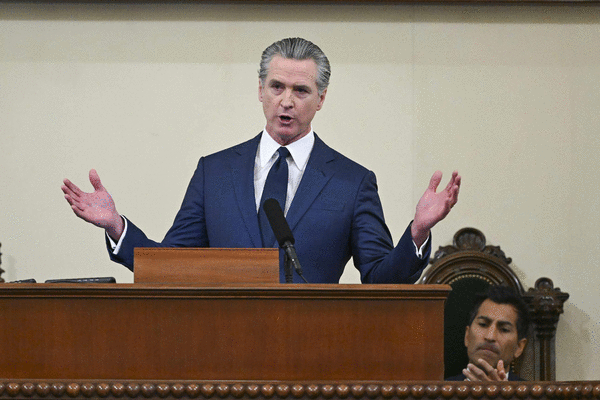
California Gov. Gavin Newsom’s budget proposal would “put the state on precarious footing” because it does not incorporate the significant risk of a stock market downturn plummeting income tax returns, the California Legislature’s independent and nonpartisan fiscal analyst said Monday.
Citing a $30 billion difference between his agency’s estimates of projected revenues and the executive branch’s, Legislative Analyst Gabe Petek said Newsom’s budget runs the risk of huge deficits if tax revenue does drop precipitously. On top of that, Petek wrote that over the last four years the governor and Legislature had plugged $125 billion in budget holes largely without addressing the structural differences between spending and revenue that have led budget deficits to grow over time.
“These trends raise serious concerns about the state’s fiscal sustainability,” Petek wrote in a report responding to Newsom’s budget, which the governor released Friday.
Newsom’s budget includes a $30 billion increase in state spending, that is driven by constitutionally mandated increases in education spending and federal budget cuts. In their budget proposal, the governor and his staff acknowledged both the risk to revenues and the structural deficit.
“However, the Governor’s budget does not include material actions to address either challenge,” Petek wrote.
To guide the state to firmer fiscal ground, Petek suggested lawmakers adopt his office’s gloomier revenue projections, which lead to an $18 billion deficit, as opposed to Newsom’s projected $2.9 billion hole. Petek also urged lawmakers to significantly address the state’s structural deficit, which would take either cutting spending or increasing tax revenues.
That will present a challenge for lawmakers who want to protect programming for the state’s more vulnerable citizens amid deep budget cuts from the federal government, Assembly Budget Committee Chairman Jesse Gabriel, D-Encino, told The Sacramento Bee on Monday.
“A lot of the programs and services we’re talking about support our most vulnerable communities,” Gabriel said. “And so we want to do what we can to protect those programs and services that Californians rely on.”
Gabriel, whose committee will begin hearings next week alongside their senate counterparts, said lawmakers will be seeking a balance between addressing the state’s budget woes and maintaining funding to social services Republicans in control of Washington D.C. have cut back. That balance will be tough to find. The One Big Beautiful Bill Act, Republican’s budget measure, will cost the state $1.4 billion in funding for Medi-Cal, the state Medicaid program, and the CalFresh food assistance program, Newsom’s budget director Joe Stephenshaw said last week.
Lawmakers will kick off their budget-writing process by questioning both the legislative analyst and the governor’s finance staff, Gabriel said. Newsom will introduce a revised budget proposal in May, when the state will have a clearer sense of whether revenues fall off at the start of this year.
Gabriel also acknowledged lawmakers’ responsibility to oversee state spending seriously as well, and would be scrutinizing government programs for wastefulness. “We know people work hard, and we need to spend our tax dollars as efficiently and effectively as possible, and so that is going to be very much top of mind,” he said.
Republican lawmakers have criticized Newsom’s budget as based in accounting gimmicks, and one that does not address meaningful financial problems as the governor is broadly known to be considering a presidential campaign in 2028.
Last year, it was the Legislature that rejected some of Newsom’s proposed cuts in higher education and social services. A June budget agreement between Newsom and legislative leaders largely addressed the deficit by spending out of reserve accounts while also curtailing Medi-Cal enrollment for undocumented immigrants.
Advocacy groups and the various associations of government service providers who lobby the Legislature are likely to press lawmakers not to make reductions at the same time as the federal government. Last week, Graham Knaus, the chief executive of the California State Association of Counties, criticized Newsom’s budget for not responding to the cost burdens shifting to local governments.
“This budget proposal does not in any way acknowledge the impact of (One Big Beautiful Bill Act) on counties and our local communities,” he said in a statement. “If the state doesn’t step up, communities across California will crumble.”
_____
©2026 The Sacramento Bee. Visit sacbee.com. Distributed by Tribune Content Agency, LLC.






Comments