She sued city for destroying her property in a homeless sweep. Can she win?
Published in News & Features
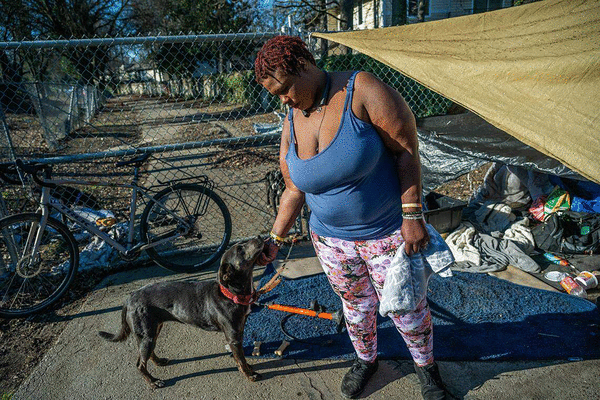
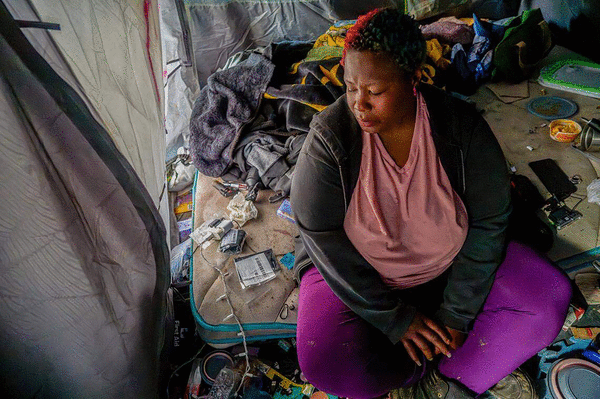
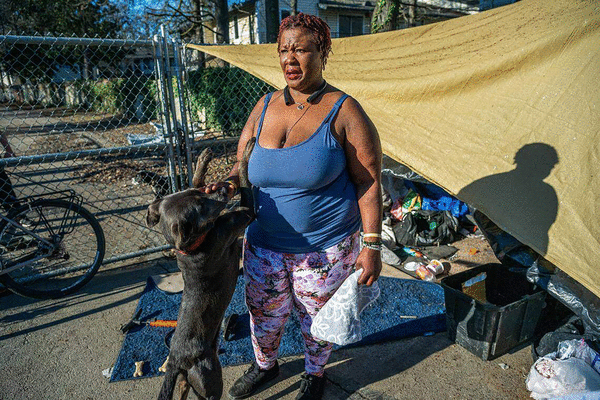



SACRAMENTO, Calif. — Elizabeth Williams could not understand why the city threw away her tent, her laptop and all her medications — twice. Now, the meticulous receipt-saver is suing Sacramento for $12,239.43 in small claims court.
Trashing her belongings, she argued in court filings, was a violation of her Fourth and 14th Amendment rights, constituting an unreasonable search and seizure, and infringing on her right to due process.
Williams, 38, has been homeless for more than a decade. While she doesn’t have enough money to pay for an apartment, she uses her disability benefits to pay for other necessities.
And she kept her receipts.
Williams documented $5,239.43 in lost property and sued for an additional $7,000 for emotional damages. Court filings claim that, because the city threw out her laptop last February – and her replacement laptop in June – she dropped out of the online GED program she had been attending and stopped going to virtual therapy appointments. Her life, she said, unraveled.
After Williams rejected the city’s offer to settle with her before an initial court appearance last month, the case pressed on. Representatives for the city argued in small claims court that officials could not have known the items she had stored in plastic boxes were not garbage. They will argue the case again on Wednesday.
Sacramento Police Department Lieutenant Sameer Sood was one of the people who appeared on behalf of the city in the Feb. 25 hearing. Sood is assigned to the department’s Impact Unit, which responds to certain homelessness calls. He told a judge that police can “absolutely” be liable for damaging a person’s property in the course of law enforcement work.
But with homeless sweeps — in which code enforcement and police often work together to clear encampments and move out the people who live in them — he said, “This area of law enforcement has lots and lots of gray area.”
The Sacramento Police Department’s internal sweeps policy does not mention a gray area. A training bulletin titled “Unlawful Camping Enforcement Guidelines” — submitted to the judge as part of the lawsuit — says that in the event of an arrest, officers should ask the homeless person to identify what should be stored and what is trash. Williams was arrested during both of the sweeps in which she lost her belongings and jailed on charges of storing personal property in public and unlawful camping under the Sacramento City Code.
The guidelines say that “officers shall safeguard personal property” of homeless people. They say that those items fall into three categories: life necessities such as important identification documents and survival gear, other monetarily or intrinsically valuable personal property or “perishable items and trash.” While perishable items and trash will not be stored, the document says, other types of property should be held by the police.
Court records say police did store some of Williams’ items, including her generator in February 2025, but other items they stored seemed far less important than her medications and her laptop, including one power bank, a chest of gemstones, a bike cupholder and a bike light.
In the court filings, Williams made a list of the things that she lost in each sweep.
“The city did not store my medication, IDs, CalFresh card, debit cards, or my laptop,” she said in a declaration about the February 2025 sweep. “The City destroyed my tent, all my clothing, shoes, sleeping bags, bedding, tables, grills and stoves, tables, utensils, charging banks, speakers, power tools, hair clippers, ropes and tie outs, sanitary products like wipes and soap, cameras I use for security, flashlights, and all our charging cords. The city destroyed our food, my dogs’ food, and my dogs’ beds, crates and (dog) strollers.”
In the same declaration, she also detailed some of the more intangible losses.
“The impact of losing everything, of being treated like my property is trash, is really big. It makes me feel as though I am worthless,” Williams said. “The sweep set me back in every possible way. Losing everything means I have to focus on rebuilding a safe place to sleep, rather than following up with my doctors or housing navigator. I don’t even have my ID anymore if I were to get an apartment tomorrow.”
In a second declaration related to the June sweep, she said, “I try so hard to survive and do my best. I was proud of being in school and programs. I was feeling good and hopeful about the future. But that was taken from me. Literally taken from me.”
What happened at hearing?
On Feb. 25, the day of the hearing, the case was assigned to Judge Stephen Lau.
In the courtroom, Lau asked Williams how an officer can differentiate debris from a homeless individual’s personal property. He said to Williams, “If it’s neatly put aside, you think they have an obligation to store it?” She said yes, that’s what she thought. She would understand if they threw out a balled-up tent, for example, but on one of the sweeps, she said they threw away a plastic box labeled “clean clothes.”
In response to a similar question, Sood said “there’s no really black-and-white” when it comes to identifying what objects to store. He explained the three categories of property outlined in the policy document.
Sood also said that officers face a “floating target.” For example, he said, if someone who was not disabled had five wheelchairs, the wheelchairs might be considered debris.
Lau asked what would happen “if the officer mistakenly categorizes something that’s important,” giving the example of a laptop — an item of objective value.
Sood said there was no good answer to the question, but suggested that it was possible a laptop could look broken.
In about four minutes of bodycam footage from a sweep of Williams’ encampment that was played for the courtroom, Williams explained to an officer that her items — arranged next to the sidewalk, with many of the items packed in closed plastic tote boxes — have been moved from where they were when she received the sweep notice. She said that she was waiting for a friend with a pickup truck to move them into her storage unit. One officer says, “It’s not being moved this second.”
After the footage was paused, Sood said that police could be liable for damaging people’s items, but reiterated that sweeps have “lots and lots of gray area.”
Looking at Williams’ things in the bodycam footage, the lieutenant said, “It’s about 75 feet of debris.”
“Of items,” the judge said.
“Of items,” the lieutenant conceded. “I’m sorry, your honor.”
Other homeless people have sued
The city frequently sweeps encampments; as part of those efforts, they may trash some personal belongings of the people who were living there. The Sacramento Bee has previously reported on the destruction of items including IDs, medication, blankets, irreplaceable family photos and a loved one’s ashes.
Public records show that county social services workers have objected to sweeps, indicating that they undermined case workers’ efforts to find people and place them in shelters or housing.
Williams had particularly meticulous records of her belongings and their cost. In one exhibit filed in the case, she included a spreadsheet of all the items that were destroyed by the authorities in February and June. Socks: $12.33. Grill: $16.93. Butane stove: $21.93. Self-heating hand warmers: $11.43. An eight-person tent: $116.36. Doghouses: $417.84. Dog beds: $56.44.
Other than the laptops and charging equipment, most of the items were relatively inexpensive, adding up to $5,239.43.
In a declaration, Williams explained the financial fallout.
“I spend all my (Supplemental Security Income) on repurchasing clothing, tents, sleeping gear, food. Things that I had and were perfectly usable, organized, and clean. I don’t have money to buy a new laptop, get rides to the doctors, and find a way to get back to my therapy. I don’t even know where to start,” Williams said.
There is precedent for homeless people suing the city or county of Sacramento in connection with sweeps. In May 2019, a group of homeless people filed a federal civil rights lawsuit against Sacramento County over an encampment clearing on Stockton Boulevard. As in Williams’ case, attorneys argued that a sweep had violated the plaintiffs’ Fourth Amendment rights protecting them from unreasonable search and seizure, as well as their 14th Amendment right to due process. They also said that deputies had used excessive force, claiming that a deputy broke a woman’s previously injured arm in the sweep.
According to the complaint, “The Sheriff’s Department workers did not use care in handling the individual Plaintiffs’ unabandoned property and treated almost all items as if they were presumptively trash.”
One of the plaintiffs in that case, the document says, lost her medication, her breathing machine and a medical device that she used to treat a bone injury when officials swept the site where she lived. The document says that another plaintiff “watched the Sheriff’s Deputies throw out her items she did not abandon but was unable to carry out at the beginning of the raid without any regard to their apparent condition, utility, and value.”
The county settled that case for $18,500, without acknowledging wrongdoing.
The Bee’s Theresa Clift contributed reporting.
©2026 The Sacramento Bee. Visit sacbee.com. Distributed by Tribune Content Agency, LLC. ©2026 The Sacramento Bee. Visit at sacbee.com. Distributed by Tribune Content Agency, LLC.






Comments