Kentucky lawmakers signal need for more safeguards on Flock cameras
Published in News & Features
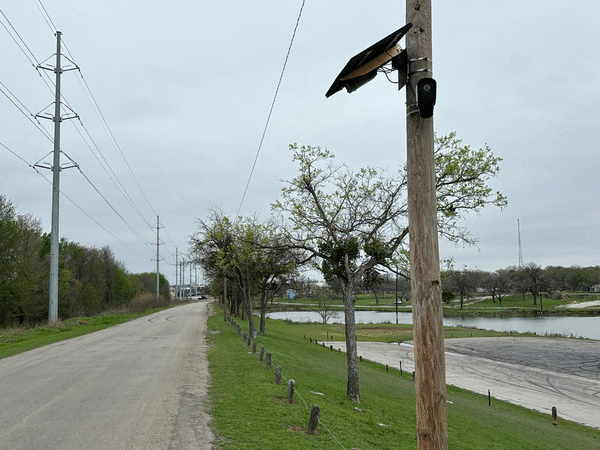
LEXINGTON, Ky. — Several members of a key state legislative committee said Thursday they wanted to see additional safeguards on the use of license plate reader cameras, including requiring a warrant for the data to be accessed.
Other members of the Interim Joint Judiciary Committee said their constituents want the cameras, which are made by companies such as Flock, banned.
The committee discussed the use of automated license plate readers camera and heard testimony from police, a representative of Flock as well as the American Civil Liberties Union and the Cato Institute.
“Overwhelmingly, I am hearing that the very citizens that we serve do not want to be monitored and surveilled in this way,” said Rep. Savannah Maddox, R-Dry Ridge.
Rep. Jennifer Decker, R-Waddy, said her constituents in Shelby County are also opposed to the cameras. It’s the top issue she hears about from constituents.
“As these cameras multiply and as they become more technologically available for being searched, searchable and shareable, people are concerned that we could already be well down the road toward the kind of surveillance state that George Orwell warned about in his dystopian novel in ‘1984’,” Decker said.
Kevin Kane with Flock Safety told the committee Flock has made multiple changes to its system to guard against misuse. The devices only take pictures of license plates and do not use facial recognition, he said. The system now requires a reason for a search but also a case number, he said. In addition, Flock does not share or sell that data to third parties. It’s up to the law enforcement agency to determine what agency it shares that information with.
Elizabethtown Police Chief Jeremy Thompson said the Kentucky Chiefs of Police see Flock cameras as a valuable law enforcement tool. Flock cameras were recently used to identify two suspects in the shooting death of a 16-year-old Louisville girl. The cameras were also recently used to identify and find seven stolen vehicles that were fraudulently obtained from a Lexington car dealership, he said.
Thompson urged legislative leaders to allow law enforcement to continue to use the tool.
“This is almost identical technology as what we utilize to collect tolls on toll bridges,” Thompson said. “I’m telling you in nearly 30 years of law enforcement, this is the best piece of technology to assist law enforcement in real time to help solve crime, to make our citizens safer.”
ACLU, Cato urge legislators to enact more safeguards
Still, officials with the American Civil Liberties Union and the Cato Institute urged the legislature to consider additional safeguards, including requiring a warrant or creating a public database so that people can see if someone has searched for their vehicle.
“We would like independent agencies to provide annual and routine audits, and we would love for you all to have reporting every year or more often on the use of ALPRs,” said Kate Miller of the ACLU.
Laura Bondank-Harmon of the Cato Institute also recommended audits and requiring police officers get warrants to access the data.
Many legislators supported requiring a warrant.
Rep. Jason Nemes, R-Middletown, said he recognizes license plate readers are an essential law enforcement tool.
“I don’t know why we wouldn’t require a warrant,” Nemes said. That would protect people’s Fourth Amendment rights not to be subject to unreasonable search and seizure. Nemes and others said a searchable database may also be an additional safeguard that would make people more comfortable with the technology.
Rep. Daniel Elliott, R-Danville, and co-chair of the Interim Judiciary Committee, agreed.
“I think that some reasonable safeguards and guardrails such as a warrant requirement with exigent circumstances would probably be something I could support,” Elliott said.
But Sen. Danny Carroll, R-Paducah, who is also a former police officer, said he supports the cameras’ use.
“This is a tool that will save lives and solve crimes. And that’s the way we need to approach it,” Carroll said.
But, Carroll said, additional safeguards and changes may be needed.
Earlier this year, the General Assembly passed House Bill 58, which is now law, which restricts when license plate readers can be used, requires agencies to publish policies and set regular audits, limits data retention at 90 days and makes misuse of camera data a crime.
Some KY cities have halted Flock camera use
The hearing comes as some Kentucky cities have severed ties with Flock and license plate reader cameras over increasing concerns about privacy. At the same time, there have also been several high-profile cases of Kentucky police officers using Flock cameras for personal use.
In August, a Shively police officer was charged with five counts of official misconduct and five counts of unlawful access to a computer after it was discovered he accessed the Flock system more than 2,000 times to track a woman in Kentucky and Indiana.
A Louisville police detective is currently under investigation for misuse of Flock data, according to Louisville Public Media. The detective had previously been suspended for two days over similar misuse of the license plate reader system.
Lexington has had Flock cameras since 2022.
Susan Straub, a spokeswoman for the city, said the city will make an announcement about license plate reader cameras on Friday. The city has more than 125 cameras.
Other states are in the process of rolling back the use of automated license plate readers due to mounting public push back.
The Florida Department of Transportation announced on Aug. 31 that permits for the cameras on state highway right-of-ways will be revoked. Local law enforcement agencies have 30 days to take state Flock cameras down, but many agencies have opted to take down the cameras on city and county roads, according to the Tallahassee Democrat.
There is also movement on the federal level to curtail license plate reader cameras.
Northern Kentucky U.S. Rep. Thomas Massie, a Republican, said Thursday he will file a bill this week that would prohibit the use of federal funds to buy or maintain license plate reader and biometric surveillance cameras.
“The federal government shouldn’t provide ‘security’ grants to cities and police departments that have gone beyond the pale and turned their communities into a version of ‘1984’,” Massie said.
_____
©2026 Lexington Herald-Leader. Visit kentucky.com. Distributed by Tribune Content Agency, LLC.






Comments