Alex Saab appears poised to plead guilty in Miami money-laundering case
Published in News & Features
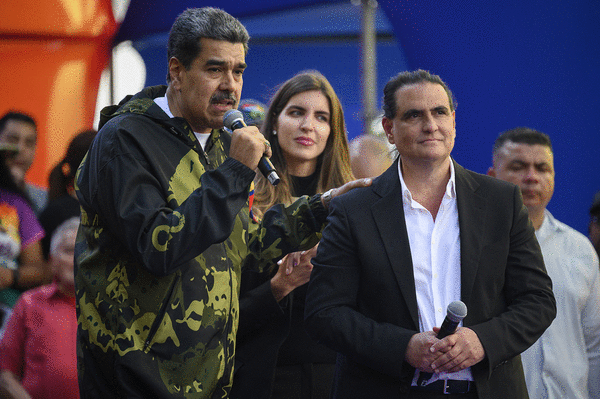
MIAMI — Alex Saab, the Colombian businessman accused of serving as a financial front man for Venezuela’s government, appears poised to plead guilty Tuesday in a new federal money-laundering case in Miami, after a judge scheduled a change-of-plea hearing and canceled his upcoming jury trial.
The hearing is scheduled for 11 a.m. before U.S. District Judge Kathleen M. Williams in Miami, signaling that a case that once appeared headed for a November jury trial may instead be approaching a negotiated resolution.
The court has canceled both the trial and a previously scheduled Zoom calendar call and removed them from Williams’ calendar. Such a move typically occurs when a defendant has reached, or is preparing to formally enter, a plea agreement with prosecutors.
Exactly what Saab, 55, intends to admit remains unclear. Court records do not yet publicly disclose the terms of any agreement with prosecutors, and the docket entry scheduling Tuesday’s proceeding lists the case caption as “USA v. SEALED” rather than under Saab’s name.
Saab is currently charged with one count of conspiracy to launder monetary instruments, an offense carrying a maximum penalty of 20 years in federal prison. He pleaded not guilty in July.
The expected plea would mark another extraordinary turn in Saab’s dealings with the U.S. justice system. He was extradited from Cape Verde to Miami in 2021 to face an earlier money-laundering prosecution, only to be granted clemency by President Joe Biden in December 2023 as part of a prisoner exchange with Caracas. Saab was flown back to Venezuela, where Nicolás Maduro’s regime celebrated his return as a diplomatic victory.
Less than three years later, he is back in the same federal courthouse facing a different case.
Venezuelan authorities deported Saab to the U.S on May 16 amid a rapidly changing relationship between Caracas and Washington. Two days later, he made his initial appearance in Miami federal court.
The latest prosecution goes beyond the allegations in Saab’s first U.S. case, describing a financial network that prosecutors say began with Venezuela’s CLAP food-subsidy program and later expanded into oil trading as U.S. sanctions squeezed the country’s most important source of revenue.
According to the indictment, Saab and his associates set off the conspiracy around October 2015 by bribing Venezuelan officials to secure lucrative contracts connected to the Comité Local de Abastecimiento y Producción, or CLAP, which distributed subsidized food during the country’s deepening economic crisis.
Prosecutors say the conspirators used shell companies, fraudulent invoices, falsified shipping records and other fabricated documents to divert hundreds of millions of dollars intended to buy food for vulnerable Venezuelans. Some of the proceeds were allegedly moved through U.S. bank accounts.
“This indictment alleges that a humanitarian food program intended to support vulnerable Venezuelans was instead manipulated for massive personal enrichment,” U.S. Attorney Jason A. Reding Quiñones said when the charges were announced. “According to the charges, the defendant used bribery, shell companies, and fraudulent documents to siphon hundreds of millions of dollars for personal gain.”
Prosecutors say the operation evolved as Washington tightened sanctions against Venezuela.
Beginning in 2019, according to the indictment, U.S. sanctions sharply constrained Venezuelan exports, particularly oil, putting pressure on the government’s finances and its ability to meet foreign obligations, including payments allegedly owed to Saab and his associates through the CLAP program.
Saab and his co-conspirators then allegedly used their access to Venezuelan officials to obtain billions of dollars worth of crude belonging to state oil company Petróleos de Venezuela S.A., or PDVSA, and sell it under false pretenses. Proceeds from those transactions were moved to and through U.S. bank accounts to promote and conceal the CLAP scheme, prosecutors say.
“Alex Saab allegedly used American banks to launder hundreds of millions of dollars stolen from a Venezuelan food program meant for the poor and proceeds from the illegal sale of Venezuelan oil,” Assistant Attorney General A. Tysen Duva of the Justice Department’s Criminal Division said when the indictment was announced.
The allegations connect two periods in Venezuela’s economic crisis: the corruption accusations surrounding a program created to feed millions of Venezuelans and the opaque oil-trading networks that emerged as sanctions increasingly isolated PDVSA from conventional markets.
Saab became one of the most politically sensitive figures in the long confrontation between Washington and Caracas.
U.S. authorities portrayed him as a financial operator for Maduro’s government who relied on a network of companies and international transactions to move money and conduct business despite sanctions. Venezuela cast him as a diplomat persecuted by Washington for helping the country circumvent what it described as an illegal economic blockade.
That dispute was at the heart of Saab’s first prosecution.
He was arrested in Cape Verde in June 2020 when his plane stopped to refuel on the way to Iran and was extradited to the United States the following year. His attorneys argued, among other things, that Saab was traveling as a Venezuelan diplomat and was immune from prosecution.
The case never reached trial.
Biden granted Saab clemency in December 2023 as part of an agreement with Maduro’s government that also secured the release of Americans detained in Venezuela. Maduro publicly embraced Saab upon his return to Caracas.
His return to U.S. custody this year underscored how much the relationship between Washington and Caracas had changed since his release.
The new prosecution has moved quickly. Saab pleaded not guilty in July and initially faced a Sept. 8 trial. Prosecutors and defense attorneys later jointly requested more time, telling Williams they needed to review evidence in what they described as a complex international financial case.
Williams postponed the trial until November. That trial is now off the calendar.
Court records identify Saab’s attorneys as Joseph Michael Schuster and Neil M. Schuster. Assistant U.S. attorneys Monique Botero and Joseph Palazzo are prosecuting the case.
_____
MIAMI — Alex Saab, the Colombian businessman accused of serving as a financial front man for Venezuela’s government, appears poised to plead guilty Tuesday in a new federal money-laundering case in Miami, after a judge scheduled a change-of-plea hearing and canceled his upcoming jury trial.
The hearing is scheduled for 11 a.m. before U.S. District Judge Kathleen M. Williams in Miami, signaling that a case that once appeared headed for a November jury trial may instead be approaching a negotiated resolution.
The court has canceled both the trial and a previously scheduled Zoom calendar call and removed them from Williams’ calendar. Such a move typically occurs when a defendant has reached, or is preparing to formally enter, a plea agreement with prosecutors.
Exactly what Saab, 55, intends to admit remains unclear. Court records do not yet publicly disclose the terms of any agreement with prosecutors, and the docket entry scheduling Tuesday’s proceeding lists the case caption as “USA v. SEALED” rather than under Saab’s name.
Saab is currently charged with one count of conspiracy to launder monetary instruments, an offense carrying a maximum penalty of 20 years in federal prison. He pleaded not guilty in July.
Tuesday’s expected plea would represent a remarkable second turn through Miami’s federal criminal justice system for a businessman who for years occupied a central position in the confrontation between Washington and Venezuela’s government.
©2026 Miami Herald. Visit miamiherald.com. Distributed by Tribune Content Agency, LLC. ©2026 Miami Herald. Visit at miamiherald.com. Distributed by Tribune Content Agency, LLC.




Comments