Boston Mayor Wu pitches $100 million tax breaks for developers to kickstart stalled housing construction
Published in News & Features
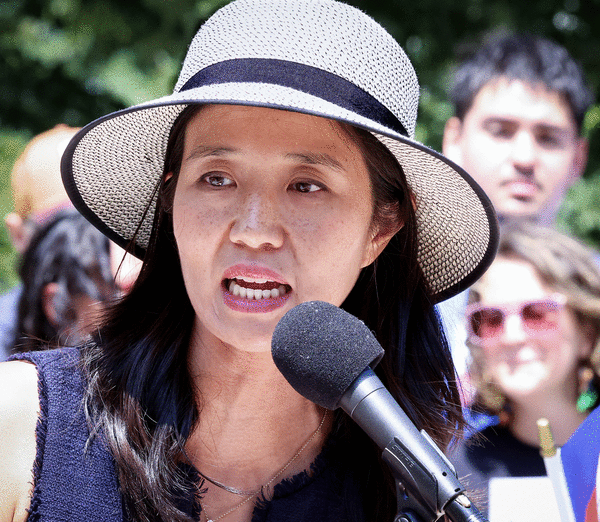
BOSTON — Boston Mayor Michelle Wu is targeting tax breaks toward four housing developments that have been approved by the city but stalled due to financial constraints, as part of a larger plan to kickstart lagging construction.
Wu on Monday proposed $31.5 million in collective tax abatements for the four market-rate projects, which are expected to create 1,400 new housing units. About 185 units will be affordable.
“Residents urgently need more housing now, and we can’t afford to let approved projects that are ready to build remain stalled because of today’s tough economic headwinds,” Wu said in a statement. “These targeted abatements would help put shovels in the ground within the next year, creating 1,400 new homes and over 1,500 jobs — all with no net revenue loss to the city.
“Boston is open for business and we’ll keep using every tool available to get more housing built for our residents,” Wu added.
The abatements, amounting to about $22,500 per housing unit, have to be approved by the Boston Planning and Development Agency Board, which will take up the matter next month.
The projects targeted by the city are:
— One Mystic Avenue in Charlestown, which would create 408 units, 45 of which would be income-restricted, in a 16-story transit-oriented building.
— 22-24 Pratt Street in Allston, where an underutilized industrial site would be transformed into a new 16-story development with 318 units, 27 of which would be income-restricted.
— 83 Leo Birmingham Parkway in Brighton, where the former site of various radio stations would be converted into 333 new units, 52 being affordable.
— Allston Yards Building D in Allston, where 341 new units, 61 of which would be affordable, are planned alongside retail and entertainment uses.
When briefing reporters on the plan, Chief of Planning Kairos Shen said the four projects were chosen because they were most feasible, in terms of the tax breaks leading to construction next year. The projects have been approved by the city, but lacked the necessary financing to move forward.
“The developer and proponent are marching the ball down the field, and they’re right at the goal line, and they just need that help to get over, and the tax relief that we’re offering, which is prudent and conservative, will get them over,” Shen said. “That’s what these four projects need that fit the criteria.”
That criteria, Shen said, is for developments that have more than 100 planned units with some set aside as affordable, and meet high-energy efficiency standards.
The city is in discussions with about a dozen other developers that could be eligible. All told, the abatements could result in roughly $100 million in tax relief, the figure Wu has stated she is “comfortable” with, for up to 4,000 housing units, per Shen.
The money would come from the city’s $110 million housing accelerator fund, which was created last year to kickstart stalled housing production and draws from surplus funds from the city budget.
The tax breaks would work by exempting developers from paying taxes on the full assessed value of the property, which changes every year, for a period of five or 10 years.
Current tax rates would remain the same during construction for each plan. Abatements would kick in once the building is ready for occupancy, and expire with the property owner paying full taxes after the five- or 10-year period.
The tax rate would increase by 2.5% annually under the five-year plan.
Only one targeted developer, 22-24 Pratt St. is seeking the 10-year agreement. When the building is cleared for occupancy, the city assessor would evaluate what the full tax rate is for its assessed value, and then create a tax schedule that amounts to a 50% abatement on average over 10 years. It would result in lower tax payments at first and then higher taxes in the final few years, city officials said.
Wu’s team said it remains committed to the affordability requirements that have increased under her administration, when the number of income-restricted units developers are required to set aside increased from 13% to 17-20%, depending on the size of the development, in October 2024.
But city officials seemed to acknowledge that stricter affordability requirements have made it more costly for some developers to build in Boston, and led to stalled construction.
The four targeted projects, and many of the dozen others under consideration — and thus considered more shovel-ready — were approved while affordability requirements were at the lower 13% mark.
The city shared that two of the four targeted projects have been granted 50% buyouts from their inclusionary zoning requirements.
One Mystic Avenue and 22-24 Pratt St. are making $14 million and $8.1 million contributions, respectively, to allow for affordable housing to be created elsewhere in the city, in lieu of getting the on-site IZ exemption.
“We are comfortable with that,” Chief of Housing Sheila Dillon said. “It helps them with feasibility, and one, it would jumpstart these particular projects, but also we have a really healthy pipeline of affordable housing projects.”
Still, the city has no plans to roll back affordability and green-energy requirements, according to Shen. Doing so wouldn’t be “smart,” he said, given that, “This mayor has made it very clear that we should be building for the future.”
Meanwhile, the abatements have been kicked around by the Wu administration since 2023. They were rejected by Wu in early 2024, when she said the city couldn’t afford the tax breaks at the scale required to move the needle on jump-starting development and lowering rents.
Dillon said the cash-strapped city has deemed it can now afford the “modest” new proposal Wu has put forward, with an eye toward “creating new housing that is desperately needed.”
“It’s actually a very responsible thing to do,” Dillon said. “We’re not collecting taxes now, but we really are setting up for financial health down the road.”
Shen added, “If we don’t take action, these projects may not be built for another five years. … We’re not reducing the tax base at all. We’re growing it. We’re just growing it slower than what the normal rate would be.”
________
©2026 MediaNews Group, Inc. Visit at bostonherald.com. Distributed by Tribune Content Agency, LLC.






Comments