Ask the Pediatrician: Parenting after trauma: Understanding your child's needs
Published in Health & Fitness
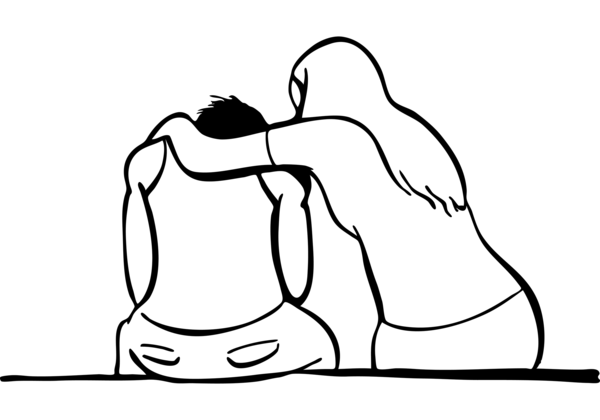
All children need to feel safe, understood and valued. This is especially true for children who have experienced trauma. Early, hurtful experiences can cause children to see the world differently and to react in seemingly unpredictable ways.
Children who have been adopted, have been placed into foster care, or have experienced significant adversities may need extra help to cope with what has happened to them in the past. They may also need trusted, predictable and caring adults to teach them more adaptive ways to have their needs met moving forward. Knowing what experts say about early trauma can help you understand your child’s behavior and support your child’s development.
An event is traumatic when it threatens the child or someone the child depends on for safety and care. Trauma may be due to abuse, but trauma may also be due to other events such as neglect, separation, violence between caregivers, natural disasters and accidents.
A frightened child may feel helpless in the face of a world that appears unpredictable or out of control. When this happens, the body's protective reflexes set off a "fight or flight" panic response that can make a child's heart pound, raise their blood pressure, and lead to emotional outbursts or aggressive behavior. When attuned and invested adults can help the frightened child feel safe, understood, and valued, these protective reflexes and panic responses are brief. But in the absence of such attuned and invested adults, these panic responses can be sustained and lead to long-term changes in the way the child’s genes interact, the way the child’s brain develops and functions, and the way the child understands and interacts with others.
Some children are more sensitive to adverse experiences than others. What is traumatic for one child may not be traumatic for another. It may be harder to detect trauma in children who have been neglected, because they often don't show signs of physical injury like bruises. These children may worry about having their basic needs met, like food, safety or connection. Even worse, neglect may have robbed them of the attuned and invested adults needed to turn off those panic responses.
Because they may see some adults as untrustworthy, mistreated children often resist help from all adults. Some may withdraw from people and seem shy and fearful. But others may be very friendly with everyone they meet, crossing personal boundaries and putting themselves at risk for more abuse. They may feel forced to choose between "trust no one" and "trust everybody, but not really.”
Trauma has more severe effects when it happens repeatedly, with multiple stresses stacked upon one another. Younger children as well as those with fewer social supports or coping skills can also be more severely impacted by trauma.
From the child's perspective, traumas are experienced as a pattern of sensations, with images, sounds, smells, thoughts and feelings all mixed. Traumas can also “remembered” the same way, rushing into the present without a child even realizing they are experiencing a memory. These remembered -- often overwhelming -- patterns of sensation associated with past trauma are called "triggers."
Triggers can be smells, sounds, places, postures or tones of voice. Even emotions can be a trigger. For example, being anxious about school may be related to being anxious about violence at home. This can cause dramatic and unexpected behaviors like physical aggression or withdrawal. Triggers can be hard to identify, even for a child. If a child knows what a trigger is, the child will often try hard to avoid it.
Remembering a traumatic event can cause some of the original fight-or-flight reactions to return. This might look like a "tantrum" or overreaction. Sometimes anxiety can cause a child to "freeze" or blankly stare as if they are in their own world. This may look like defiance or "zoning out." A child who sees the world as a place full of danger may do this. Many children who have been abused or neglected go through life always on edge and have difficulty maintaining control of their emotions because their body is always ready to freeze, flee or fight in self-defense.
Being ready to flee or fight shows up in many ways. Children who are always on guard may have trouble concentrating, a symptom called "hypervigilance." These effects of past trauma can be easily confused with hyperactivity and inattention, classic signs of attention deficit hyperactivity disorder (ADHD), and children may incorrectly receive this diagnosis if caregivers and doctors do not realize the effects of trauma on development.
Children who have experienced trauma may also be overwhelmed with emotions and have trouble with the unexpected. Their need for predictability and control may be seen as "manipulative" or as always wanting things done their way. Not trusting adults can be mistaken as a disrespect for authority and can cause problems at home and school. It can also make learning harder.
Going from one activity to another may be hard as well for children living with trauma. When these aggressive responses are extreme and trauma reactions are not considered, it can be labeled "oppositional defiant disorder" or "intermittent explosive disorder." These terms do not recognize that a child's reactions might have been appropriate at the time they experienced a trauma, even though they may be no longer appropriate now.
Children who have been adopted or are in foster care have often suffered trauma. They may see and respond to threats that others do not, and their brains may always be "on guard." Many children who come from the foster care system have never learned to depend on consistent, reliable adults, so typical parenting practices may not work. It can be hard to remember that these strong emotional reactions may be directed at you, but they are not about you. Stay calm and remind yourself that these behaviors aren’t meant to be personal attacks. These strong feelings are in response to the traumas that happened in the past. Your child is just processing these overwhelming emotions in the only way they know how.
That doesn’t mean you can’t have a loving, healthy relationship with an adopted or traumatized child, but it does mean increased care and attention might be needed to get there. Some tips parents of adopted or traumatized children can consider include noticing and avoiding unnecessary triggers for the child, keeping them on a steady, predictable routine, allowing them a sense of control through simple choices, and avoiding discipline that includes physical punishment. It’s important to allow your child to feel their feelings. Teach your child words to describe their feelings when they are calm, words they can use when they get upset. Show acceptable ways for them to deal with feelings. Then, praise them for expressing their feelings or calming down.
It’s important to allow your child to feel their feelings, but that may require you to be OK even when your child is not OK. This models the “distress tolerance” that we want all children to develop. If children learn that they are not supposed to feel a certain way, they may try to avoid big feelings. But avoiding big feelings is the essence of anxiety. Instead of avoiding those big feelings -- and all of their potential triggers -- teach your child how to cope with them. Begin by using some words to describe their feelings when they are calm, words they can try to use when they get upset. Then note the activities that bring them joy, be it books, LEGOs, drawing, singing, dancing, sports or puzzles. If a child has a passion, you can teach how to handle big emotions by reminding your child to engage in those joy-filled activities when they are feeling overwhelmed. Finally, note and praise steps in the right direction, by saying “thank you for using your words, and good job on using that book to calm down.”
Helping children to heal and grow after trauma begins with trust. When attuned and invested adults help children to feel safe, understood and valued, they are building the trust that is needed to learn more adaptive ways to handle big feelings
Children are remarkedly resilient and do the best they can with what they have been given. It is our job to provide them with the tools they need and to guide them as they grow. It may be a slow process with many setbacks, but the rewards are worth the effort. By understanding that your child's past experiences impact the way they see and respond to their world, you have taken the first steps to building a safer, healthier world for your child.
____
Andrew Garner, MD, PhD, FAAP, is a Clinical Professor of Pediatrics at the Case Western Reserve University School of Medicine. Dr. Garner has practiced primary care pediatrics with the University Hospitals of Cleveland for more than 25 years. Dr. Garner has co-authored an American Academy of Pediatrics-published book entitled “Thinking Developmentally: Nurturing Wellness in Childhood to Promote Lifelong Health.” When not practicing pediatrics, advocating for children and their families, or writing about relational health, Dr. Garner enjoys hiking, fishing, watching baseball, and spending quality time with his wife and two adult children.
©2026 Tribune Content Agency, LLC.






Comments