San Diego County supervisors greenlight plan to build own Tijuana River treatment plant
Published in Science & Technology News
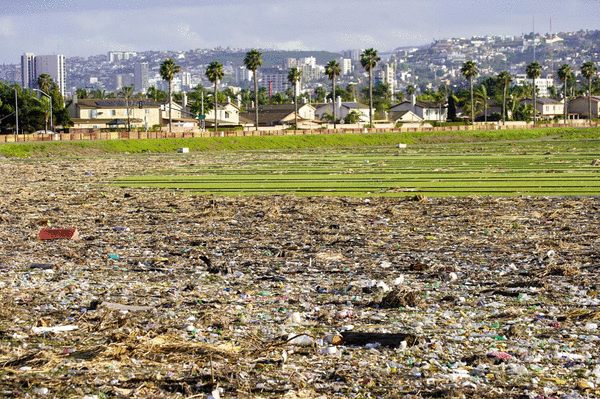
SAN DIEGO — The San Diego County Board of Supervisors voted Tuesday to launch a new phase of the county’s fight against Tijuana River pollution, approving funding to plan a new treatment system to capture sewage from the river itself and to advance a permanent fix at a toxic air pollution hot spot in South County.
Supervisors voted 4-1 to approve the Tijuana River Capture and Cleanup Initiative, with Supervisor Joel Anderson opposed. A second measure funding infrastructure at the Saturn Boulevard hot spot passed unanimously.
The capture and cleanup measure directs the county’s chief administrative officer to begin an 18-month project development and engineering analysis, funded by $1.8 million from the county’s Unlocked Reserves Framework, according to a county staff report. It also converts the board’s ad hoc subcommittee on the crisis into a standing committee with permanent oversight.
A separate measure allocates $4 million to advance design, environmental review and permitting for a permanent box culvert project at Saturn Boulevard, where hydrogen sulfide levels have reached 16 times the state air quality standard. That work will proceed alongside a $2.5 million interim pipe-extension project already underway, with construction anticipated in 2027.
The proposed treatment system would be separate from the existing South Bay International Wastewater Treatment Plant, operated by the U.S. section of the International Boundary and Water Commission. That plant treats wastewater Mexico captures and conveys to it but does not treat pollution once it enters the river itself, according to Chair Pro Tem Paloma Aguirre.
“When they talk about the 100% solution, they’re talking about waiting for Mexico to fix it,” Aguirre told the board, referring to a federal upgrade plan for the existing plant. “I have never in my entire life heard of a body of government depending on a different country to bring health, safety and welfare (to its own people), which is our responsibility to our constituents.”
Chair Terra Lawson-Remer, who co-sponsored both items with Aguirre, said the initiative reflects years of unmet promises to South Bay communities. Vice Chair Monica Montgomery Steppe voiced support for both items, saying the action “lays the groundwork to build a locally controlled treatment system on the San Diego side of the border.”
Supervisor Jim Desmond said he would support the measures, but argued responsibility ultimately lies with Mexico.
“I would like to see Mexico stand up and finally fix the source of this issue, I think we all would, and we’ve been waiting decades for that to happen,” Desmond said. “This is Mexico’s fault.”
Anderson cast the lone vote against the capture and cleanup initiative, saying he wanted to see a formal coalition of affected cities — including Imperial Beach, San Diego and Coronado — before the county moved forward. He also suggested leveraging water sales to Tijuana through the Otay Water District as negotiating leverage.
“It’s not our lane,” Anderson said of the initiative, though he voted in favor of the Saturn Boulevard measure.
Lawson-Remer said building a coalition remains part of the plan but that the county could not afford further delay.
“We can’t wait for all our little cities and all our counties and everybody to agree before we act,” she said.
The board heard public comment from 18 speakers, along with more than 200 written comments on the two items combined. Supporters included Sarah Davidson of the Surfrider Foundation’s Clean Border Water Now program, who said the county’s southernmost beach had been closed 1,728 consecutive days. Charles Rilling, representing the Sierra Club’s San Diego chapter, and Mia Mendoza, representing the San Diego Regional Chamber of Commerce, also voiced support.
Some speakers raised concerns about the county’s spending plans and questioned whether the project was necessary given ongoing federal and binational efforts. One caller argued the $1.8 million allocation amounted to further delay without a clear design or funding plan in place.
Much of the long-term funding for the initiative could come from a proposed countywide sales tax measure headed for the November ballot. The measure, which qualified after organizers submitted about 151,000 signatures, would raise the countywide sales tax rate from 7.75% to 8.25% and is projected to generate $360 million in new revenue in its first year, with 22.5% dedicated to Tijuana River Valley sewage mitigation.
Aguirre said that revenue, if approved by voters, could be used to bond for up to $1 billion in infrastructure funding.
“We wouldn’t have to depend on the federal government or Mexico to bring immediate relief,” Aguirre said at a news conference Monday ahead of the vote.
©2026 The San Diego Union-Tribune. Visit sandiegouniontribune.com. Distributed by Tribune Content Agency, LLC.






Comments