LZ Granderson: Michigan race tests whether voters care more about issues or identity
Published in Op Eds
Nestled between two large lakes, near the northwest tip of Michigan's lower peninsula, you'll find more than 1,000 acres of land dedicated to the performing arts.
The list of children who have spent time there and gone on to have distinguished careers is extensive. Oscar winner Da'Vine Joy Randolph. Grammy winner Norah Jones. Emmy winner Felicity Huffman. The backdrop where they rehearsed, befriended and dreamed of fame is lush and picturesque. Getting accepted into the Interlochen summer camp meant "you got it, kid." Paying for the century-old school meant "you got money, kid."
Or know someone who does.
This is one place where Jeffrey Epstein and Ghislaine Maxwell hunted for victims, according to documents released by the Department of Justice. Epstein, who attended the school as a 14-year-old bassoonist in 1967, began making regular visits between 1994 and 2000. Using his wealth and power to present himself as a generous alumnus to administrators, Epstein lured children into his sex-trafficking operation by promising to pay for the next year's tuition.
I could never vote for someone who hears the details of what happened to Epstein's victims and chooses obstruction for political reasons. Justice for those survivors is a red line for me.
Everyone has a red-line issue. Some Americans draw the line at abortion access. For others, it's gun policy.
During the 2024 Democratic presidential primary, for the more than 100,000 Michiganders who voted "uncommitted" rather than supporting President Joe Biden, the red line was his handling of the war in Gaza. Polls show the war contributed to Vice President Harris' defeat later that year as well. And here we are, two years later, and war in the Middle East again will be a deciding factor.
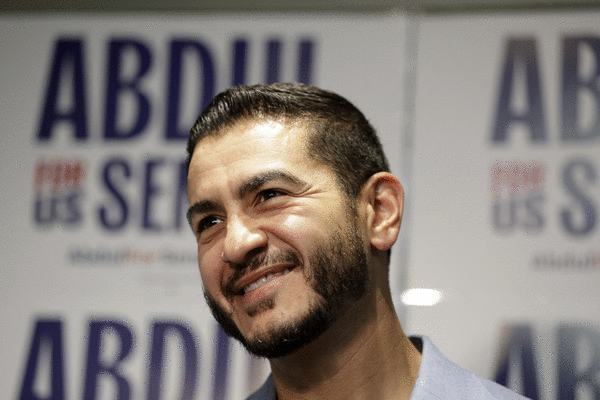
Only this time, it does not appear to be a question about the Democrats' message so much as it is about the messenger. While it is true the Trump administration's handling of the economy and wars in Iran and Gaza have made him unpopular — even among Republicans — it is also true the faith of Michigan's Democratic Senate nominee, Abdul El-Sayed, is a red line for some.
Rep. Nancy Mace, R-S.C., recently posted on social media that "every single Muslim holding public office in America is a trojan horse, and a threat to both national security and our republic"; President Donald Trump said without evidence that the 41-year-old epidemiologist El-Sayed "hates Jews"; and his 2020-election-denying opponent, Mike Rogers, dropped an ad targeting Democrats who felt "hopeless because the person who won does not represent your values." Rogers also has tried to link El-Sayed to comments other people have made about 9/11, not being bashful at all about using Islamophobia to drum up support.
It's exhausting. It's disappointing. And sadly, likely effective.
Amir Hassan is a Christian who was endorsed by Trump, but only 1 in 3 Republicans voted for him in a House primary in Michigan, preferring the candidate Tom Smith, even though he had dropped out of the race weeks earlier. Republican state Rep. David Martin said he "hates to think" that Hassan's Arabic name cost him the election.
"Anybody who has sat with Amir Hassan and heard his testimony and his belief and his faith in Jesus Christ would have been convinced," Martin told local outlets afterward. "It's sad. I mean, look at John F. Kennedy. They thought he'd have more allegiance to the pope than to the country and to the Constitution. Obviously, we've gotten well past that."
When I recently asked Rep. Jamie Raskin, D-Md., about Americans' resistance to voting for someone who wasn't a Christian, he brought up the same point about Kennedy and anti-Catholic sentiment.
At a town hall with El-Sayed near the University of Michigan on Wednesday, Raskin discussed Kennedy's acceptance speech from the 1960 Democratic Convention in Los Angeles, in which the future president said: "I hope that no American, considering the really critical issues facing this country, will waste his franchise by voting either for me or against me solely on account of my religious affiliation. It is not relevant."
Raskin, who is Jewish, frames the decision facing voters in this year's midterm elections as being about a different red line: "Those of us who have been fighting Donald Trump and his authoritarianism and corruption and violence against American citizens and immigrants for 10 years now understand that this is an essential referendum about the future. Where we have democracy or where we have autocracy. This is our chance to cut this reign of lawlessness and terror in half in this election. That is the overarching question here."
Rep. Debbie Dingell, D-Mich., attended the town hall to support El-Sayed as well, and she concurred about the stakes. She said she is tired of being asked about distracting nonissues — such as comments from the fringe-left online personality Hasan Piker — when "we are facing far more important issues like the cost of living and war."
I don't think any Democrat would disagree with her. There are far more pressing concerns than any gadfly's remarks. The question is, where will all of those concerns rank when voters in Michigan are staring at a ballot with the name Abdul El-Sayed? Will they draw the line at abetting pedophiles? At "lawlessness and terror"? Or at electing a Muslim?
____
YouTube: @LZGrandersonShow
©2026 Los Angeles Times. Visit at latimes.com. Distributed by Tribune Content Agency, LLC.

Comments