Commentary: What 'affordability' really means to working-class voters
Published in Op Eds
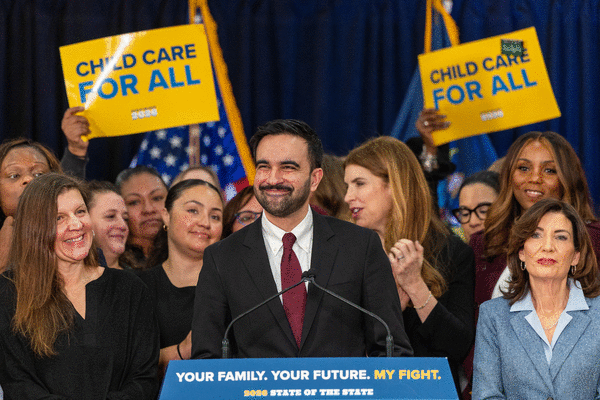
Democrats’ obsession with “affordability” is right on target, given that American workers’ share of GDP is near the lowest ever recorded. Today, 61% of Americans are skimping at the grocery store, and housing and childcare are unaffordable even for many college grads.
So it’s not surprising that “affordable basics” are the top priority of both key groups Democrats need to win in the midterms: liberal college grads and the working class, as we found in a poll of 5,770 adults (1) conducted earlier this year.
But not all Democrats have learned to lean into affordability, and even those who have could make the case more effectively.
Dig deeper into the consensus around “affordable basics” and you find an important divergence. College grads’ key economic priorities all concern prices, whereas top working-class priorities also include raising wages, creating jobs and boosting economic opportunity.
This reflects a K-shaped economy where the affordability crisis reflects not just high prices but low wages. “Nothing is affordable if you don’t have a good job,” observed Jason Walsh, executive director of the BlueGreen Alliance.
Increasing wages, we found, is a top 10 priority for Latino and White working-class respondents. It was also in the top 10 priorities for all Black voters, whether or not they have a bachelor’s degree. In other words, to reward a constituency Democrats need to retain (Black voters) and another they need to attract (working-class White and Latino voters), Democrats must focus not just on prices, but also on wages. This often gets lost in vague language of “affordability.”
Our polling revealed a second warning for Democrats: The fight between moderates and progressives is a distraction. Don’t rely on a list of policies or fight over which ones should be included. Don’t get mired in policy details. What Democrats need is a wide tent full of people who can connect with working-class voters. Embrace a simple, consistent message that we need to return to an economy that rewards hard work. Both progressives and moderates can do this.
New York Mayor Zohran Mamdani won by promising a city “where hard work is repaid with a stable life.” Centrist President Bill Clinton said much the same thing in the 1990s: “If you work hard and play by the rules, you should be given a chance to go as far as your God-given ability will take you.” Both messages connect with key blue-collar values of hard work, stability and personal responsibility.
In our study, we found that working-class voters strongly prefer a plain-language approach that explains in concrete terms how a specific policy will improve their lives. The most dramatic example we found in our study was universal childcare. While only 55% of working-class respondents supported that abstract formulation — “universal childcare” — 83% supported “ensuring that all children have access to affordable, high-quality childcare so parents don’t need to quit jobs they need to support their families.” Note how this reframing shows how childcare would improve workers’ daily lives. It also taps a central working-class value: pride in hard work. We found that linking policies to hard work can increase working-class support up to 30 percentage points.
One third and final warning. It may be difficult for Democrats to pursue this economy-first message without disappointing their liberal, college-educated base, many of whose top priorities are cultural. Compare the list of priorities in the two columns below: elites prioritize fighting authoritarianism, preventing gun violence, ending racism and defending abortion access, but non-elites don’t.
Nowhere is the divergence clearer than on authoritarianism, an issue that animates Democratic elites but is low-priority for the working class. Whereas liberal college grads ranked the issue as their second most-important priority, it fell to 19th among blue-collar voters. The only framing that resonated with working-class voters at all, we found, tied defense of democracy to kitchen-table economics: 58% of working-class respondents agreed that “When Donald Trump ignores the rules, prices rise, jobs feel less secure and it gets harder for working families to keep up.” That scored highest. What scored lowest? A formulation that decries Trump for ignoring constitutional checks. Democrats will have to choose between winning the working class and pleasing constitutional law professors. Not a hard choice.
The first step in connecting with working-class voters is for Democrats’ college-educated base to admit that their priorities aren’t the same as those of the working class. That’s a heavy lift, both because liberal college grads like to think of themselves as champions of the oppressed and because many feel entitled to a mind-meld with candidates they support. Reaching across class lines requires seeing politics as the process of building coalitions with people who are fundamentally unlike you in certain ways.
Are Democrats willing to do that to win? We’re about to find out.
____
(1) Our survey was conducted by Verasight in January and February. Liberal college grads had incomes in the top 25%. Working-class Americans without college degrees had incomes in the middle 50%.
____
This column reflects the personal views of the author and does not necessarily reflect the opinion of the editorial board or Bloomberg LP and its owners.
Joan C. Williams is director of the Equality Action Center and a distinguished professor of law (emerita) at the University of California College of Law, San Francisco.
_____
©2026 Bloomberg L.P. Visit bloomberg.com/opinion. Distributed by Tribune Content Agency, LLC.











































Comments