Commentary: We're stuck with the dollar as the global currency, along with all the downsides
Published in Op Eds
Vice President JD Vance’s recently resurfaced comments rightly question whether the U.S. dollar should continue to be the world’s reserve currency. He has also recognized that the problem dates back 40-some years, thereby indicting President Reagan and his Fed chairman, Paul Volcker. Equal blame should go to President Carter, who appointed Volcker in 1979. And the system’s deep origin was President Nixon’s 1974 agreement that Saudi Arabia could charge whatever it wanted for oil, provided it traded in dollars. But it was under Reagan and Volcker, in 1981, that the hammer fell.
I became executive director of the congressional Joint Economic Committee in January 1981, as interest rates hit 20%, driving the economy to the wall. It fell to my intrepid members, chaired by Henry Reuss, D-Wis. — along with a few brave Republicans like Jack Kemp, R-N.Y. — to oppose the policy. We saw that whipping inflation meant defeating America’s trade unions by destroying the industries they worked for. Reuss’ Milwaukee, a capital of machine shops, was hard hit. Ohio, then the heart of manufacturing, was devastated. Vance, born in 1984, grew up in the Rust Belt wreckage of those years.
The same high interest rates that battered industry did save the dollar, which soared in value. German and Japanese cars and machinery conquered U.S. markets, while the supposed threat of the deutschemark and yen to the dollar receded. In 1985 the Treasury engineered a depreciation, but the industrial damage was irreversible, and the dollar’s supremacy was locked in. Eventually Europe would adopt the euro, and industrial power would shift to China, yielding the world we inhabit today.
For many years the “end of history” crowd argued that as “benign hegemon,” the U.S. would reap financial rewards and also supply the thin edge of the most advanced technologies to the world. Regular Americans could buy and consume the fruits of other people’s industrial and farm labor. China would become a well-behaved liberal democracy. If any nation tried to move off the dollar exchange-reserve system, the military was available, as Libya and Iraq would find out.
However, military strength rests on industrial power. New technologies emerge by practice and perfection of skills and by selection from many options. Industrial and engineering decline erode the skills and sap the options. Eventually, leadership passes elsewhere. A military built on obsolete doctrines and supplied from a depleted base cannot cope.
What remains is the hollowed-out edifice of financial power. Perhaps this too will one day fall — as it did for the previous hegemon, Great Britain, bankrupted by two world wars. But one day is not now, or necessarily soon. President Franklin D. Roosevelt insisted on subordinating the sterling area — those nations and colonies that used the British pound as a reserve currency — to the dollar, because the U.S. was ready and willing to take over. The U.S. back then had no industrial peer.
Today, China is an industrial peer. But the U.S. still has no financial peer. Even the financial crisis of 2007-2009, a made-in-America debacle, did not shake the international dollar. Sanctions imposed on Russia have created a non-dollar, non-euro zone, but it is far from taking over.
Most importantly, financial hegemony would not serve China well. It would worsen that nation’s wealth distribution and erode its industrial advantage. So China maintains capital controls and manages its exchange rate, while building vast reserves of oil, metals and strategic minerals. A chronic export surplus is the price worth paying for progress, for security and for the social stability on which Chinese state legitimacy rests.
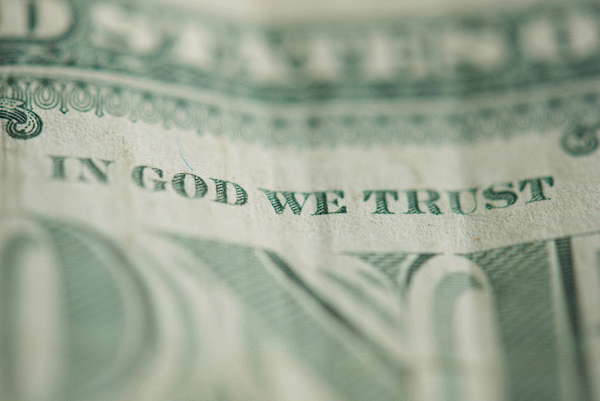
Thus the problem Vance described has no known solution. To rebuild U.S. industrial and military power is impossible while the God-almighty dollar reserve system endures. Subsidies and tariffs can help keep the old and backward afloat. They cannot move them to the low-cost, high-volume, new-tech frontier. That frontier will not magically return to a country that kicked away the foundations before Vance was born.
But even if the dollar system collapses someday, it would not help. Devaluation would fuel inflation — as in Britain in the 1970s. To rebuild industry, technology and the society that can sustain them would require the kind of whole-of-society effort last seen here in the 1930s and 1940s, at the dawn of the age of oil. Even should the necessary state structures be created, it is far from sure that the resources would be there. For now, the future is in the hands of the artificial intelligence companies and their data centers, which will drive up power prices and erode the electrified prosperity that has underpinned American life for a century.
One might compare the U.S. at present and the late USSR — a superpower with a bloated military, obsolete technologies, a disaffected population and an aged politburo, trapped by its ideologues. But there is another parallel, well-suited to the gilded sensibilities of Donald Trump. It is the court of Louis XV, reputed to have said, throwing up his hands after an ill-fated war and a disastrous defeat, “Après moi le déluge”— after me, the flood.
And with Vance as the future Louis XVI, waiting in the wings.
____
James K. Galbraith, a professor of public affairs and government at the University of Texas at Austin, is the author of the forthcoming book “The Power to Destroy: How Bad Economics Drove America’s Decline.”
____
©2026 Los Angeles Times. Visit at latimes.com. Distributed by Tribune Content Agency, LLC.


















































Comments