Data center moratorium pitched as counter to AI impacts
Published in Political News
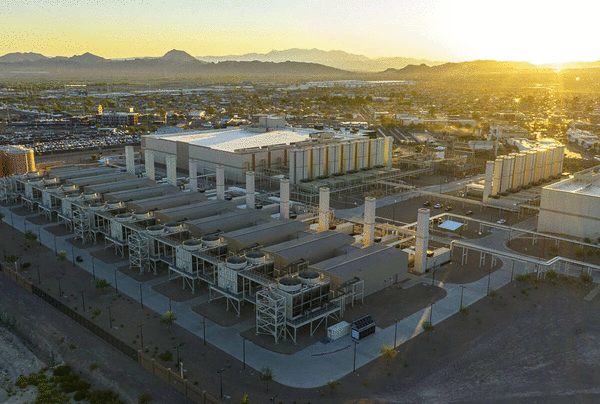
WASHINGTON — Leading progressives unveiled legislation Wednesday that would pause construction and upgrades of artificial intelligence data centers, highlighting an issue where voters are concerned and the Trump administration plans to back industry.
Sen. Bernie Sanders, I-Vt., and Rep. Alexandria Ocasio-Cortez, D-N.Y., released their draft bill, dubbed the Artificial Intelligence Data Center Moratorium Act, which would condition building centers on the enactment of federal laws to regulate AI and associated energy costs and environmental effects.
The effort, while unlikely to advance under Republican control of Congress, still marks a sharp contrast to the Trump administration’s AI policy framework released last week. That document urged Congress to streamline permitting for data centers and avoid creating “open-ended” liability for AI firms, while curtailing state regulatory authority.
It comes as Democrats hope to retake one or both chambers of Congress in the November midterms, which would give them a platform to address public concerns over data centers and their impacts on energy and consumer technology costs.
At a news conference, Sanders said a moratorium on new data centers would “give us time” to understand AI risks and “protect working families.”
He emphasized public concern about AI, especially in the workforce.
“They understand that these billionaires are investing huge amounts of money into AI and robotics, not to improve life for working families, but to dramatically increase their own wealth and power,” Sanders said. “You think the average American is sitting around trusting that the multibillionaires are going to transform society for the good of ordinary people? I don’t think so.”
Affordability and the economy are likely to be the defining issues of the midterm campaign, with Democrats seeking to put the blame for high costs on President Donald Trump.
Ocasio-Cortez pointed to rising energy costs, including near data centers. When asked about efforts by the Trump administration to mitigate that rise through the “Ratepayer Protection Pledge” large tech firms recently signed at the White House, she said it’s important to look to consumers to see if the pledges are working.
“I think as much as … I personally have differences with this administration, I would want them to be successful in reducing the energy bills of American people. But people aren’t feeling it. It’s not working,” she said.
Both Sanders and Ocasio-Cortez listed AI impacts they hope their bill and the proposed AI regulations could combat, including labor displacement, mental health problems and deepfake misinformation related to elections.
Regulatory aims
The bill would put a moratorium on new and upgraded data centers “used for the development or operation of artificial intelligence models at scale” and that exceed certain electricity loads.
It would allow that moratorium to be lifted if federal laws were enacted in three categories.
The first would require that the federal government review artificial intelligence products prior to their release to check that the products “do not threaten the health and well-being of working families, privacy and civil rights, and the future of humanity.”
The second would ensure that “the economic gains of artificial intelligence and robotics will benefit workers, not just the wealthy owners of Big Tech companies,” including putting in place policies to prevent AI-related job displacement and to ensure that AI companies’ wealth is “shared with the people of the United States.”
The third category would require legislation to put limits on new data center construction or upgrades. It would require that the centers not increase electricity or utility costs, not “exacerbate the threat of climate change or harm the environment,” give communities the ability to reject data centers, prevent government subsidies and require the creation of union jobs.
The bill would also require the Commerce Department to prohibit the export of “computing infrastructure hardware” such as chips to countries that don’t have similar regulations in place.
Negative sentiment
The effort to tie AI and data centers to progressive priorities like wealth distribution comes as a wide swath of voters are worried about how AI will impact the future.
An NBC News poll of 1,000 registered voters conducted in late February and early March found that 57% of respondents agreed that “the risks outweigh the benefits of AI.”
The same survey found that voters aren’t inclined to trust either party to handle AI at the moment; 33% of respondents said that neither party would be good at handling AI. Some 20% favored Republicans to react well and 19% favored Democrats.
In December, House Minority Leader Hakeem Jeffries, D-N.Y., created the House Democratic Commission on AI and the Innovation Economy.
In a statement, he urged a balance between allowing AI companies to “continue to thrive” while preventing “bad actors from exploiting this transformative technology and inflicting harm.”
“At this watershed moment in technological history, the people we are privileged to represent understandably have questions about how AI will affect their lives into the future,” Jeffries said. “House Democrats are ready, willing and able to lean into those issues so we can uplift the health, safety and economic well-being of the American people.”
_____
©2026 CQ-Roll Call, Inc., All Rights Reserved. Visit cqrollcall.com. Distributed by Tribune Content Agency, LLC.



















































Comments