Trump looms over WA's 3rd District race for U.S. House control
Published in Political News
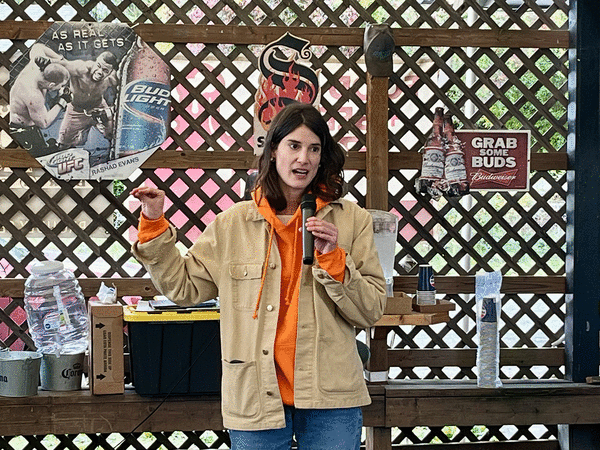
ILWACO, Pacific County — Rep. Marie Gluesenkamp Perez stood inside a brewery in this sleepy town where the Columbia River meets the Pacific Ocean, explaining to a crowd of supporters about how Washington, D.C., is often confused about her focus on sea lions.
“They thought we were talking about sea manatees,” she said, holding a beer on a recent Friday in August. The audience laughed. She detailed the salmon-eating mammals’ risk to the region’s way of life and highlighted her bill to control their population — an effort backed by President Donald Trump. “Protecting our salmon runs is so important.”
Chandler Protzman, 31, shuffled behind the Ilwaco bar, pouring drinks and wiping spills. He hadn’t considered whether he would vote for Gluesenkamp Perez or her Republican challenger, state Sen. John Braun, in November. The Democratic incumbent seemed authentic, he said, and he appreciated her fervor for local issues. But the Trump administration’s immigration policies were at the top of his mind.
“I don’t quite agree with it, how ICE is going around grabbing people,” Protzman said. He hopes to hear the candidates talk about that.
But neither really is — and that is by design.
Gluesenkamp Perez and Braun are running campaigns that largely steer clear of Trump and his most controversial policies. Instead, they are sticking to the issues they say define Southwest Washington: manufacturing, timber, skilled trade jobs and the region's natural resource economy. Gluesenkamp Perez touts her signature right-to-repair legislation and desire to see shop class in schools; Braun points to his Chehalis business and his record fighting higher state taxes and pursuing cheaper energy costs.
They touch on some national debates, including reproductive rights and the cost of living. And since the primary, their campaigns and allies have begun trying to tie the other candidate to forces outside the Pacific Northwest: Democrats are portraying Braun as a Trump rubber stamp, while Republicans cast Gluesenkamp Perez as being part of a socialist wave.
But at the center of both campaigns is a local pitch. Each candidate casts themselves as the better champion for a district that prizes its independence.
Both have good reason to keep it that way.
Gluesenkamp Perez has narrowly won a district Trump carried three times, and has crafted a reputation as an independent-minded Democrat willing to break from her party. Braun is trying to introduce himself to voters without letting his party define him, as Trump’s approval ratings have tanked amid anger with the war in Iran and rising costs.
Yet the race keeps escaping that frame.
Across Washington’s 3rd Congressional District — a mostly rural expanse bordering Oregon and the Pacific Ocean — voters are talking about Trump anyway. Some want Gluesenkamp Perez to stand in his way, others want Braun to help carry out his priorities. Even undecided voters describe a choice that reaches well beyond Southwest Washington.
The 3rd is one of the small number of House races nationwide that will help determine whether Republicans remain in control of the House or if Democrats take the majority. The nonpartisan Cook Political Report rates the race as a toss-up. People who live in the region should expect to see a flood of outside money and TV ads trying to influence their votes. Both the Democratic Congressional Campaign Committee and the National Republican Congressional Committee have tapped it as a priority.
In more than two dozen interviews stretching from Pacific to Skamania counties, voters repeatedly brought the conversation back to the issues the campaigns have sought to sidestep: Trump, his second-term policies and the national consequences of a vote in a district that could help decide the House majority.
Two blocks away from the Ilwaco brewery, Doug Hubbard, 68, tended to his yard.
“I like Gluesenkamp Perez; I think she’s done fine,” Hubbard said, hauling branches and bramble onto his truck’s flatbed. “But I want us to keep the majority.”
So it’s simple, the longtime Ilwaco resident said: He’s voting for Braun.
Keeping Trump at bay
Later that day, Gluesenkamp Perez stood on a stage in Chinook, Pacific County, where residents gathered before a local salmon derby, a competition to catch the largest fish.
“It's such an encouragement to talk about something that’s real, and not the same stuff that you hear on cable news all the time,” she said. “Actually, President Trump came out and supported my bill: I introduced a bill this year on allowing our tribal partners to shoot sea lions.”
The crowd cheered. Cheryl Varese, 67, a board member of the Chinook Port Alliance, praised Gluesenkamp Perez’s focus on local matters. “In a small town, you have to understand the values of people,” Varese said at a fundraiser hosted by the board.
And the next morning, while awaiting the start of a parade in Rainier, Thurston County, Gluesenkamp Perez chatted with nearby parade participants, detailing her push for right-to-repair legislation that would make it easier for people to fix their own electronics, from tractors to laptops.
Gluesenkamp Perez’s rare mentions of Trump on the stump are precise in scope. She references an effort of hers that he supports — demonstrating her ability to reach across the aisle — or she emphasizes that her challenger is backed by Trump and other GOP leaders, arguing that unlike her, he is not an independent voice for the district. An internal campaign strategy memo instructs that “generic opposition to the president as a person” should be avoided, in addition to “national party conflict.”
It's unusual in a midterm landscape where Trump dominates debate and Democrats nationwide hammer home their vows to check him.
“Broadly, he is a symptom,” Gluesenkamp Perez said of Trump in an interview with The Seattle Times at the parade. “If you just go after the symptom and you don't think on a broader scale, you're not going to fix the reason that symptom is showing.”
“He remains relatively popular in my district, but I think it's not always for the reasons people think,” she added. “Sometimes Trump can effectively identify a problem, and I can agree that there's a problem. But I profoundly disagree with his solution to the problem.”
Her voters, though, often made the calculation more directly.
“I’m not a Trump fan,” James Owen, 71, said curtly as he finished a slice of pie in an east Vancouver diner. “The other guy is a Trumper.”
Linda Woods, 79, erupted in a rant while surveying the bustling Clark County Fair from a bench.
“This country is the biggest mess I’ve ever seen,” she said, banging her cane against the ground. Woods wondered whether immigration officials would racially profile her daughter, whom she adopted from Honduras. She accused Trump of ruining monuments in the nation's capital, and she is angry about the Iran war.
“Democrats have to retake the House,” Woods said, which means she will vote for Gluesenkamp Perez. But she doesn't understand the incumbent's insistence on staying local.
"We need someone strong enough for national issues," Woods said, shaking her head.
A split-ticket district
Washington’s 3rd is seen as the only competitive race in the state, where some voters are accustomed to voting for Republicans in some races and for Democrats in others.
It has backed Trump since 2016, including in 2024, when he carried the district even as Gluesenkamp Perez won reelection. It also twice rejected Joe Kent, a far-right-wing candidate who ran for Congress as a MAGA loyalist.
Democrat Brian Baird held the seat from 1999 to 2011, followed by Republican Jaime Herrera Beutler, who also represented the district for 12 years but lost the 2022 primary race after voting to impeach Trump over the Jan. 6, 2021, attack on the U.S. Capitol.
Gluesenkamp Perez flipped the district for Democrats in 2022, winning by less than 1% of votes cast. Her margin widened to just under 4% in 2024.
The district’s counties are as varied as its landscape. Clark County, anchored by the Vancouver area mere miles from Portland, leans Democratic. To the north, inland, forested Lewis County is reliably conservative. On the coast, Republicans’ grip on Pacific County has loosened as Trump’s margin shrank.
Herrera Beutler told The Times that she also led with local matters on the campaign trail. “You need to be about the issues of the district. Pro or con all the national stuff, it will register; it’s just further down the list for voters here,” she said.
Yet now, as Trump appears to loom too large, voters appear to be moving that national context up the list.
“I really like her,” Bill Kennedy, 75, said of Gluesenkamp Perez at the Clark County Fair. “I like voting for who I think would do the best job. If I’m undecided, I might lean Republican.”
“I like Trump, but if Braun says he’ll do anything that Trump says, I don’t want that. I want somebody that thinks for themselves,” he added. His ultimate desire is simple, though, he said, sighing: “If they could just learn to play nicely in the same sandbox.”
Braun's case for independence
Braun told employees at Braun Northwest, his family emergency vehicle manufacturing business, that they are his favorite topic while courting voters.
“I got some other stuff going on where I’m talking to a lot of people, and I can tell you, my favorite part of that is this group right here,” he said at an August celebration for the company’s 40th anniversary in Chehalis.
The company’s blue logo, stamped over a white building facing Interstate 5, has taken center stage on the campaign trail. Braun’s interviews and campaign materials emphasize his manufacturing experience, followed quickly by his time in the Navy.
He also deftly acknowledges Trump's support, while distancing himself from the president — a tactic used by some Republicans in tight races across the country.
“Trump has helped us bring Republicans together to work on the same plan,” Braun told The Times. “But we've, from the very beginning, run a very independent campaign. I have been very clear on that. I agree with him on some policy issues. I disagree with him on other policy issues.”
“I said thank you, I appreciate the endorsement, but we're going to go run a very independent campaign because we understand what the district looks like,” Braun added.
Like his opponent, his mentions of Trump and national debates are exceedingly scarce. Still, voters supplied that national context themselves as Braun jogged alongside his blue truck at an August parade in the small town of Stevenson, Skamania County.
Braun waved to residents, stopping to shake their hands, before speeding up his trot to catch up with his truck. His campaign team yelled: “Vote for the veteran, vote for John Braun.”
Greg Brown, 66, yelled back: “You got my vote!”
“Because I hate Democrats,” Brown later told The Times. “They espouse socialism.”
Joshua Lavios, 39, said he supports Braun because of concerns about the southern border and because he wants to see voter ID laws implemented. Arnold Bell, 60, said Braun is “aligned with the Trump agenda, and that’s the way I feel.”
As Braun’s truck neared the end of the parade route, Braun caught his breath.
“You’ve really got to show up,” he said. It’s a very independent district.”
No escaping the stakes
Back at the Ilwaco brewery, Layne Prest, 69, had hoped to hear the incumbent address the criticism she faced from the left.
“Some people are down on her, making the perfect the enemy of the good,” Prest said, praising her commitment to the region. “She is clearly rooted in the Pacific Northwest.”
Still, some of the loudest applause during Gluesenkamp Perez’s remarks came when she reminded the audience that the race is bigger than the place she had spent the day talking about.
“I am the only one left running for reelection in a seat that Trump won in the last three elections,” she said to raucous applause.
For all the effort to keep the race grounded locally, the national stakes had found their way into the room.
_____
© 2026 The Seattle Times. Visit www.seattletimes.com. Distributed by Tribune Content Agency, LLC.


































Comments