Abby McCloskey: The Texas Senate race is becoming a debt debacle
Published in Op Eds
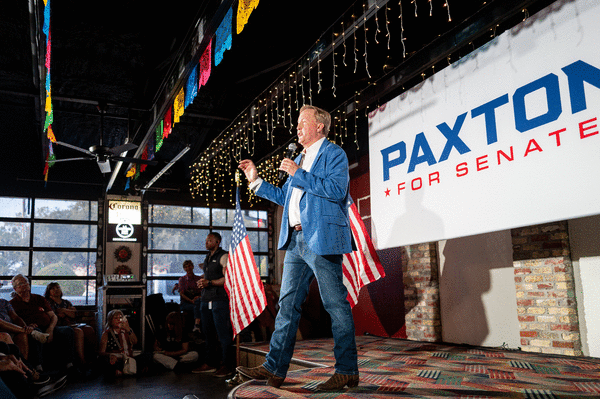
Republicans don’t tend to run for office promising to rack up new federal debts. Especially in Texas. But that’s what state Attorney General Ken Paxton is doing in his campaign for the U.S. Senate.
Affordability tops the list of concerns for Texans this midterm cycle. A recent Fox News poll found Texas voters care most about inflation and high prices. Immigration and border security came in a distant second. The same poll shows Paxton slightly trailing Democratic nominee James Talarico (48% to 51%), as has been the case for months.
So Paxton’s pulling out all the affordability stops. The single largest cost-of-living measure Paxton has proposed is doubling the federal Child Tax Credit, a partially refundable tax credit that parents can claim annually per child ages 0 to 17, from $2,200 to $4,400. For context, the U.S. spent $128 billion on the CTC in 2025. Paxton’s proposal would mean the U.S. spends roughly $250 billion a year on the CTC alone. For perspective, that is roughly the annual spend on the U.S. Navy.
I’ve long advocated for spending a larger share of taxpayer revenue on kids and families, who receive the short end of the federal spending stick. Kids receive $1 for every $6 spent on Americans over the age of 65. This, as official government estimates put the cost of raising a child in the U.S. at several hundred thousand dollars — and climbing.
It’s also widely popular to give more money to families. Expansions of the Child Tax Credit are particularly popular, and poll almost equally well among Democrats and Republicans (upwards of 80%).
Plus, given Paxton’s significant corruption problems, it’s no wonder he’s leaning into a Kinder Ken image.
But Paxton’s CTC proposal comes with numerous other expensive proposals, including a $25,000 tax deduction for out-of-pocket healthcare expenses, a $50,000 deduction for first-time homebuyers, and a $5,000 tax deduction for healthy lifestyle choices, including GLP-1 weight-loss medications.
Moreover, the cost-of-living issues Paxton is seeking to provide relief from — including rising gas and food prices — have been worsened by the Trump administration’s tariffs and wars, priorities that Paxton is keen on advancing.
Suffice it to say: Texas is no longer in its Ross Perot era, picking and choosing among limited spending priorities. Nor is it clear how any of Paxton’s ideas would be funded, a pressing question considering America recently crossed into $40 trillion in the red.
But don’t hold your breath waiting for Talarico to lambast Paxton’s spendthrift proposals. The state representative has his own budget-busting promises, starting with a public option for health insurance and going on to universal child care, universal paid leave, investing in renewable energy, “fighting tooth and nail to protect Social Security and Medicare,” and putting money into workforce training programs, rural broadband, and lowering grocery prices — in addition to expanding a plethora of existing tax credits.
As the Democratic Party gains socialist energy, I expect growing pressure on candidates to make even more spending promises the closer we get to November.
In case you were wondering, taxes on billionaires and investments won’t begin to cover this. Harris and Biden ran on a similar revenue-raising plan, and according to the Committee for a Responsible Federal Budget, that would have brought in $850 billion over a 10-year window. That’s about 3% of the revenue needed to fund Medicare for All, which CRFB estimates at around $30 trillion over a 10-year window.
This leaves us Texans with two very different choices that frustratingly run in the same economic direction. Republicans like to frame money back to constituents in the form of tax credits and deductions. Democrats tend to favor outright government spending. But both put pressure on the federal budget at a time when the bond markets are already sending out tremors.
At some point, instead of promising more and more federal outlays to be paid for at a later date, we need a strategic rethinking of taxes and spending. The vast majority of federal outlays go towards entitlements — Social Security alone is nearly a quarter of the federal budget — and interest payments, while everything else is getting squeezed. I’ve argued for a modernization of our entitlements system that creates room for new priorities such as paid parental leave and an updated disability system. Such a review arguably should deliver more support for the vulnerable, and I’d put children in that category.
Treasury Secretary Scott Bessent has said the Trump administration is planning for an “increased focus on fiscal consolidation.” That’s hard to credit from an administration that has added $3 trillion to the 10-year budget outlook, according to the Committee for a Responsible Federal Budget. But if Bessent is sincere, it would be a positive direction and demonstration of seriousness.
Until then, promising to drive down the cost of living by spending money we don’t have is what we Texans call “all hat and no cattle.”
____
This column reflects the personal views of the author and does not necessarily reflect the opinion of the editorial board or Bloomberg LP and its owners.
Abby McCloskey is a columnist, podcast host, and consultant. She directed domestic policy on two presidential campaigns and was director of economic policy at the American Enterprise Institute.
©2026 Bloomberg L.P. Visit bloomberg.com/opinion. Distributed by Tribune Content Agency, LLC.

















































Comments